A rough animated scene can tell a video generator where objects should move. But more detailed guidance does not necessarily make the resulting video more faithful. ProxyGenBench, a November 25 preprint led by Zhenchen Tang and Haolin Lu with coauthors across research institutions and Tencent, studies that distinction rather than judging output only by visual polish.
Three kinds of instruction-following
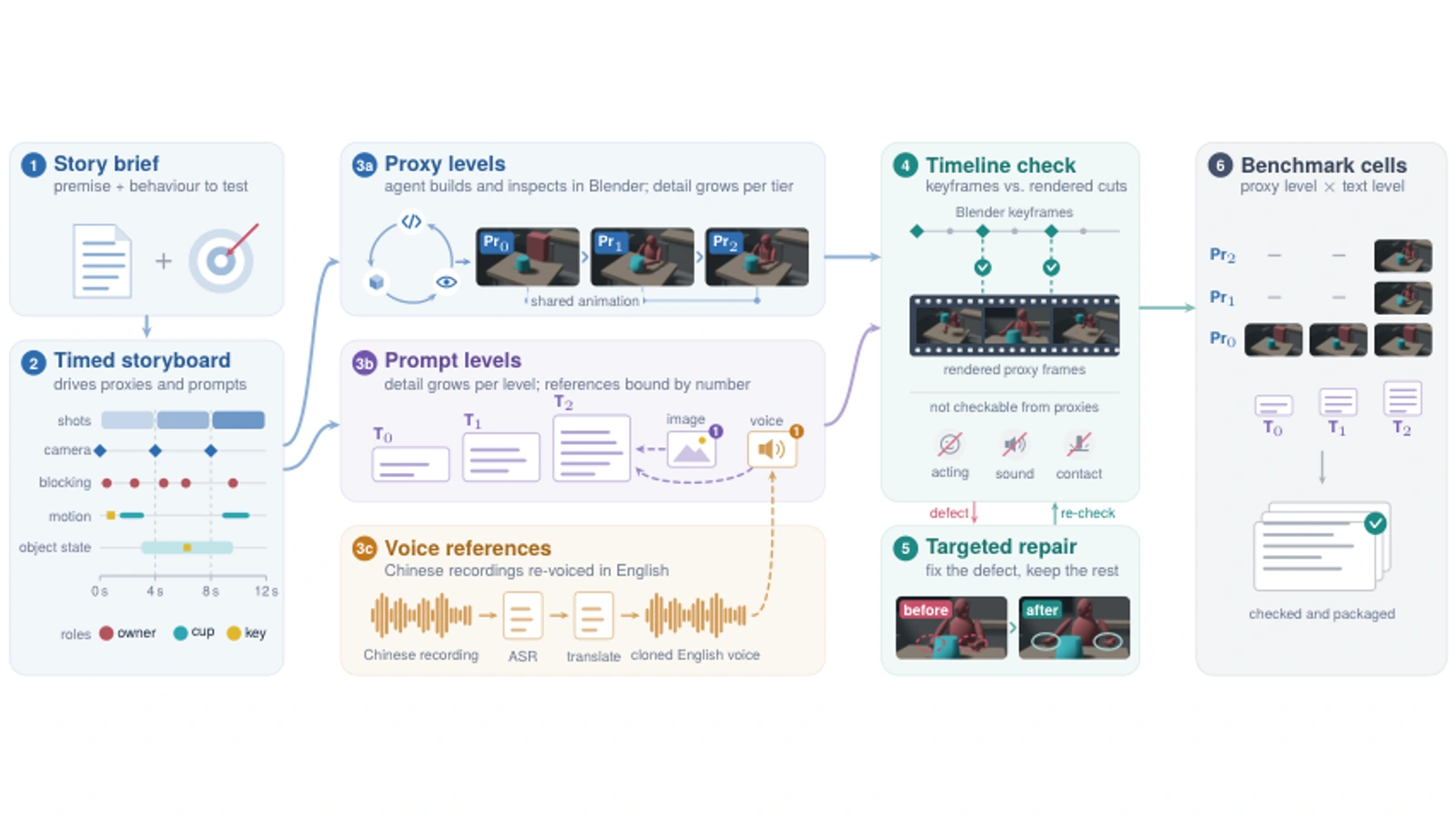
The benchmark contains 60 scenes and 312 cases across dynamic action, multi-shot storytelling and multi-view consistency. It evaluates whether a model preserves intended structure, completes details omitted from a rough proxy, and binds text, image or audio conditions to the correct entities and events.
Those objectives can conflict. A generator should improve an intentionally crude representation without replacing a required object, motion or relationship. A plausible-looking result can therefore be an unsuccessful response to the actual scene specification.
The authors instantiate 32 criteria as case-specific checklists. They distinguish a structure-sensitive Strict score from Joint Success, which asks whether all critical preservation checks pass together. A model's strong average does not imply that every important constraint survives in the same clip.
Keep the comparison groups separate
The main results include separate settings with and without independent audio references. Those references are conditioning inputs, not a test of audio generated in the output. The groups do not include identical model coverage and should not be collapsed into a single universal ranking.
A matched analysis compares 50 proxy/no-proxy output pairs from 18 scenes. Under a VLM preference protocol that reverses presentation order, proxy-guided outputs are preferred in 35 pairs, or 70%; the remaining outcomes are ties or order-dependent. That is a result for those comparisons, not 70% accuracy on all video generation.
The paper also finds that increasing proxy detail does not consistently improve final outputs. Geometry and motion detail change together in its proxy levels, so the experiment does not independently isolate the effect of each one.
What is available now
The official project page and announcement repository expose the research description. The repository explicitly says evaluation code and dataset will be released after review. We therefore have not catalogued it as an available open implementation or model checkpoint.
The paper is CC BY 4.0; that license supports the credited construction figure used here, but should not be substituted for a future code or dataset license. VLM judging also has limits for subtle physics and precise audiovisual synchronization. Independent execution would be needed before treating its scores as a complete production qualification.
Our analysis
For creators, the useful contribution is the checklist mindset: decide which relationships must remain true before judging how attractive a shot looks. That is especially relevant to recurring characters, dialogue and multi-shot continuity, where a polished error can cost more repair work than a visibly rough draft. The study supplies a way to ask those questions; it does not establish that any tested generator reliably satisfies them all. We reviewed its methods and release status without running the benchmark.
Independent primary-source review. No upstream tests, inference, installations, weight downloads or hardware benchmarks performed. Publisher measurements are not independent validation.