
PrismML's Ternary Bonsai 2.5 27B, announced November 24, targets coding agents and longer tool-driven tasks while retaining the ternary weight format of its earlier release. It is based on Qwen3.8-27B, rather than a claim that a new architecture was trained from scratch.
The publisher's exact GGUF card identifies three packings with different runtime requirements. That distinction is essential to interpreting the headline 5.93 GB size.
The packing determines which runtime can read it
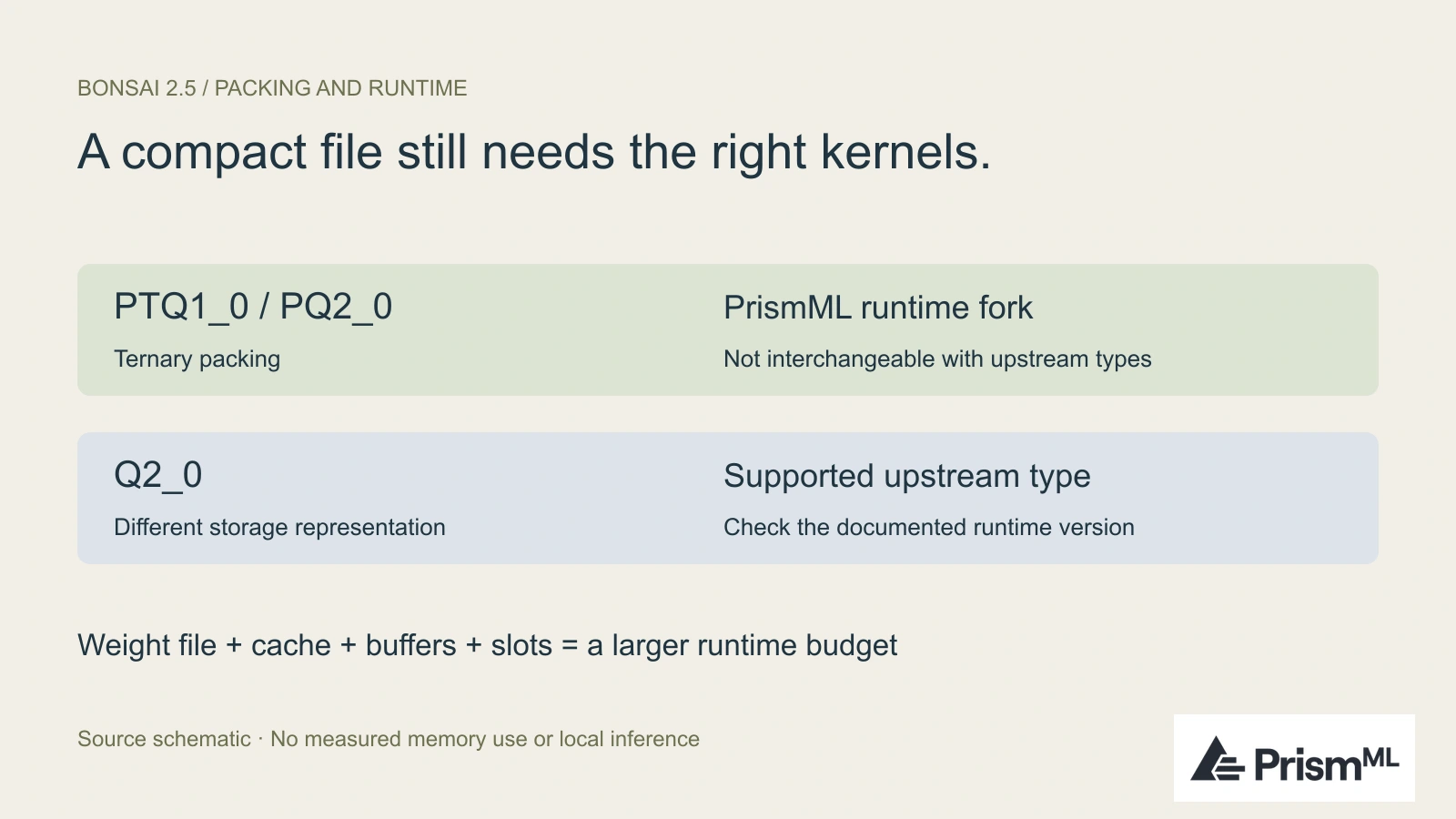
PTQ1_0 stores the ternary values densely and is the packing associated with the 1.76-bits-per-weight, 5.93 GB figure. PQ2_0 uses two-bit slots. Both need the ternary kernels in PrismML's llama.cpp fork; the card warns that an ordinary upstream build rejects those types.
The Q2_0 file instead uses a standard upstream type, with a documented minimum llama.cpp release. The three base files represent the same ternary model, but their storage and kernel behavior are not interchangeable. Separate MTP variants include a draft head, and optional vision projection assets are distinct from text-only serving.
Weight size is not the complete memory budget
The card includes a low-memory warning about automatic server parallelism and a community report where selecting one request slot reduced total GPU use. That is an attributed report under one configuration, not a measured result from AiBrainWorX or a guarantee for all devices with a similar memory label.
Context, cache allocation, buffers, optional components and the serving build remain part of the budget. A small model file does not by itself prove that a long-context request fits, that concurrent requests fit or that a particular consumer GPU will provide an acceptable response time.
Keep the measurement groups separate
PrismML reports a five-benchmark tool-calling average of 77.2 versus 77.7 for its FP16 comparison, with all evaluated models using thinking mode and xhigh effort in that comparison. Its shorter press announcement highlights a different grouping, so those averages should not be mixed as if they described one identical test.
The card's plain-decoding speed table also specifies batch one, one GPU, selected prompt/generation lengths and no speculative decoding. It separately reports MTP results. A runtime-kernel improvement, an agent-task score and a speculative-decoding gain answer different questions.
These remain publisher-reported comparisons. We did not reproduce them, and a close average does not prove statistical equivalence or equal reliability on every tool.
Our analysis: Bonsai's value proposition is the combination of a compact representation and an implementation designed to use it. The practical decision is therefore model plus packing plus runtime, rather than a single download-size number. Compatibility should be established before transferring a benchmark expectation to another serving environment.
The model's hosted license and its demo/integration repository are Apache 2.0; its runtime fork carries MIT. Our exact model profile links those resources. We reviewed the release history, card, licenses and runtime guidance without downloading weights, running a server or qualifying hardware.
EXPLORE THE SOURCE
Projects in this story
Model repositories
These are the exact public repositories referenced in the coverage. Public weights may have restrictions: check each publisher’s terms.
- prism-ml/Ternary-Bonsai-2.5-27B-GGUF ↗Apache-2.0
Original source-reviewed reporting. No software installed, model weights or datasets downloaded, inference, upstream tests, security audit, hardware qualification or cloud deployments performed.