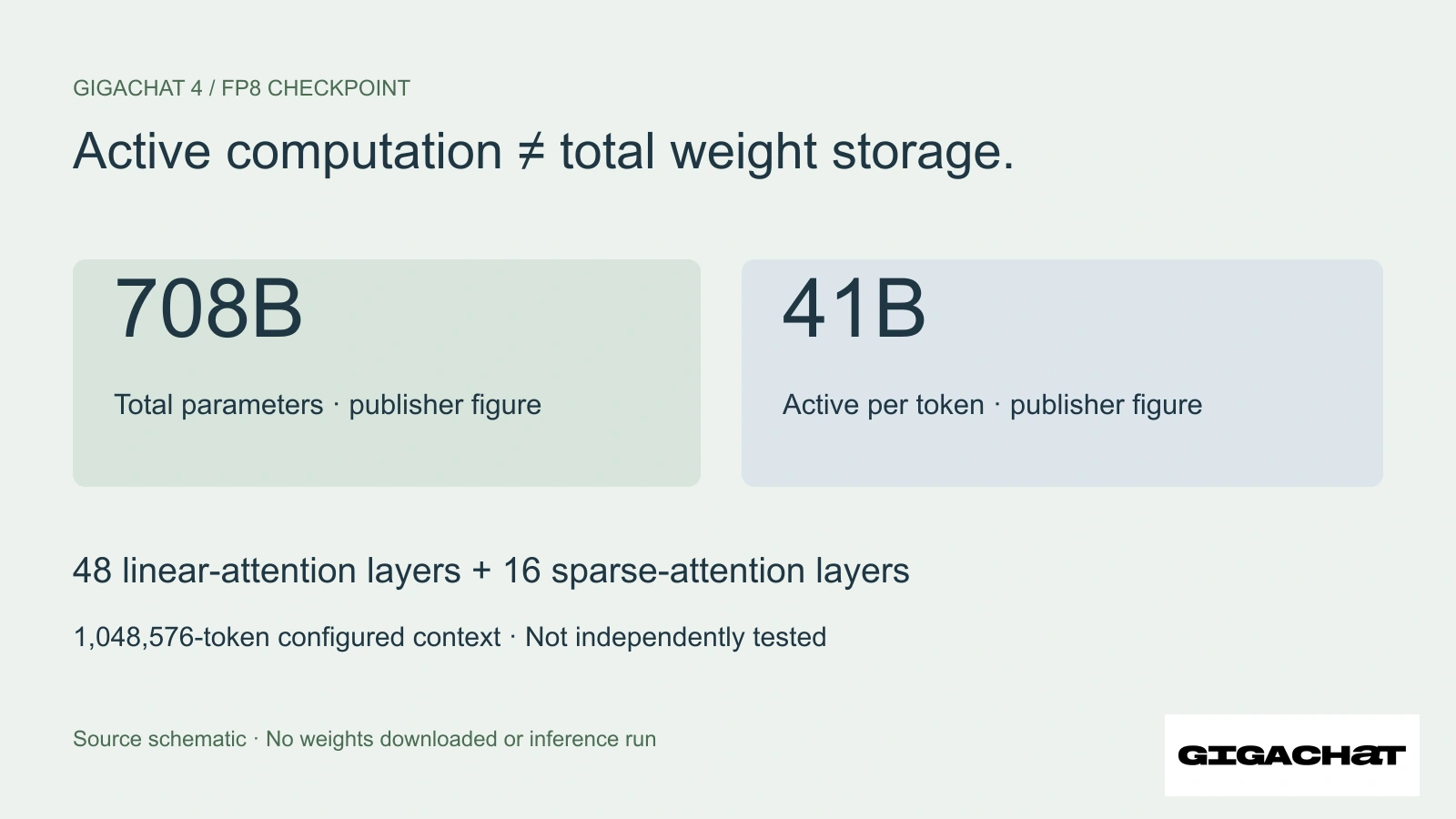

The GigaChat 4 FP8 checkpoint brings instant and reasoning responses into one instruction-tuned model. Its publisher describes a mixture-of-experts system with 708 billion total parameters, 41 billion active per token and a configured context limit of 1,048,576 tokens.
The release date needs care. The Hub repository was created November 20, but its public history records the checkpoint publication on November 26. A November 27 change updates the chat template; it is not evidence that another model was trained or that the weights were newly released that day.
The card labels this FP8 repository as a quantized form of its linked BF16 instruction-tuned base. A new precision artifact or chat-template edit should not be mistaken for evidence of a separate training run.
Two modes, one checkpoint
The model card describes request-level selection between instant and reasoning operation. Its documented template enables reasoning when the option is omitted. Integrators therefore need to inspect both their request settings and the parser their serving stack uses, rather than assuming an absent flag means a short direct answer.
The architecture combines 48 linear-attention layers with 16 sparse-attention layers. According to the publisher, the linear component maintains recurrent state, while the sparse component selects 2,048 earlier tokens per query. The configured million-token limit is not our measurement of retrieval accuracy, response latency or usable context under a particular workload.
Active parameters do not describe the storage requirement
The 41B figure concerns parameters selected during a token's computation. It does not turn the full release into a 41B-weight download or establish that it fits a consumer GPU. The published FP8 deployment examples use two nodes, each with eight H100 80GB GPUs.
Those examples are publisher configurations, not a tested minimum or a hardware recommendation from us. Runtime buffers, cache, concurrency and context settings also consume memory. We did not download any weight shard or attempt a local or cloud deployment.
The card documents recurrent multi-token prediction and a separate DFlash2 draft model for speculative decoding. These are different serving configurations with their own requirements. Their availability does not supply a universal speedup figure for an arbitrary prompt, GPU or serving build.
Read the benchmark conditions
The publisher's tables separate instant and reasoning evaluations and identify seven-hour timeouts for several coding and agent tasks. Their notes distinguish Harbor-based runners from the separate DeepSWE runner, and explain task-specific scoring, including cheating-adjusted NL2Repo results.
Those are publisher-reported experiments, not independent comparisons conducted by AiBrainWorX. The card also describes interactive agent-harness checks on an internal checkpoint; that qualification should not disappear when discussing the downloadable release.
Our analysis: GigaChat 4 is relevant to the open-weight ecosystem because it exposes a large hybrid design and its serving assumptions for inspection. The useful comparison is not simply whether 41B is smaller than another headline number. It is whether the full checkpoint, runtime, evaluation budget and response mode match the intended task.
The exact model repository declares MIT and includes an MIT license file. The linked code/report repository also declares MIT; datasets and downstream services have separate terms. Our model profile records the exact publisher and revision, and our repository profile links the technical material. We reviewed the card, configuration, history, license and serving documentation, without running the model or validating its benchmark results.
EXPLORE THE SOURCE
Projects in this story
Model repositories
These are the exact public repositories referenced in the coverage. Public weights may have restrictions: check each publisher’s terms.
Original primary-source-reviewed reporting. No upstream installations, runtime tests, weights, datasets, inference, benchmarks, cloud resources or deployments performed.