Vernier, introduced in a November 23 preprint, asks a question often missing from model leaderboards: how small a performance difference can the available evaluation evidence distinguish? Its analysis focuses on zero-shot time-series forecasting boards and the independent data sources behind their displayed scores.
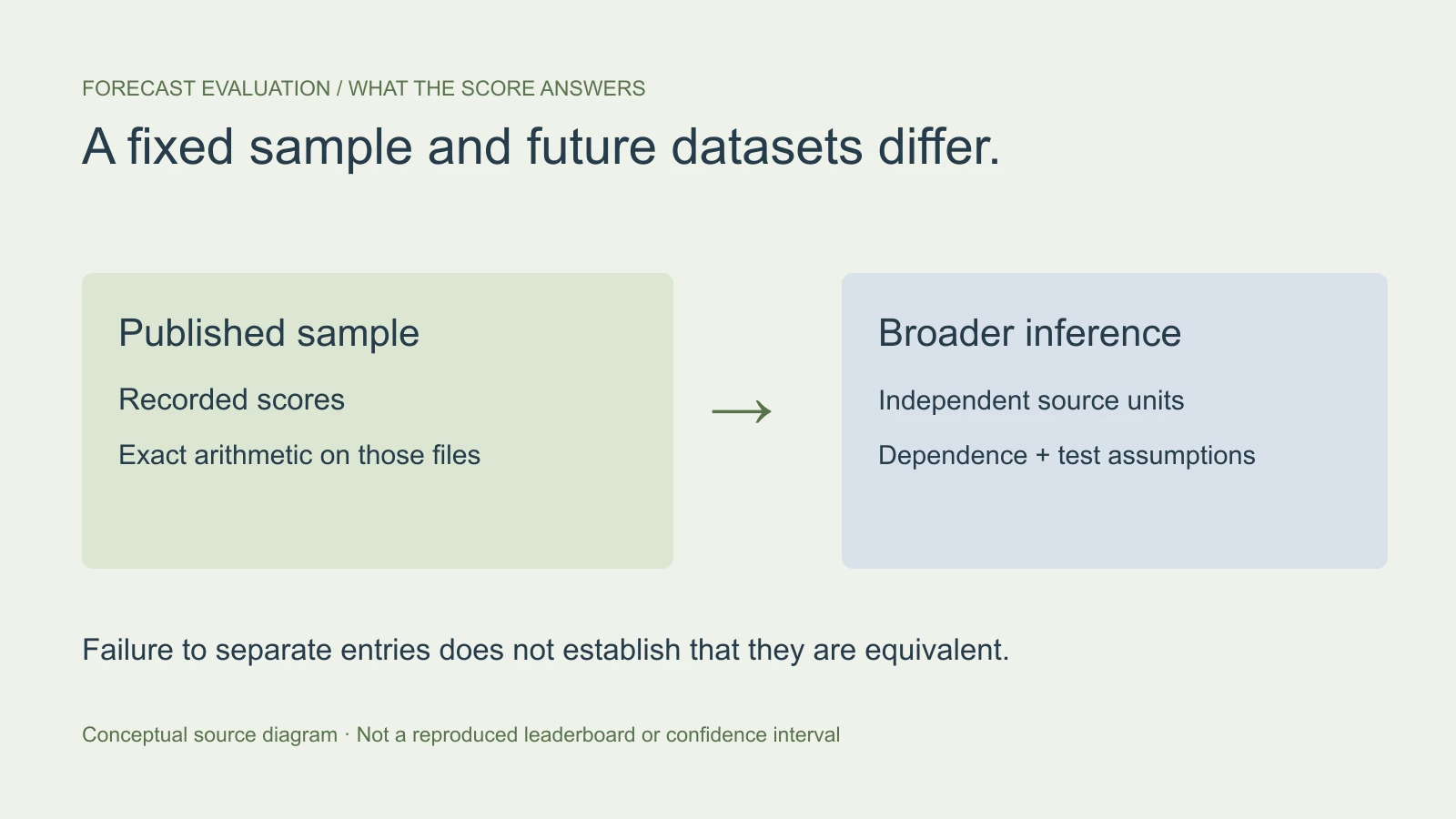
The key distinction is between computing a mean on a fixed evaluation set and using that mean to infer performance on other datasets. The published mean can be exact for the chosen sample while the order between close entries remains uncertain under another reasonable draw of datasets.
The number of configurations is not the number of independent sources
The paper's GIFT-Eval snapshot has 97 configurations drawn from 28 datasets. Multiple frequencies or horizons from the same dataset can move together, so treating every configuration as an independent observation would overstate the amount of independent evidence.
Under the authors' specified test and clustering procedure, the analyzed snapshot has a resolution of about 6.8 mean-rank units against a median neighboring gap of 0.91. These values concern the paper's dated snapshot, including its September 7 GIFT-Eval files. They are not measurements of today's live board or a universal error bar for every entry.
The resolution convention uses a defined significance level and statistical power. Failing to separate two entries under that procedure is not proof that the models are equivalent. The paper also reports different behavior for BOOM, emphasizing how the chosen independent source unit affects the conclusion.
Rankings can change without either model changing
Some aggregation rules rank each submission against the rest of the pool. Adding another entry can therefore alter the relative order of two existing entries even if their own result files stay unchanged.
The authors replay version histories and report 43 top-ten pair reversals across four boards under pool-dependent rules. That observation is about historical ranking arithmetic, not a claim that those models suddenly improved or deteriorated. We did not rerun the replay or audit every historical result file.
A separate experiment examines how much past history a forecasting model actually receives. The paper argues that this should be disclosed alongside aggregation, evaluation windows, normalization and sampling. A configured context limit is not necessarily the amount of history delivered in a particular evaluation.
Our analysis: a leaderboard is more useful when it explains the resolution of its evidence rather than presenting every adjacent place as a distinct capability tier. For deployment choices, the magnitude and stability of a gap can matter more than the difference between two ordinal positions.
What readers can inspect
The Apache 2.0-licensed Vernier repository provides reporting code and documents pinned snapshots separately from live fetching. Our repository profile links the source. The paper's own qualifications about sampling units, dependence and test assumptions remain part of any interpretation.
We reviewed the procedure, main results, snapshot documentation and scope appendix. We did not download a forecasting model, recompute a ranking, run a forecast or validate the statistical findings independently. This is analysis of evaluation evidence, not a new model release.
EXPLORE THE SOURCE
Projects in this story
GitHub repositories
- therealram18/vernier ↗View project details
Original primary-source-reviewed reporting. No software installation, weights/downloads, credential revocation, graph operations, model inference, upstream test execution or benchmark reproduction performed.