InitFree-SfM, a November 23 preprint, combines learned correspondences and metric depth with an initialization-free structure-from-motion pipeline. It addresses a gap between solving an optimization objective and recovering camera poses and scene geometry that are actually accurate.
Traditional bundle adjustment generally starts from a useful estimate of cameras and structure. Initialization-free approaches aim to recover both without an initial global estimate. That is a demanding optimization problem, and a small surrogate error can still accompany an incorrect reconstruction.
Depth adds a geometric constraint
The authors augment Object Space Error with depth information. A viewing direction constrains where a scene point lies along a ray only incompletely; an estimated metric depth contributes information about its position along that ray.
The complete pipeline also uses depth-consistent track construction and joint metric refinement. The paper's ablations therefore matter: a comparison between whole pipelines does not isolate the effect of a new optimization term from the effect of stronger geometric constraints or different correspondences.
In its reported experiments, learned depth substantially improves reconstruction over the evaluated initialization-free alternatives. The authors also compare with established structure-from-motion systems and study low-overlap image collections. We treat those as their experiments rather than independent accuracy results from AiBrainWorX.
Match the conditions before reading a speed claim
The low-overlap comparisons report angular accuracy at specified thresholds and separate matcher configurations. The paper's runtime figure uses the same matcher for the displayed methods and averages over the selected subsets. It is not a universal speed ranking over every possible installation, scene or matching configuration.
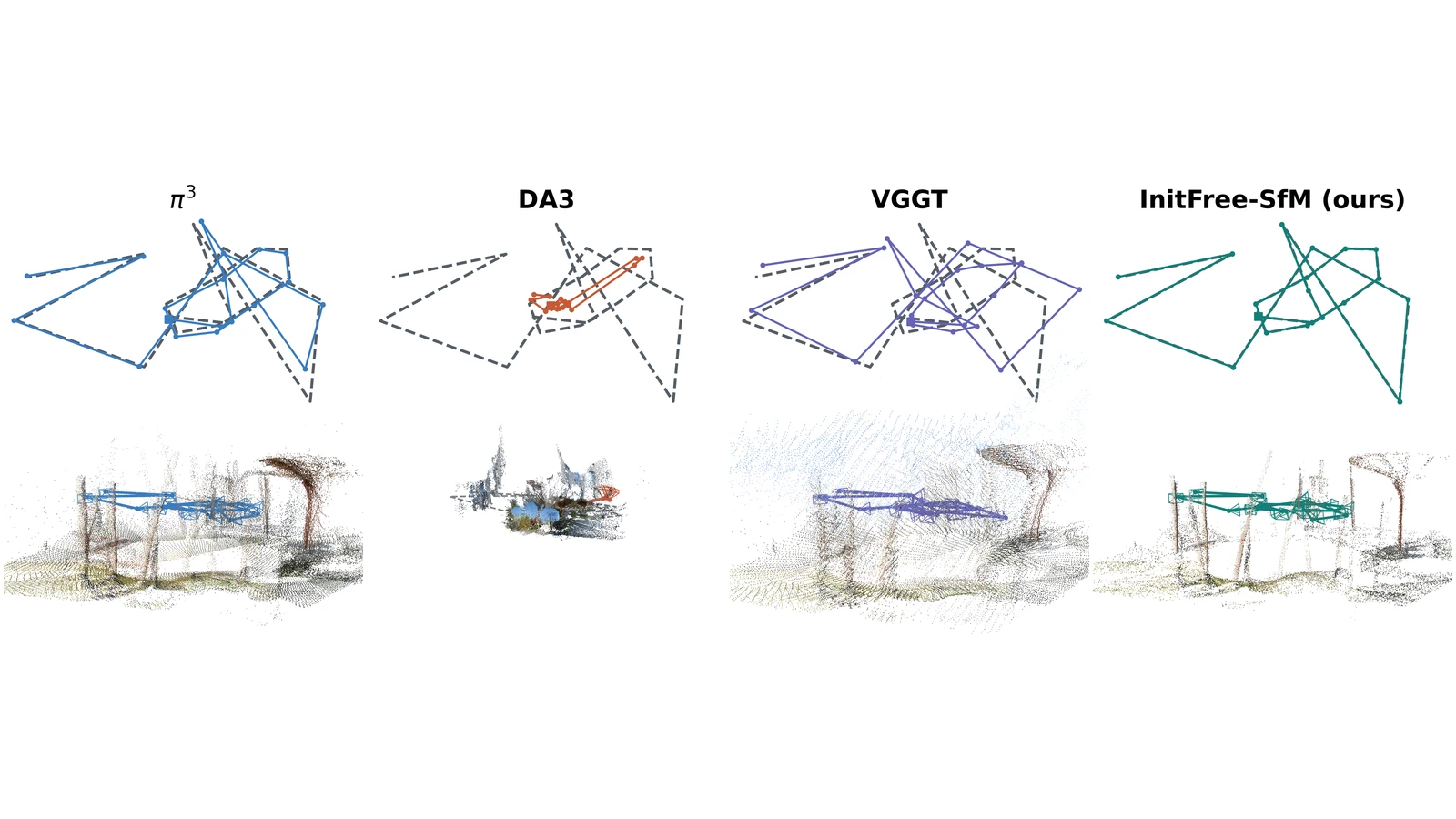
Qualitative point-cloud images can make the result easier to understand, but they do not replace the evaluation protocol. A plausible-looking scene, a lower surrogate objective and an accurate camera reconstruction are different kinds of evidence.
There are also important assumptions behind the name. The work does not remove the need for image measurements or pretrained components. The authors identify known camera calibration as a benefit to their method and leave stronger uncalibrated reconstruction and scaling to larger image collections as future directions.
Our analysis: the useful contribution is to bring practical geometric evidence back into an optimization problem. For reconstruction workflows, an algorithm's convergence is valuable only insofar as it helps recover the intended scene. The paper's emphasis on that distinction is more informative than calling the method assumption-free.
Research availability is not an installable release
The paper links a project repository. At our check, its public tree contained only a short title-level README, and we did not establish an implementation or code license there. We therefore describe the paper, rather than announce downloadable open-source software or a new model checkpoint.
We reviewed its method, experiments, ablations, runtime conditions and limitations. No weights were downloaded, code installed, photographs processed or reconstruction benchmark run for this coverage.
Original primary-source-reviewed reporting. No software installation, weights/downloads, credential revocation, graph operations, model inference, upstream test execution or benchmark reproduction performed.