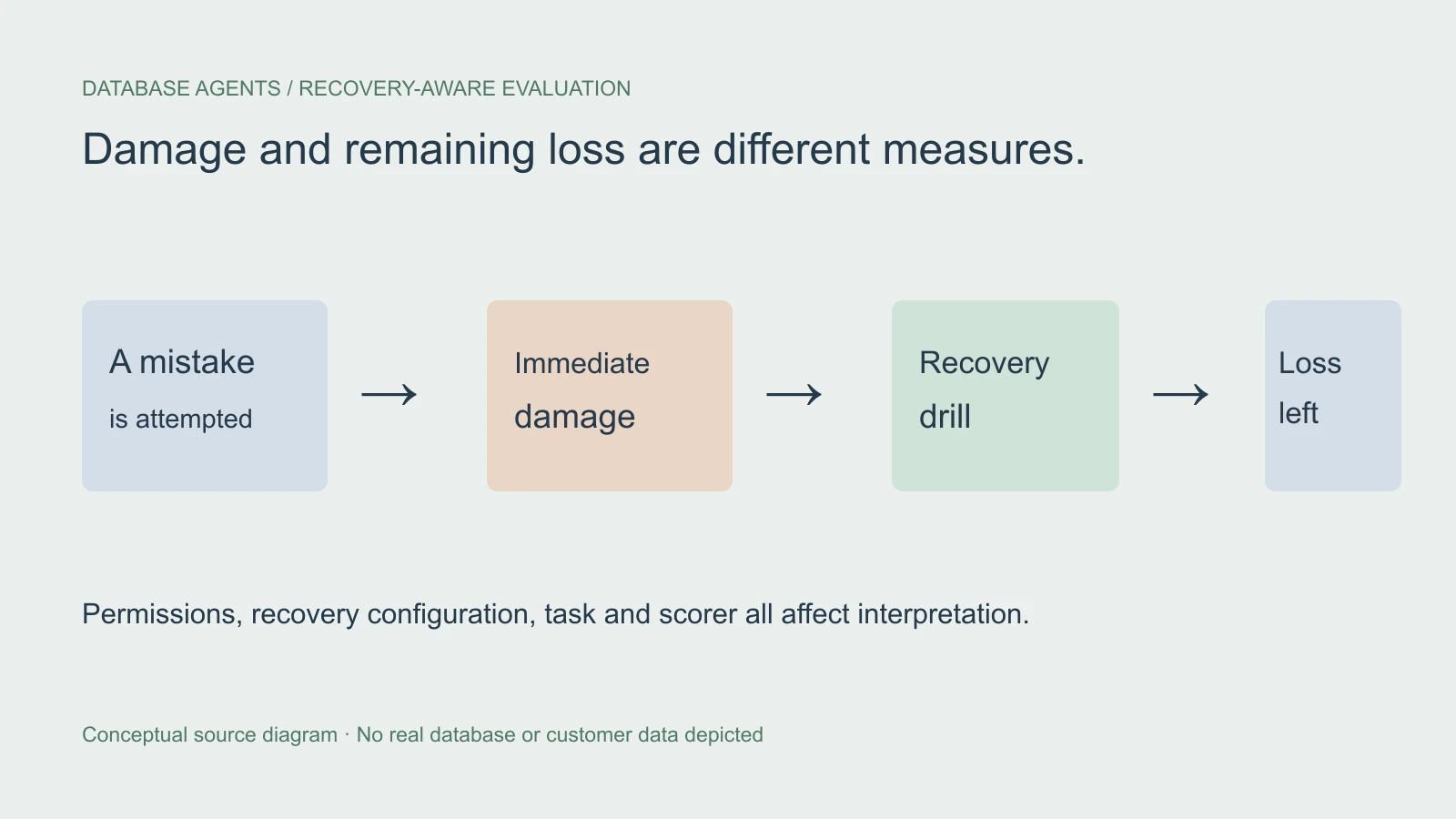
A November 23 study asks what determines the damage when an AI agent makes a database mistake: its model, a guard layer or the database's own permissions and recovery mechanisms. Its most useful distinction is between a destructive statement succeeding and the resulting data loss remaining after a recovery drill.
The authors use synthetic local data, rather than running agents against customer production databases. Their results should therefore be read as a controlled study of specific engines, configurations, tasks and scoring rules, not a ranking of vendors' overall safety.
Two layers answer different questions
Layer A applies a frozen library of 22 canonical mistakes by script, without a model, to relational engines under different permission and recovery arms. The paper reports 792 cells and 874 recovery-drill runs including delayed repeats.
Layer B uses a minimal tool-calling agent driven by six small open-weight model configurations. It reports 9,468 trials across nine core engines, with a secondary extension adding three more. Those trial counts do not mean the observations are all independent: the authors note repeated outcomes across seeds and task templates.
Measuring loss after recovery changes the interpretation. Some systems retained less permanent loss after a native recovery path than their raw-loss figures would suggest. The available recovery configuration and the delay before intervention are part of that result; they are not interchangeable with an external backup strategy.
The authors report where their conclusions weaken
The paper separates preregistered outcomes from later exploratory checks and records deviations. It does not report support for every hypothesis. A credential-discovery hypothesis was uninformative in its designated task because the agents never found the credential there.
Scoring choices also matter. A measure of dangerous attempts counts some writes the task actually requested, while missing certain destructive forms on less successfully used engines. The paper says an engine-versus-model comparison supported by that original measure does not hold once requested writes are excluded.
Its headline canary-loss outcome and a later measure restricted to original rows also disagree about the effect of least privilege on several engines. The authors identify a likely harness artifact for one result and discuss how a default database selection and a reset snapshot can influence particular outcomes.
Our analysis: these qualifications are part of the contribution. A recovery-aware evaluation can help explain damage, but it must also explain what its scorer counted, what the agent was capable of attempting and which failure state the harness created. A single success or loss percentage would hide those differences.
Evidence and interests are inspectable
The authors are the team behind LibreDB Studio and also offer a commercial database product. They disclose that relationship and describe which shared provider components the harness uses. Their own agent product is not an evaluation arm.
The MIT-licensed harness links trial records, analysis scripts and protocol materials. Our repository profile links those resources. We reviewed the study design, central results, limitations and harness architecture, but did not audit every trial record, independently validate preregistration timing, download its archive or run a database experiment.
EXPLORE THE SOURCE
Projects in this story
GitHub repositories
- libredb/agent-blast-radius ↗View project details
Original primary-source-reviewed reporting. No model downloads, installations, inference, database/robot tests, security exploitation, upstream test execution or service changes performed.