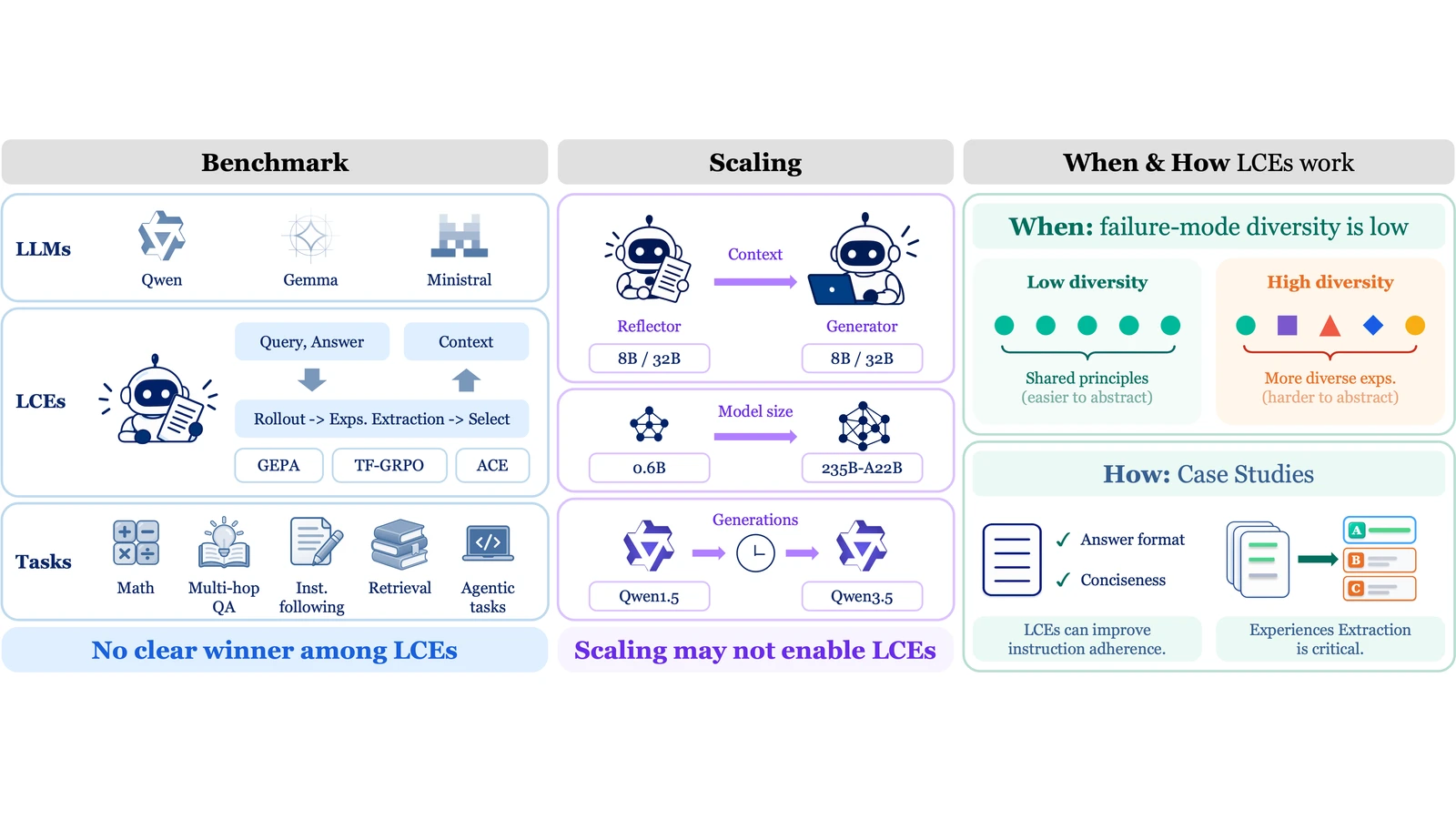
Revisiting LLMs as Context Engineers, a November 23 preprint, studies when a model can turn previous examples and failures into instructions that help on later tasks. Its central finding is scoped but useful: none of the evaluated context-engineering methods wins consistently across the tested tasks and models.
This is context optimization rather than ordinary weight training. The model generates or revises prompts, experiences or metadata using feedback from offline trials. The resulting context is then used to guide subsequent answers.
Learning an instruction is not the same as generalizing it
The authors compare automated methods with simpler prompting baselines across tasks involving different reasoning patterns. Their experiments include mathematical reasoning, multi-hop questions, instruction following, retrieval-style tasks and agent workflows.
Some methods improve the validation performance used to select an engineered context. The paper distinguishes that optimization-stage improvement from performance on test examples. More model parameters or more context-generation iterations do not consistently reverse the cases where an approach fails.
That does not establish that context engineering is useless, or that the same method cannot be effective on a particular application. It means the tested optimizer, task, feedback and model combination needs to be evaluated rather than assuming that an increasingly elaborate prompt must help.
Diverse failures are harder to compress into advice
The paper reports a negative association between gains and the diversity of reasoning failure modes, with an aggregate correlation around minus 0.5. The authors also examine alternative factors and a mixed-effects analysis. These are observations within their experimental design, not a causal law for all language models.
A proposed explanation is that recurring errors can yield a reusable instruction, while heterogeneous failures are harder to summarize into a principle that transfers. Adding more experiences can also add irrelevant or conflicting advice. Whether that happens depends on the specific evidence the optimizer extracts.
Some apparent gains concern following an output instruction more reliably. The paper's case studies examine answer extraction and format compliance, including responses that contain an answer but are scored as incorrect. Improving those cases is valuable, but it should not silently be presented as acquiring a new reasoning capability.
Our analysis: teams building memory or prompt-optimization systems should distinguish a useful stored lesson from a longer transcript of previous attempts. The practical question is whether the selected context helps on held-out work, at an acceptable token and optimization cost. Success on examples used during selection cannot answer that question alone.
What is available
The authors publish LCEBench, an MIT-licensed code repository containing benchmark and method material. Model and dataset terms remain separate. Our repository profile links the source for readers who want to inspect the setup.
We reviewed the paper's formulation, main comparisons, scaling and failure-analysis sections, answer-extraction discussion and repository documentation. We did not run an optimizer, download a model or independently reproduce the reported correlation. This is analysis of a research study, not a new model release or a guarantee about a particular production prompt.
EXPLORE THE SOURCE
Projects in this story
GitHub repositories
- costa-nus/LCEBench ↗View project details
Original primary-source-reviewed reporting. No model downloads, installations, inference, database/robot tests, security exploitation, upstream test execution or service changes performed.