
SpeakLeash has published an INT8 ONNX export of Bielik-SPLADE-82M, a Polish sparse-retrieval encoder designed to run on CPUs. Its repository history records the export upload on November 25, following the original model repository on November 24. This is a deployment artifact derived from the existing encoder, rather than a separate newly trained foundation model.
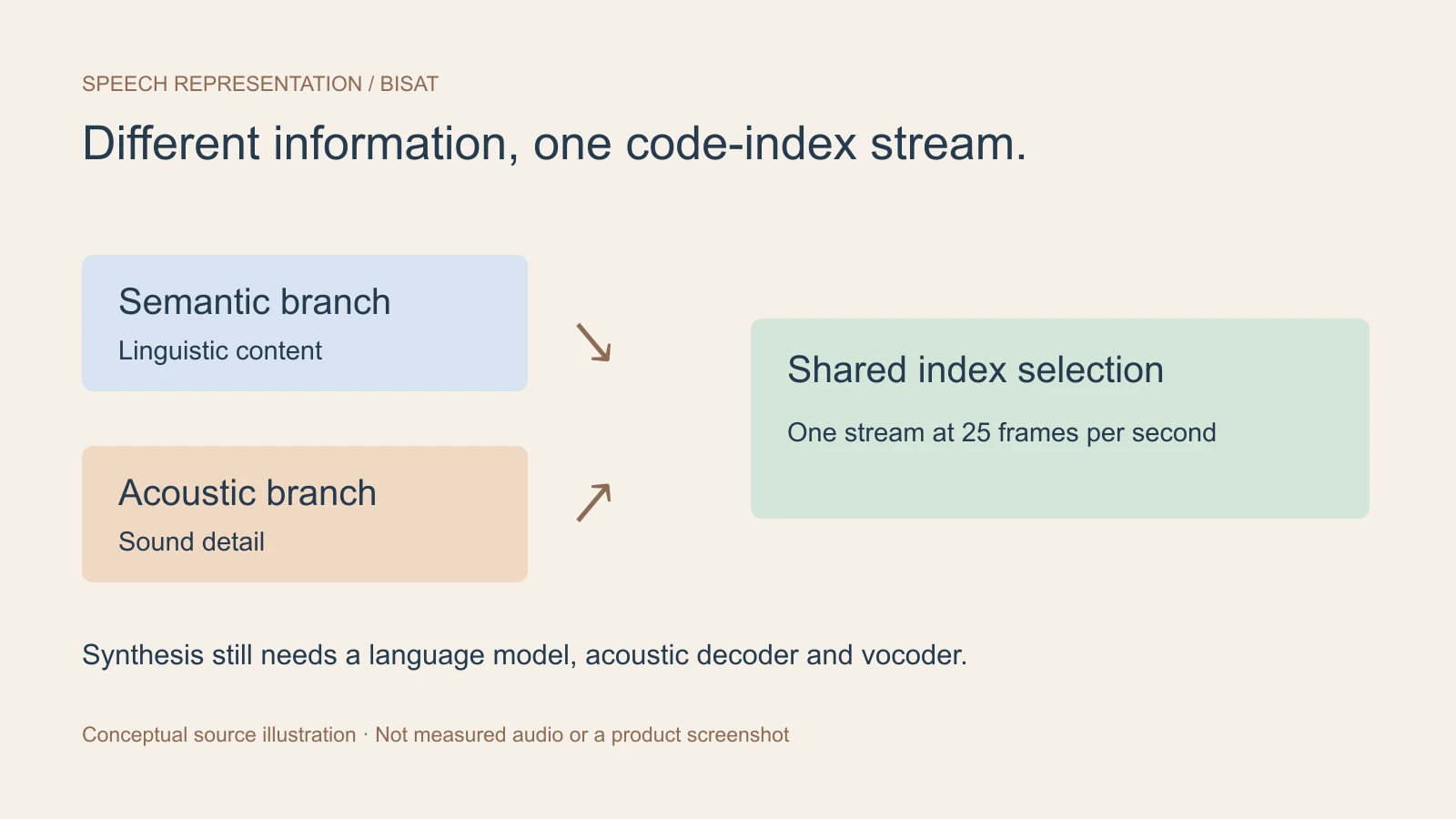
SPLADE turns text into weighted vocabulary terms for retrieval. That gives a search system a different building block from a conversational model: the output helps rank documents, rather than writing an answer to the query.
What the export changes
The publisher's graph includes the pooling that converts token-level predictions into a final sparse vector. Its output has 50,001 vocabulary dimensions. It is therefore not interchangeable with a Sentence Transformers ONNX backend expecting token-level masked-language-model logits.
The card reports a 227 MiB model file and a median query time of 3.7 milliseconds with six threads on an AMD Ryzen 5 5600X, versus 44.9 milliseconds for its PyTorch FP32 comparison. The roughly twelvefold ratio describes that query-encoding experiment, with short queries and no other workload running. It is not an independently measured speedup of a complete production search service.
Query quality is not the same as rebuilding the index
Across ten public PIRB tasks, the export's card reports 64.88 nDCG@10 for INT8 queries, compared with 65.06 for the PyTorch model. Importantly, both query paths search an index built using the PyTorch model. The publisher explicitly says an index encoded with the export has not been evaluated.
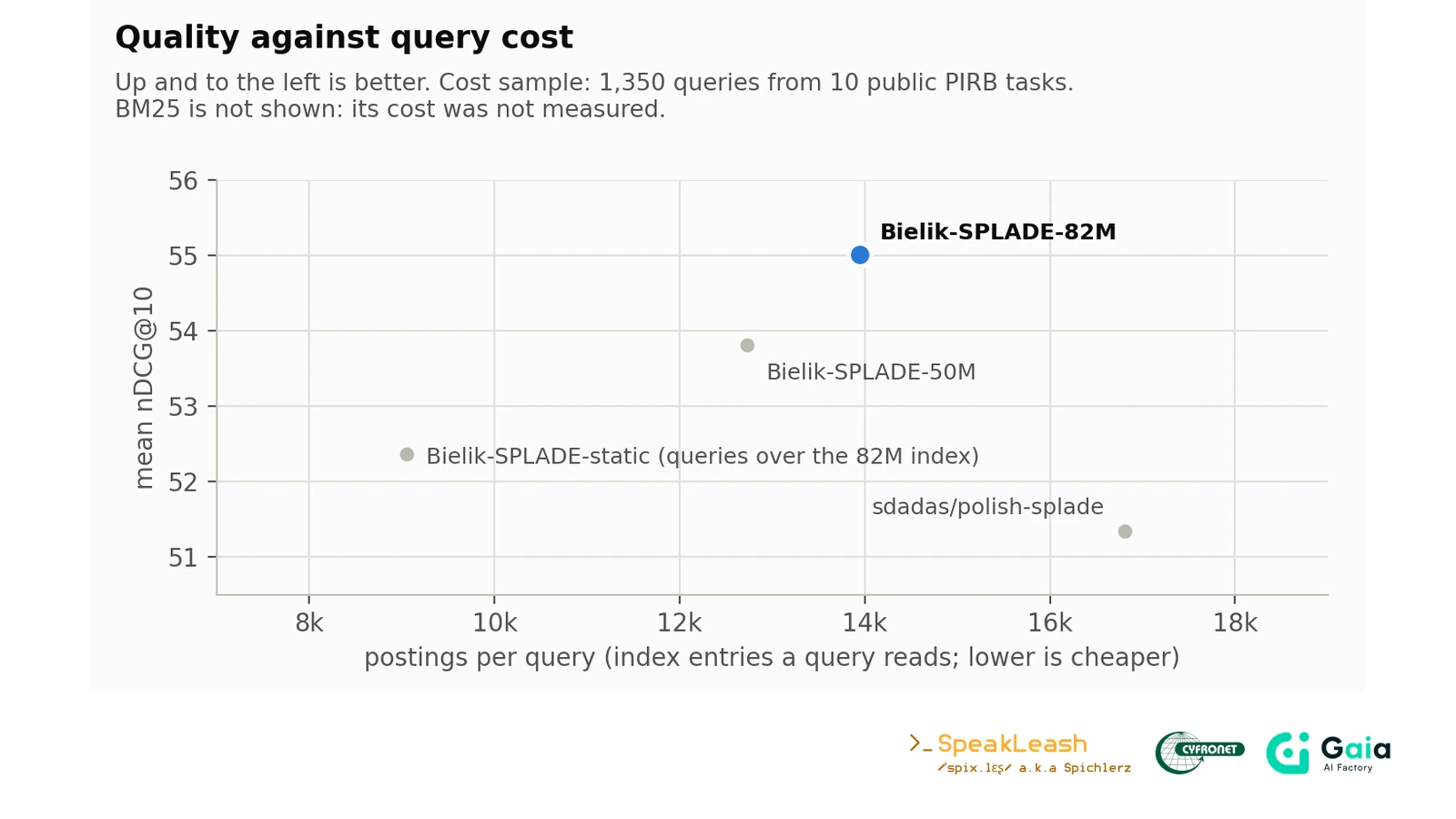
The card's broader PIRB discussion concerns the publicly available portion of the benchmark. Neither the ten-task export comparison nor the base-model charts should be described as a result on every PIRB task. They also do not establish equivalent quality in another language or a company's private corpus.
A small weight file does not eliminate working-memory costs. The graph creates FP32 token-by-vocabulary intermediates. The publisher reports about 332 MiB after loading but roughly 4 GB peak while encoding its batch-eight passages. The bundled encoder limits padded token batches; plain ONNX code needs its own batching discipline.
The terms follow the artifact
The base card treats the model as a Gemma Model Derivative because of its teacher and training-signal provenance. The export carries the Gemma Terms of Use, prohibited-use policy and notice. It is not an unrestricted Apache-licensed checkpoint merely because an earlier base was Apache 2.0.
Our analysis: this is a useful regional-language deployment release because it documents both a practical CPU path and the boundaries of its evidence. Before replacing an encoder, a team still needs to check index compatibility, memory under its actual passage lengths and retrieval quality on its own documents.
Our ONNX profile and original-model profile link the actual artifacts. We read the cards, export wrapper, history and terms; we downloaded no weights and ran no retrieval benchmark.
EXPLORE THE SOURCE
Projects in this story
Model repositories
These are the exact public repositories referenced in the coverage. Public weights may have restrictions: check each publisher’s terms.
- speakleash/Bielik-SPLADE-82M-v1.0-ONNX-INT8 ↗Gemma Terms of Use
- speakleash/Bielik-SPLADE-82M-v1.0 ↗Gemma Terms of Use
Original primary-source-reviewed reporting. No model downloads, installation, inference, training, database migration, upstream tests or independent benchmarks performed.