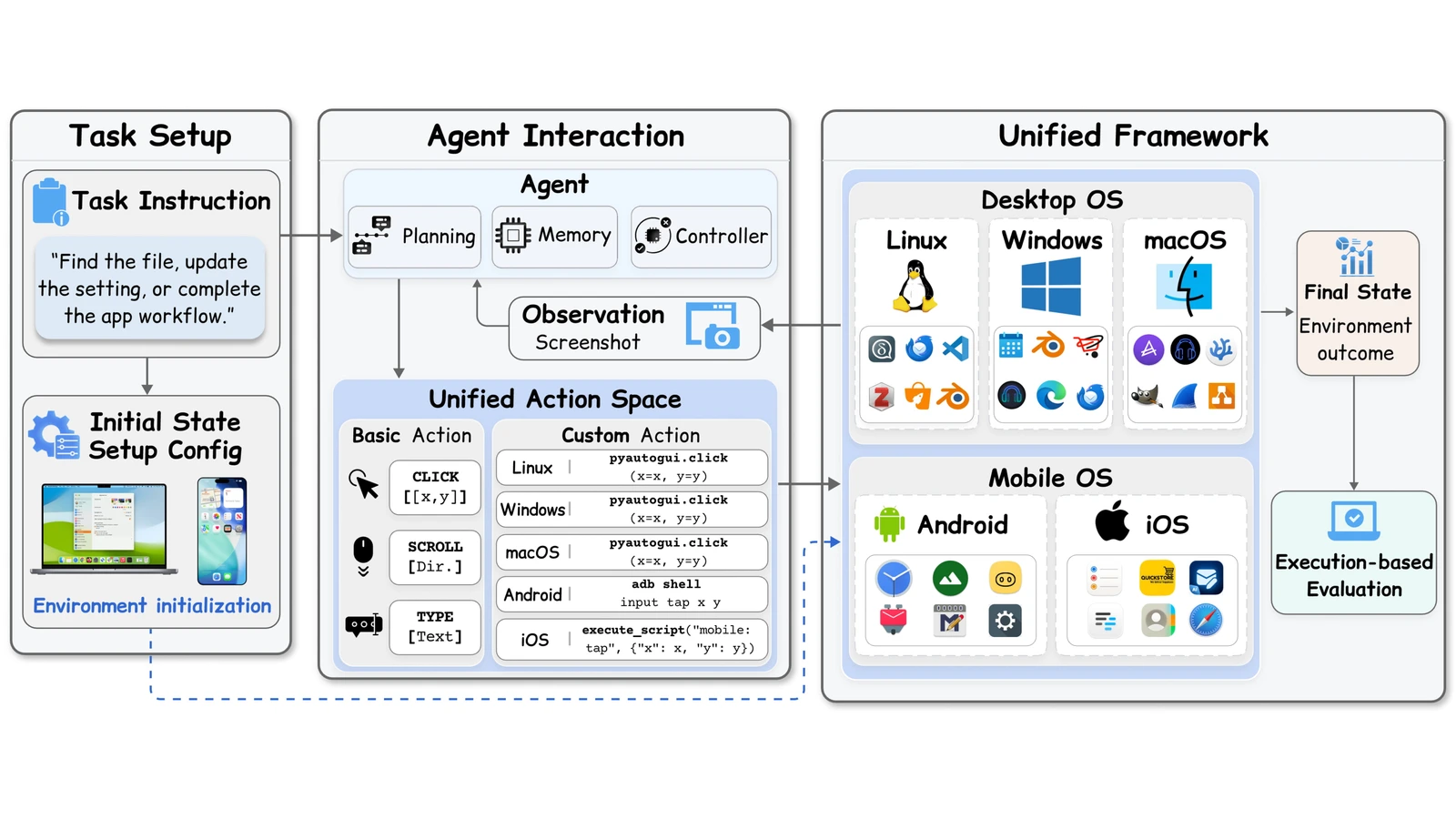
OS-Omni, a November 25 preprint and public benchmark project, evaluates computer-using agents on longer workflows across desktop, mobile and browser environments. The central question is whether an agent leaves the requested outcome in the application, rather than merely producing a plausible sequence of clicks.
The current repository and version-one manifest specify 300 tasks: 48 each for Windows, Linux, macOS, Android, iOS and web, plus 12 cross-device workflows. The project plans versioned waves, so a benchmark name without its release version is not enough to identify a comparable test set.
Success is the resulting state
Tasks initialize an environment and use task-specific evaluators to inspect its final state. The paper describes persistent changes such as saved documents, account or cart state and calendar or message updates. This separates an agent saying it finished from an evaluator finding the requested result.
Some application coverage uses controlled service-backed Open-series software. That makes repeatable setup possible but should not be described as testing every production application with the same name or function. Reset procedures, task assets, evaluator versions and installed software are part of the experimental setup.
The 12 cross-device workflows use one visible screen: a Linux or Windows desktop displays an Android companion through scrcpy. They are not unrestricted tests of every possible device pairing or a separate endpoint for each screen.
The averaging rule affects the headline
The paper reports a strongest agent macro-average of 68.5% against a 77.3% human reference. Macro averaging gives each evaluation track equal weight. A 12-task cross-device track therefore has the same track-level influence as a 48-task platform.
When every task receives equal weight instead, the paper's two leading systems are nearly tied, at 67.0% and 66.7%. Those numbers answer a different aggregation question; they are not contradictory measurements of an identical average. Both are author-reported results, not runs reproduced by AiBrainWorX.
The current repository's platform-summary CSV also contains blank cells and older track labels. We do not present it as an independent reconstruction of the complete paper table. Readers comparing runs need the versioned task inventory, actual evaluation coverage and aggregation method together.
Our analysis: a final-state benchmark addresses an important gap between a convincing demonstration and a durable completed task. Its result remains scoped to the selected software, observation and action interfaces, step budgets and evaluators. A strong score on one platform does not establish reliable behavior on the others.
The code repository carries Apache 2.0. A separate VM repository declares MIT metadata, but that declaration alone does not establish permissions for every operating system or installed application. We read the paper's main evaluation sections, manifest and release documentation; no VM was downloaded or agent run.
Our benchmark repository profile links the source and its setup boundaries. This is benchmark coverage, not a new foundation-model release.
EXPLORE THE SOURCE
Projects in this story
GitHub repositories
- OS-Copilot/OS-Omni ↗View project details
Original primary-source-reviewed reporting. No software installation, model/VM download, inference, training, upstream tests or independent benchmarks performed.