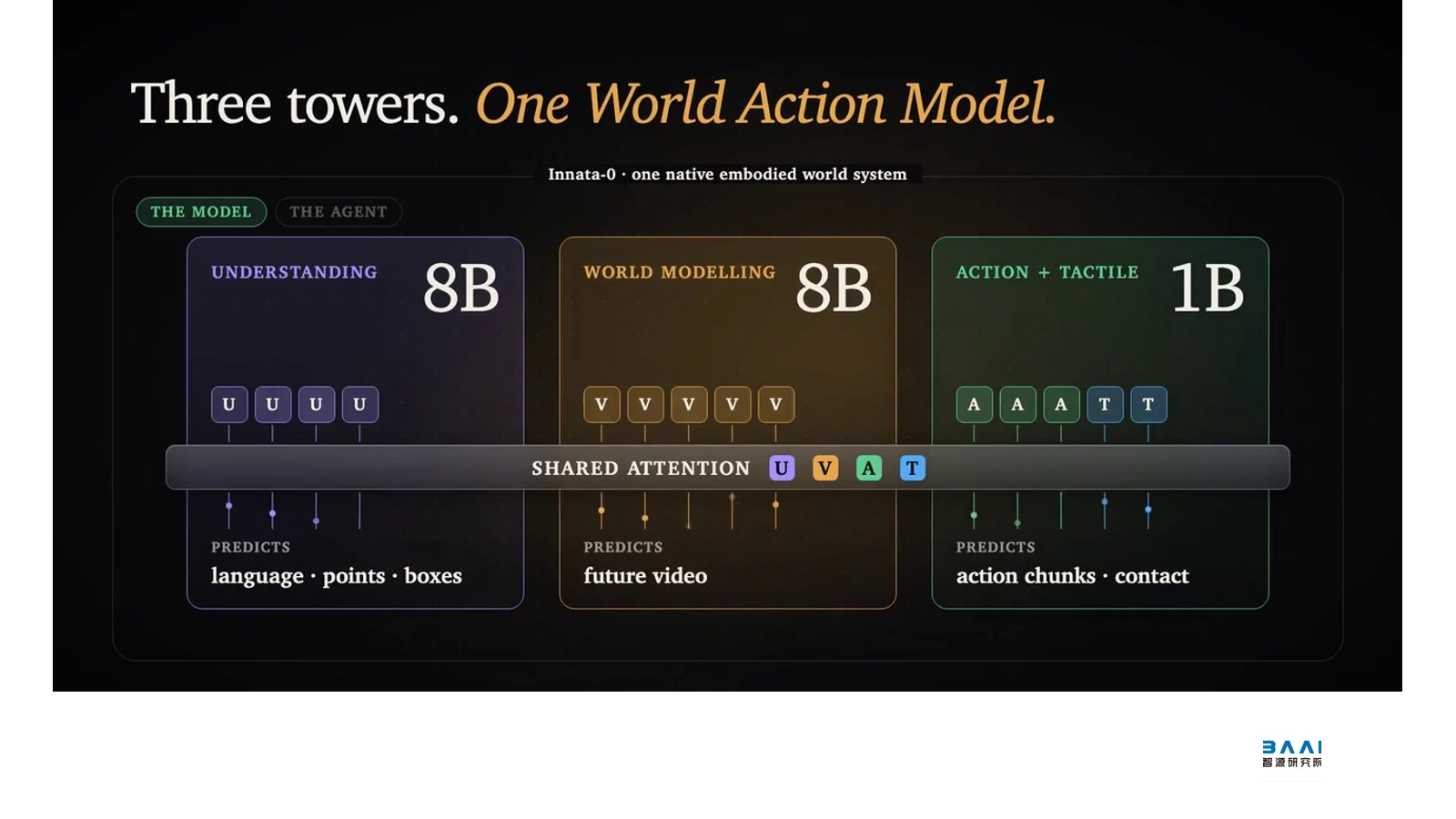

BAAI has published four Innata-0 checkpoints spanning visual understanding, action-conditioned world prediction and simulator-specific robotic policies. Their repository histories show weight uploads on November 26 UTC, followed by Apache 2.0 release commits and card clarifications on November 27 UTC. The technical report was submitted on November 23; those are separate events.
The inference runtime describes a system combining understanding, prediction and action, while marking its public path as a release candidate. Its checkpoint-specific input contracts matter more than a generic claim that one model can control any robot.
Four checkpoints, different jobs
Innata-0-Understanding is an approximately 8.77-billion-parameter vision-language model that answers questions about images or video. Innata-0-ACWM, at about 15.75 billion parameters, predicts video from an initial observation and normalized robot actions. A plausible predicted video is an output to evaluate, not proof that executing those actions is safe.
The approximately 16.18-billion-parameter world-action checkpoints target different simulators. RoboDojo uses five observations from three cameras plus corresponding 14-dimensional joint states, an instruction and a plan. It predicts 16 actions with 14 values each at 25 Hz.
RoboCasa365 instead accepts a three-camera observation and a 16-dimensional robot state, then predicts 16 actions with 12 controller values at 20 Hz. These are not interchangeable action formats. Camera order, normalization, coordinates and timing remain part of the checkpoint's contract.
The evaluation status is unusually explicit
The current cards say full closed-loop evaluation of the released RoboDojo and RoboCasa inference paths has not been completed. Matching a representative request elementwise against an original implementation is a narrower check than reproducing a complete simulator benchmark.
For Understanding, BAAI reports that a new release evaluation covered all 18 reported metrics, with four matching at recorded precision and a largest absolute difference of 0.6993 percentage points. For ACWM, it reports generating 1,000 WorldArena episodes but completing eight of 15 metrics, without a newly calculated overall score. The paper's 67.63 score should therefore not be presented as the finished result of that new release evaluation.
Our analysis: publishing checkpoint contracts and partial reproduction status gives researchers a useful starting point. It also makes clear why a smoke-test pass, an offline numerical match and a successful closed-loop policy are different achievements.
All four current checkpoint license files and the inference runtime use Apache 2.0. The separately obtained VAE, datasets, evaluators and other components retain their own terms. The documented environment includes Linux, Python 3.13 and compatible NVIDIA CUDA 13 support; we have not established consumer-GPU fit.
Our model profiles for Innata-0-Understanding, Innata-0-ACWM, Innata-0-WAM-RoboDojo, Innata-0-WAM-RoboCasa365 and runtime profile retain the exact artifacts and qualifications. We reviewed the cards, histories, licenses and evaluation guides; no checkpoint, simulator or robot was run.
EXPLORE THE SOURCE
Projects in this story
GitHub repositories
- baai-eai/innata-framework-inference ↗View project details
Hugging Face models
These are the exact public repositories referenced in the coverage. Public weights may have restrictions: check each publisher’s terms.
- BAAI/Innata-0-Understanding ↗Apache-2.0
- BAAI/Innata-0-ACWM ↗Apache-2.0
- BAAI/Innata-0-WAM-RoboDojo ↗Apache-2.0
- BAAI/Innata-0-WAM-RoboCasa365 ↗Apache-2.0
Original primary-source-reviewed reporting. No weights, software installation, inference, upstream tests, robotics simulation or independent benchmarks performed.