
Tencent's OmniEVIE-4B is a multimodal retrieval model designed to retain local evidence while compressing an index. Its first public release commit is dated November 24 UTC, and its technical report was submitted later that day. November 26 and 27 card updates clarify modes and badges; they are not new checkpoint launches.
The 4.54-billion-parameter model, from Tencent IMA Product Center and Tencent Youtu Lab, supports text, natural images, visual documents, video and agent-related retrieval. It is an embedding and retrieval system, not a general chat model answering every returned passage correctly.
Why keep more than one vector?
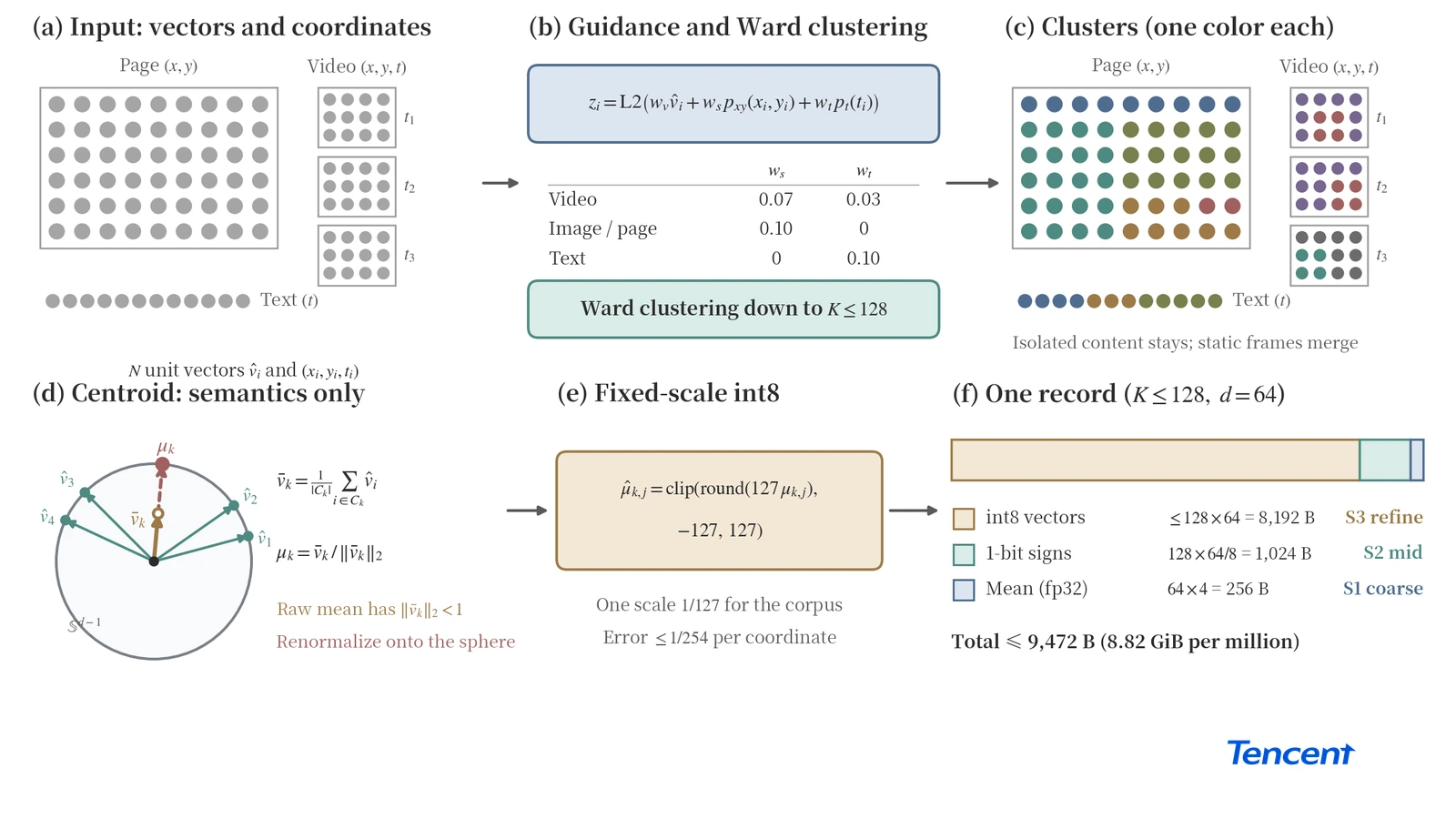
A single vector offers a compact summary but can lose a small relevant detail in a dense document or long clip. OmniEVIE retains multiple vectors and links matches to spatial or temporal coordinates. The publisher's examples return a page region or a video interval, giving an application something more specific to inspect than a whole-file match.
The same checkpoint has two distinct modes. Full retains the uncompressed 2,048-dimensional token sequence. Compressed clusters each record into at most 128 64-dimensional int8 vectors, with additional representations supporting three search stages. These are alternative representations of one model's output, not separate full and compressed model releases.
The publisher gives an upper record layout of 9,472 bytes, or 8.82 GiB per million records, for that compressed configuration. That describes the specified representation; it is not a promise that an entire production service, all source media and every database structure fit in the same memory.
Read the quality and speed numbers together
The report gives MMEB-V3 scores of 60.68 for Full and 60.06 for the compressed configuration across 190 tasks. It also reports a 54.2-millisecond single-thread query on a million-record index. Those are publisher measurements, not independently reproduced results from this desk.
The documented workflow first encodes documents and queries with the model, then searches the index. CPU index-query timing should therefore not be advertised as the latency of encoding an arbitrary new video, constructing an index and producing a final answer. Input processing, hardware and retrieval configuration all affect an application's end-to-end behavior.
The card's prominent ranking is also explicitly filtered to non-audio models and tied to a dated leaderboard snapshot. An audio-excluding ranking is not a claim that OmniEVIE covers audio or leads every retrieval task.
Our analysis: evidence coordinates can make retrieval output more useful to a person or downstream tool. They do not establish that the matched region supports an answer, or that compression preserves every important detail. Evaluation should examine those local matches and the chosen storage-quality tradeoff.
The model and code have Apache 2.0 terms, with Qwen and ColPali-related third-party notices. Our model profile and repository profile link the exact artifacts. No weights, index build, query or benchmark was run for this review.
EXPLORE THE SOURCE
Projects in this story
GitHub repositories
- Tencent/OmniEVIE ↗View project details
Hugging Face models
These are the exact public repositories referenced in the coverage. Public weights may have restrictions: check each publisher’s terms.
- tencent/OmniEVIE-4B ↗Apache-2.0
Original primary-source-reviewed reporting. No weights, software installation, inference, upstream tests, robotics simulation or independent benchmarks performed.