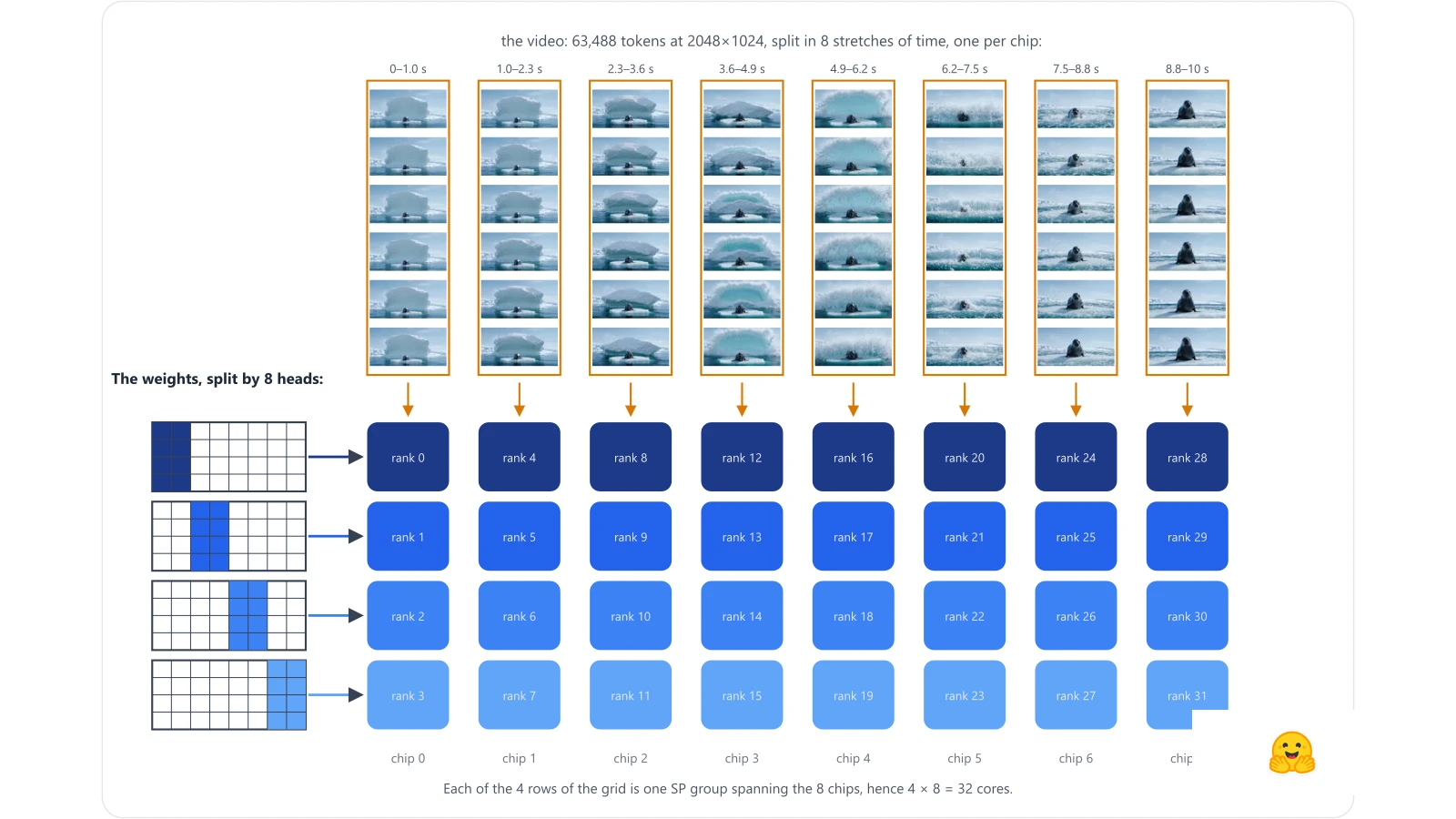

A November 27 Hugging Face engineering report describes generating synchronized video and audio with LTX-2.5 on AWS Trainium3. The author reports 22–23 seconds for a ten-second clip at 2048 by 1024 pixels, once the models were loaded, using 32 of a trn3.48xlarge instance's 64 NeuronCores.
That is a specific warmed-up pipeline result, not an independently reproduced hardware ranking. The report compares it with a published LTX API figure for a ten-second 1080p clip, but the resolutions and measurement conditions differ. It explicitly sets aside a CUDA comparison because the available reference lacked sufficient measurement detail. The timing does not establish a cost advantage or universal superiority over NVIDIA hardware.
The host was part of the bottleneck
The initial working attempt used four cores and took about five minutes twenty seconds at 960 by 544. The final configuration split the weights four ways and the video sequence eight ways, bringing 32 cores to one clip. Those before-and-after configurations also differ in resolution and pipeline stages, so the reported improvement should not be treated as an equal-workload benchmark.
Some of the largest savings came from coordinating CPU and device work: avoiding repeated prompt encoding across ranks, sharing decoded frames and allocating CPU threads so idle ranks did not crowd out the active host process. Other changes addressed graph size, attention shapes and numerical behavior. This is an engineering case study about the complete pipeline, not a claim that additional accelerator cores alone delivered the result.
Startup remains separate. The author reports around three minutes to load models and roughly 80 seconds for the first clip. A service keeping processes warm faces different latency and operating-cost questions from someone starting a machine for one generation.
A film workflow still has continuity limits
The example chains shots through earlier frames rather than relying on prompts alone. It follows the distilled two-stage recipe: eight steps, latent upscaling, then three final steps. The author selected among multiple takes and notes that each shot generates its own sound; leveling background volume does not make audio carry continuously across cuts.
The report also shows continuations of robotics and driving footage. Those are prompt-conditioned examples, not evidence that the model obeys robot actions or improves a trained controller. The author explicitly distinguishes that future training requirement from the demonstrations.
Our analysis: the useful result is a documented account of where time went. Warm latency, startup, CPU contention and graph constraints should be reported separately before anyone translates a clip time into a deployment decision.
The existing Model Watch resource now links our exact LTX-2.5 profile. Its public card is readable, but downloads require accepting publisher access conditions. The custom LTX-2.x Community License has revenue, redistribution and use restrictions; it is separate from Apache-licensed runtime code and Diffusers. The linked experiment repository has no LICENSE file in the reviewed root; reuse permission was not established. We did not run the workflow or download weights.
EXPLORE THE SOURCE
Projects in this story
GitHub repositories
- Lightricks/LTX-2 ↗View project details
Hugging Face models
These are the exact public repositories referenced in the coverage. Public weights may have restrictions: check each publisher’s terms.
- Lightricks/LTX-2.5-Diffusers ↗LTX-2.x Community License
Original primary-source-reviewed reporting. No model weights, software installations, inference, cloud deployments or independent benchmarks performed.