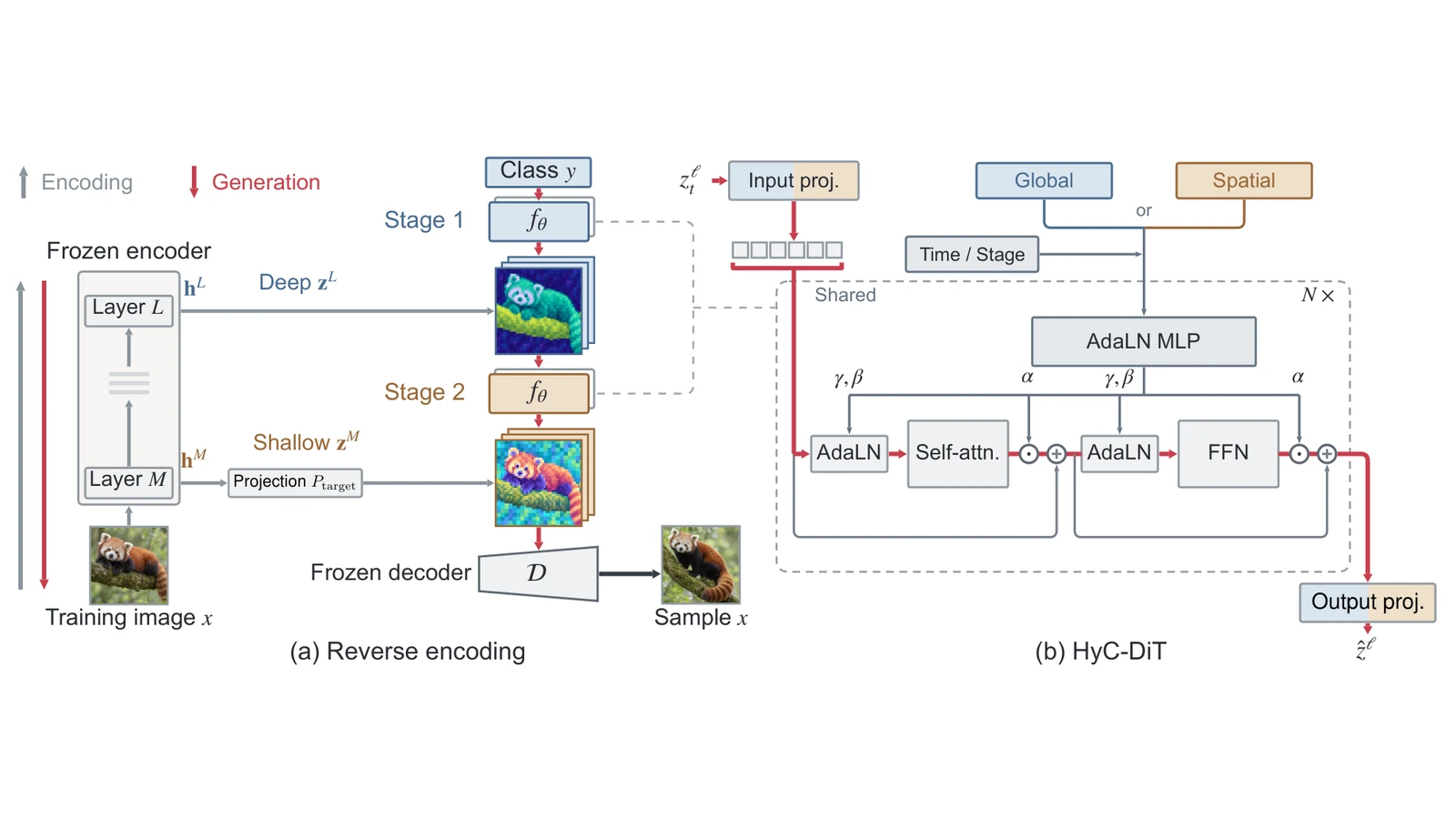
Generation as Reverse Encoding, submitted November 25, introduces RevFlow: an image-generation approach that follows a visual encoder's representation hierarchy in reverse. It first generates deeper semantic features, then shallower features retaining appearance and spatial detail, before a frozen decoder produces pixels.
The motivating distinction is between understanding an image and reconstructing one. A semantic representation can discard details that do not help recognition. Asking a decoder to recover all of those details directly can move a substantial modelling burden into that final stage.
One backbone, two representation stages
The official implementation uses a shared Transformer backbone with stage-specific conditioning. Its released workflow targets class-conditional ImageNet images at 256 by 256 pixels. That is a narrower task than a general-purpose prompt-to-image application, even though the paper also explores a text-to-image setting.
The standard XL and H configurations have approximately 690 million and 1.55 billion generator parameters, respectively, with a separate 89-million-parameter frozen pixel decoder. The repository reports five-epoch FIDs of 1.96 and 1.74 using 25 sampling evaluations in each stage. These are author measurements on the specified benchmark, not independent quality scores from our own generation.
Few-step results have a different setup
Native representation matching adapts a generator for a much shorter sampling path. The paper reports 2.85 FID for a two-evaluation XL variant, counting one evaluation per stage and excluding the decoder. The current released-checkpoint table instead lists 2.90 for its native-matching checkpoint.
We retain that difference rather than substituting one number for the other. The native-matching configuration also includes a different prediction head and additional adaptation; it is not the same five-epoch configuration sampled faster with every other condition unchanged.
Likewise, the paper's best guided result and the repository's unguided checkpoint table should not be treated as interchangeable settings. Sampling evaluations describe generator calls, not a complete wall-clock latency measurement covering every component.
Our analysis: the interesting contribution is a structured return from semantics to detail. It tests whether an encoder's intermediate representations can provide useful generation targets instead of requiring the final decoder to invent everything lost through abstraction. Benchmark quality and efficient sampling remain claims to assess under their exact training and evaluation conditions.
Weights, the frozen codec and statistics are hosted on ModelScope, rather than a verified Hugging Face mirror. We read that host's model card and MIT license alongside the MIT code license and publisher file manifest. We did not download the tensor files or independently validate their checksums.
Our model profile identifies the actual host and checkpoint family, and our repository profile links the implementation. The paper date is not asserted as the original upload date of every hosted artifact. No model was installed, trained or used to generate images for this review.
EXPLORE THE SOURCE
Projects in this story
GitHub repositories
- ChengShiest/RevFlow ↗View project details
Model repositories
These are the exact public repositories referenced in the coverage. Public weights may have restrictions: check each publisher’s terms.
- chengshi0612/RevFlow ↗MIT (actual ModelScope source)
Original primary-source-reviewed reporting. No software installation, model/VM download, inference, training, upstream tests or independent benchmarks performed.