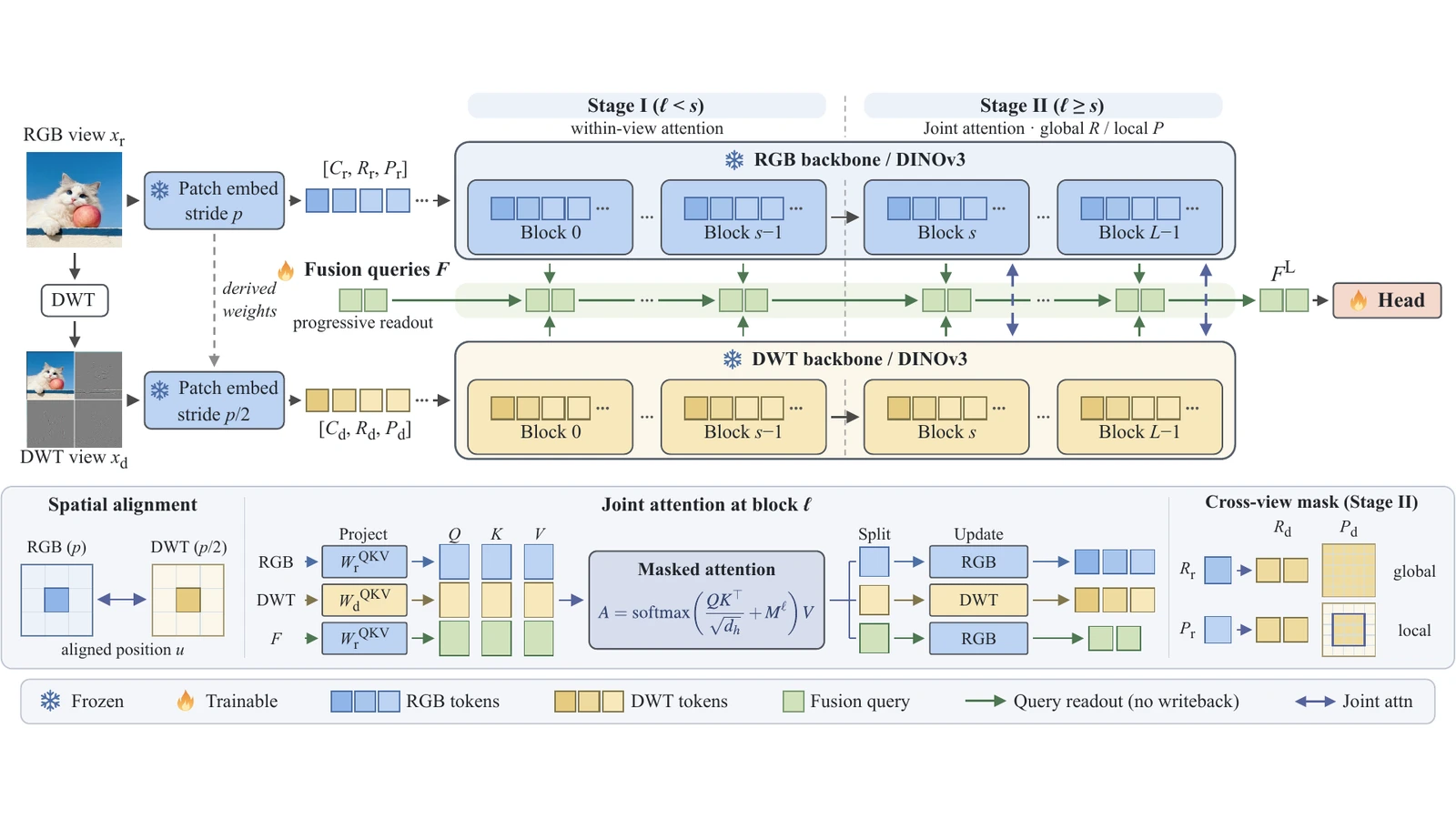
ReMoT, released with a paper, code and evaluation checkpoint on November 25, investigates whether an image detector can draw more useful evidence from a frozen visual model instead of adapting its backbone. The approach processes aligned RGB and wavelet views, then learns how to read information across the model's depth.
The authors report 91.2% average performance across eight benchmark groups with 3,074 trainable parameters. That small trainable count is a property of the readout, not the entire detector: the paper's compact implementation still stores approximately 303.95 million parameters, dominated by frozen DINOv3 weights.
Two views, staged interaction
The official implementation pairs an ordinary color-image view with a spatially aligned wavelet representation. The streams initially develop separately, then exchange evidence through staged attention. Fusion queries collect information without writing their readout state back into the image streams.
The paper explains an equivalent implementation that shares identical frozen weights and merges symmetric queries. Those reductions depend on their stated symmetry and freezing conditions; changing the model to update its two branches independently can invalidate the equivalence.
What the headline average measures
The authors train on the GenImage Stable Diffusion v1.4 partition and evaluate the same trained detector across eight groups. They average subsets within each group and weight the groups equally. Balanced accuracy is used where both classes are available; single-class subsets use ordinary accuracy.
That distinction matters. An aggregate benchmark score is not a calibrated probability for a particular photograph, nor a guarantee about every generator or real-world upload. The paper's EvalGEN table even gives a frozen DINOv3 linear probe a slightly higher group average than ReMoT, although ReMoT leads the overall eight-group comparison.
Preprocessing also forms part of the experiment. The main GenImage and AIGCDetectBench protocol JPEG-encodes synthetic images at quality 96 to reduce format bias. A separate robustness experiment applies JPEG compression and blur to both real and generated images. Those are different evaluation conditions and should not be merged into one generic robustness claim.
Our analysis: the work makes a useful case for studying how a detector reads pretrained features. It does not establish that a detection label is sufficient evidence to accuse a creator of deception. Source provenance and corroborating evidence remain necessary when the consequence of a false positive is serious.
Code and checkpoint terms differ
The code is Apache 2.0. The checkpoint card says its file includes the frozen backbone and distributes it under the DINOv3 License. We read the hosted license, rather than transferring the code's license label to the weights. November 26 card edits are not another model launch.
Our model profile and repository profile link the artifacts. We inspected the paper's method, evaluation and implementation-equivalence sections, model history and license; no checkpoint was downloaded or image-classification test run.
EXPLORE THE SOURCE
Projects in this story
GitHub repositories
- yunncheng/ReMoT ↗View project details
Model repositories
These are the exact public repositories referenced in the coverage. Public weights may have restrictions: check each publisher’s terms.
- Yunncheng/ReMoT ↗DINOv3 License checkpoint; Apache-2.0 code
Original primary-source-reviewed reporting. No model downloads, installation, inference, training, database migration, upstream tests or independent benchmarks performed.