BiSAT, a speech-tokenization study from the Japan Advanced Institute of Science and Technology, explores how one discrete token stream can retain both linguistic content and acoustic detail. Its first preprint appeared November 23 UTC; the current revision is dated November 24.
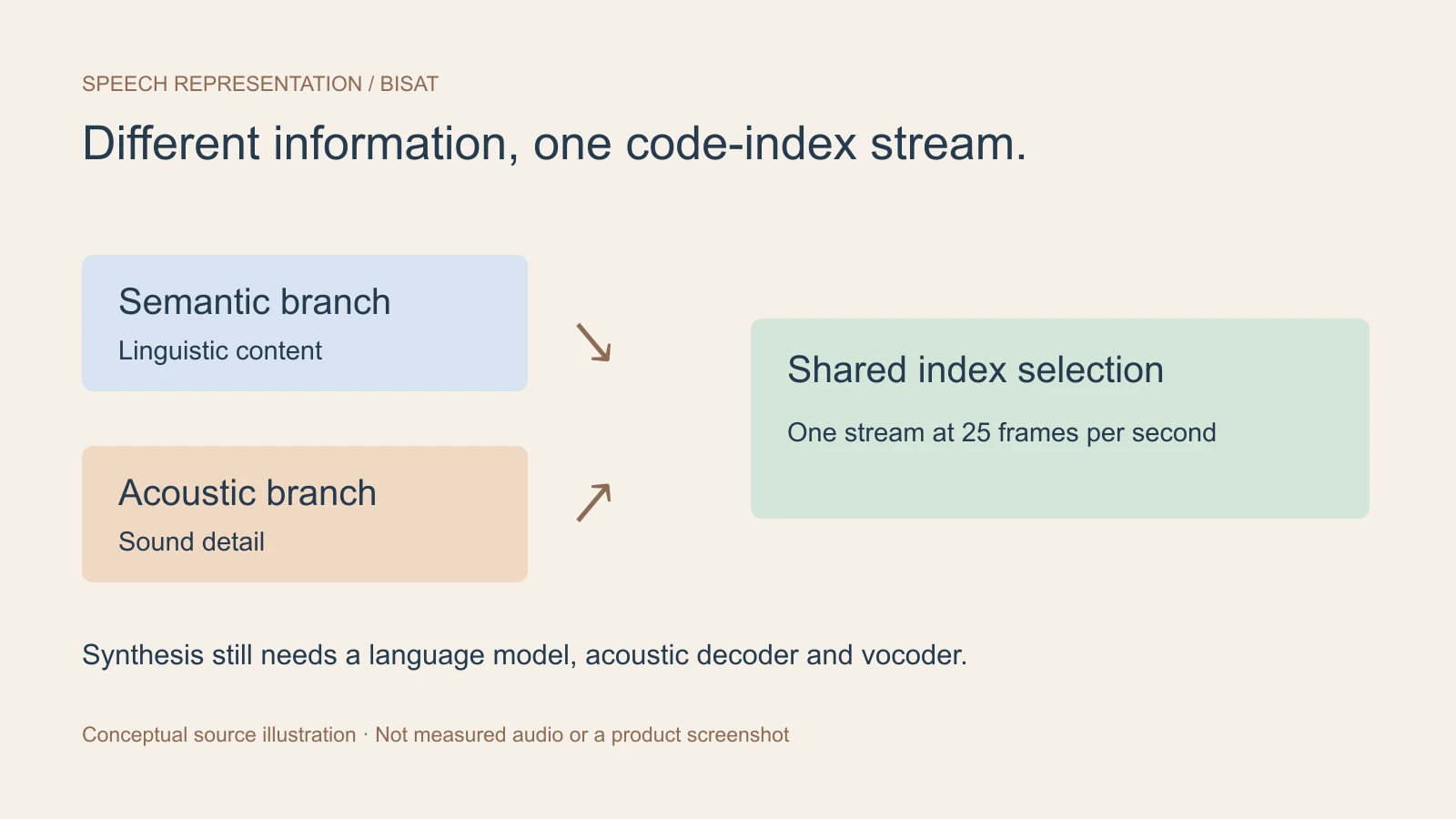
The problem is familiar in speech generation. A representation optimized for recognizing words can discard useful sound detail. A representation optimized to reconstruct audio can preserve variation that makes predicting the next speech token harder. BiSAT separates those objectives during representation learning, while linking them through a shared choice of code index.
Two spaces, one sequence
During training, the semantic and acoustic branches have separate encoders, codebooks and decoders. At each frame, a shared-index mechanism minimizes a combined quantization error across the branches. The two branches can therefore represent different information without requiring two independently serialized token streams.
The paper describes a 25 Hz stream, with 32k- and 64k-codebook configurations corresponding to 375 and 400 bits per second for the discrete indices. Those bitrates describe the token stream. They are not the size of a complete deployable synthesis system, a waveform codec file including every dependency, or an end-to-end network bandwidth measurement.
The speech-generation system combines an autoregressive text-speech language model with a speaker-conditioned flow-matching decoder and a vocoder. The token sequence alone is not a direct waveform reconstruction path.
Read the evaluation conditions
The authors report training on about 122,000 hours across 11 languages, with substantially unequal language coverage. English and Chinese account for most of the hours. Both tokenizer encoders start from an English-pretrained speech model; a multilingual dataset does not establish equal performance in all its languages.
The paper reports improved intelligibility against its selected autoregressive TTS baselines, while speaker similarity and predicted naturalness present different tradeoffs. We treat those comparisons as the authors' experiments, not a listening test or reproduction by AiBrainWorX.
Crucially, the reconstruction and zero-shot TTS benchmarks use offline decoding. Although the architecture describes chunked decoding with lookahead, those benchmark tables do not establish live streaming latency. The authors also acknowledge that they did not perform controlled full-scale ablations of every architectural component.
Our analysis: the most useful idea is to evaluate whether speech tokens make information accessible to the language model, rather than judging them only by reconstruction quality. Good reconstruction and easy sequence modeling are related goals, but they are not the same test.
A paper and demos are the verified availability
The authors provide an audio demonstration page with comparison material. We verified the paper and page, but did not establish a public downloadable checkpoint or its deployment license in those primary materials. This coverage therefore does not announce an open-model download or promise that it runs on consumer hardware.
No audio was synthesized, model downloaded or listening-quality evaluation performed for this article. The research remains worth following for its representation design, with availability and reproducibility separate from the paper's reported results.
Original primary-source-reviewed reporting. No model downloads, installation, inference, training, database migration, upstream tests or independent benchmarks performed.