A November 24 robotics preprint argues that the boundary between a reasoning agent and a learned control policy deserves to be trained explicitly. Its question is practical: from which starting states can the policy reliably take over, and can the agent recognize those states before calling it?
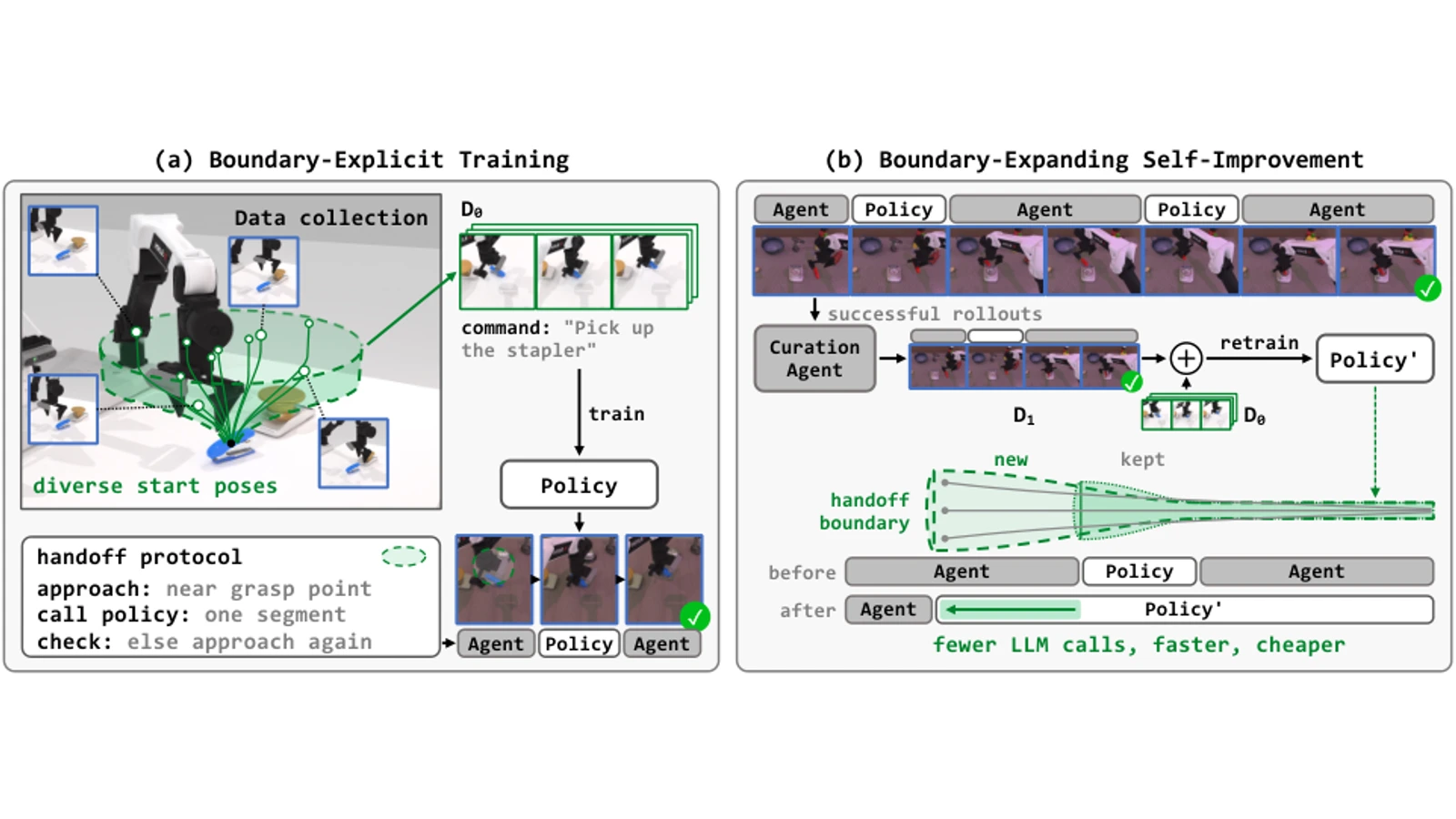
The authors call this the policy's handoff boundary. A language-driven agent may plan a sensible task yet invoke its controller from a pose unlike the ones that controller learned. Improving the planner or the controller independently does not necessarily repair their interface.
Train the contact segment, then expand it
Boundary-Explicit Training uses contact segments with varied starting poses, rather than asking the policy to absorb every part of a complete task at once. A handoff protocol tells the agent how to approach the object and when to call the learned skill.
Boundary-Expanding Self-Improvement then curates successful system rollouts and retrains the policy. In the authors' experiments, the agent can subsequently delegate earlier portions of a task, reducing how often it needs to call the language model during execution.
The concept is an operational competence boundary, not a certified safety envelope. A rule describing an appropriate starting pose does not establish collision avoidance or safe behavior around people in an untested environment.
Keep simulation and hardware evidence separate
The authors report 98.4% success in the randomized RoboTwin 2.0 setting after boundary-explicit training. Their RoboDojo evaluation uses 26 tasks from selected subsets. These are benchmark experiments under the paper's scene, task and evaluation protocol, not an independently reproduced deployment success rate.
For self-improvement, the paper reports average execution-stage API-cost and time reductions of 41.3% and 37.5% across its easy and hard RoboTwin settings. Those savings do not include all the costs of collecting rollouts and retraining. The appendix separately reports about $1,013 in API usage for collecting the two rollout datasets.
The physical-robot appendix describes a dual-arm fruit-placement task using a policy fine-tuned on 40 contact demonstrations. It shows one completed episode and explicitly leaves quantitative real-robot evaluation to future work. That demonstration should not inherit the simulated 98.4% headline.
The authors also identify limitations: curation discards unsuccessful rollout segments, and the handoff rules do not provide a learned confidence estimate for every candidate state. Both are important when considering how such a system might recover from mistakes rather than repeat only its successes.
Our analysis: the contribution is to make an interface measurable. Separating reasoning from fast physical control is useful only when the system knows where responsibility changes hands. The paper provides evidence within selected tasks, while broader hardware reliability remains an open evaluation problem.
We reviewed the method, benchmark setup, cost accounting, limitations and physical-robot appendix. We did not establish a public downloadable checkpoint and license from the examined primary materials. This is research coverage, not an open-model launch or a recommendation to deploy a robot. No simulator, robot or model was run for this article.
Original primary-source-reviewed reporting. No model downloads, installations, inference, database/robot tests, security exploitation, upstream test execution or service changes performed.