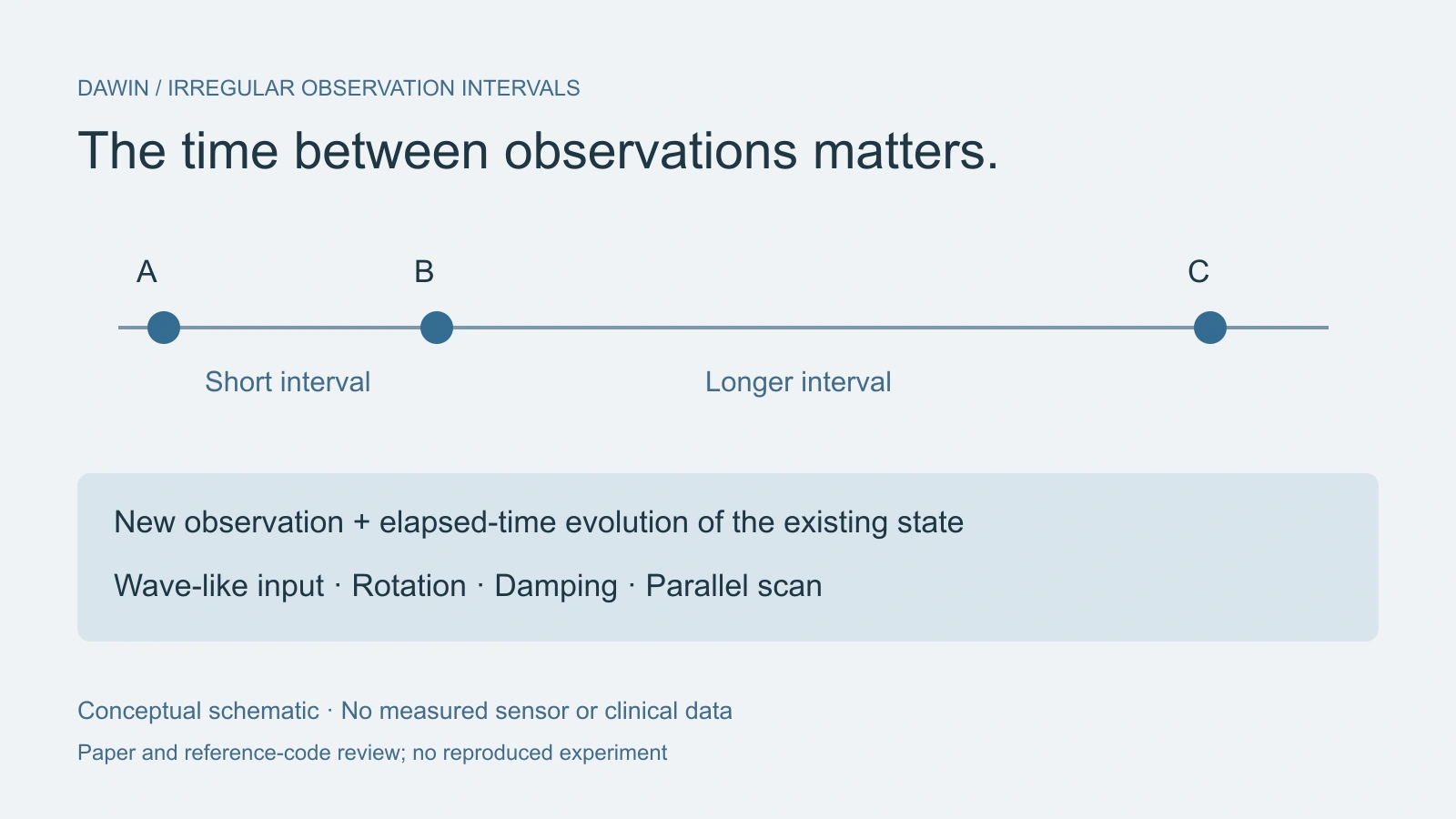
Damped Atomic Wave Integration Neurons, or DAWIN, investigates how a neural layer can retain information about the physical time between observations. The November 23 preprint by Byunggu Yu and Justin Kim combines interval-aware input with a damped internal state, targeting sequences whose measurements do not arrive at uniform intervals.
The proposal is a research primitive and reference implementation, rather than a newly released conversational checkpoint. Its timing results should not be repackaged as a claim that an existing language model becomes thousands of times faster.
Elapsed time affects the update
In the authors' construction, a new observation contributes a wave-like input and the existing state rotates and decays according to the elapsed interval. Two sequences containing the same observations with different timing can therefore produce different internal evolution.
The paper describes integration into MLP, Transformer and graph-network backbones. Its reference repository exposes the layer and related examples. Replacing a layer interface still requires an appropriate sequence representation, training setup and treatment of timestamps; it is not a compatibility certificate for every pretrained network.
A scan avoids evaluating every transition serially
The method expresses the state updates through an associative composition, allowing a parallel prefix scan. The reviewed source includes a paired-real representation, a serial fallback and a separate Triton implementation using floating-point accumulation.
This is a reason the choice of baseline matters. The paper's headline speedup of roughly 2,630 times compares its parallel layer with exact serial wave recurrence at a specified long-sequence setting on an NVIDIA B200. It does not compare every model family at that same ratio, and it is not a token-generation result.
The paper separately reports results across other backbones, batch sizes and sequence lengths. Hardware, precision and workload dimensions are part of those measurements. We did not compile a kernel, run an inference task or reproduce any throughput or memory result.
What the experiments establish and leave open
The authors report eleven tasks with parameter-matched comparators and ten seeds, covering controlled dynamics, subsampled control trajectories, pedestrian trajectories and clinical benchmark sequences. Their timestamp interventions compare true intervals with shuffled or altered intervals, alongside a negative-control task where timing is intended to be irrelevant.
Those experiments address whether the evaluated systems use timing information under the chosen protocol. Clinical benchmark results do not establish clinical efficacy, regulatory approval or reliability in a hospital, and simulated control tasks do not certify a physical robot.
The limitations section notes fixed intrinsic frequencies and damping rates, possible difficulty around sharp regime changes and interval extrapolation. The paper also provides a stability analysis, which should be read under its stated assumptions rather than treated as a guarantee for an entire trained application.
Our analysis: DAWIN is interesting because it places the timing question inside the update rather than relying only on a position index. The next useful evidence is how that design transfers across independently reproduced workloads, especially when sampling patterns change. The largest kernel ratio alone cannot answer that question.
The reference code is MIT-licensed, while the paper uses arXiv's non-exclusive distribution license. Our repository profile links the implementation. We reviewed the paper, limitations and core/scan source; no dataset, pretrained weights, clinical records or benchmark workload was downloaded or executed.
EXPLORE THE SOURCE
Projects in this story
GitHub repositories
- yumakemore/DAWIN ↗View project details
Original primary-source-reviewed reporting. No upstream installations, runtime tests, weights, datasets, inference, benchmarks, cloud resources or deployments performed.