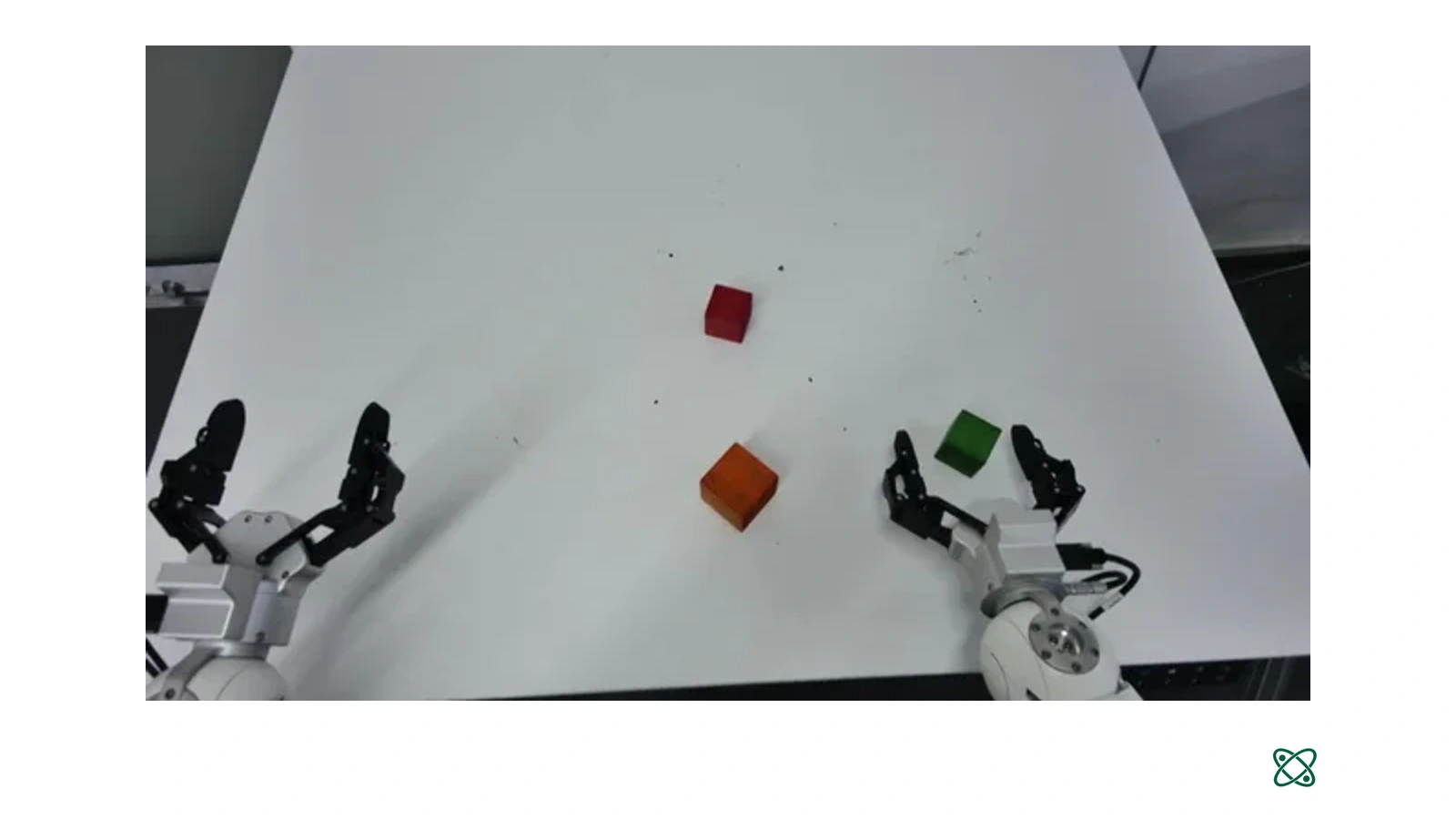

Entangle, a world-action-model study by Chendong Xiang, Chengwen Zhang and coauthors, explores a natural interface for robot instructions: show a human demonstration, then let the robot reproduce its procedure in the current scene. The paper was first submitted November 21 and revised November 25; the revision is not evidence of a separately released new checkpoint.
The official project page lists Tsinghua University, GensPI Technology and Motubrain, with demonstrations and research materials. We did not establish downloadable weights or a model reuse license from those materials. Its paper license should not be substituted for one.
Timing matters as much as the task label
A video and a robot trajectory can describe the same goal while disagreeing about when an object is grasped, moved or released. Training on that loose association can let a model recognize the task without following the particular procedure in its reference video.
Entangle combines real paired recordings with generated human demonstrations translated from recorded robot videos. The goal is to preserve the source scene, interaction order and timing so that a particular visual segment corresponds to the supervised robot actions. The authors describe 21,269 paired episodes; we have not downloaded or audited them.
The training objective also contrasts different trajectories of the same task. That asks the policy to distinguish the demonstrated execution from another valid way to reach a similar goal, rather than use task identity as a shortcut. Variable-length windows provide another part of the training setup.
Two evaluations with different meanings
On six unseen Astribot S1 tasks, the authors report a mean score of 83.5 out of 100, using ten trials per task and configuration. Those task-specific rubrics include both goals and procedural constraints. The figure should not be relabelled an 83.5% complete-success rate.
In simulation, seven held-out RoboTwin tasks are evaluated with three seeds and 100 episodes per task per seed. The reported mean success is 69.52%, compared with 46.95% for Zero-WAM under the stated protocol. That is a separate simulation success metric, not a directly interchangeable real-robot result.
The paper also shows examples involving changed layouts and substituted tools. Its limitations describe cross-scene transfer and generated-context deployment as qualitative cases requiring broader quantitative evaluation. A successful demonstration of sweeping with an unusual object is not evidence of general tool competence or safe operation around people.
Our analysis
The interesting contribution is the effort to preserve correspondence between what a robot sees and the action it should take next. Better alignment can make a demonstration more than a coarse label for a familiar task. But synthetic human-video fidelity remains part of the dependency chain, and real-robot evaluation is limited to one embodiment.
Entangle appears in AI News and Model Watch as a research report with demos, not a verified open-weight download. The paper is CC BY 4.0; our cover instead uses a separately credited official project still. We reviewed the November 25 revision, scoring details and official project page without running robots, generating training data or testing a model.
Original primary-source review. No upstream tests, experiments, model inference, training, dataset or weight downloads, installations or cloud provisioning performed. Published results remain author/provider claims.