
Tencent's Hy-MT3 release brings three translation-model sizes, 102-language coverage and the TransRubric evaluation resources into one project. The publisher dates the announcement November 24. The official Hub repositories were created earlier, and their history includes November 22 weight uploading and resharding; subsequent README updates are not new training releases.
A recent YouTube demonstration led us to the project, but its upload date is not the model's launch date. November 26 browser-extension links and November 27 mobile-app QR codes in the card are later workflow additions. We checked the original cards, configurations, licenses and history rather than treating that chatter as independent testing.
Translation is the task, not a generic chat claim
The family includes dense 1.8B and 7B models and a 30B-A3B mixture-of-experts model. Readers can inspect our 1.8B, 7B and 30B-A3B profiles before opening the original model cards.
Tencent emphasizes following terminology, formatting and other translation instructions, alongside general multilingual quality. Its image-translation discussion concerns a workflow with OCR followed by translation; that is different from demonstrating a native image-input vision model. Game-localization work also depends on preserving placeholders and rich-text conventions, not merely producing fluent prose.
The MoE model's active-parameter label is not its stored-weight size. Likewise, the configured 262,144 positional limit does not establish translation quality at that length or a memory requirement for a consumer device. We have not qualified any variant on our hardware.
The judge is part of the story
TransRubric releases task-specific rubrics and prompt-building code for model-based evaluation. The judge checks a translation against concrete criteria and produces a score on a 0–100 scale. The helpers construct messages for a chosen multilingual model; they are not a separate, independently validated judge checkpoint.
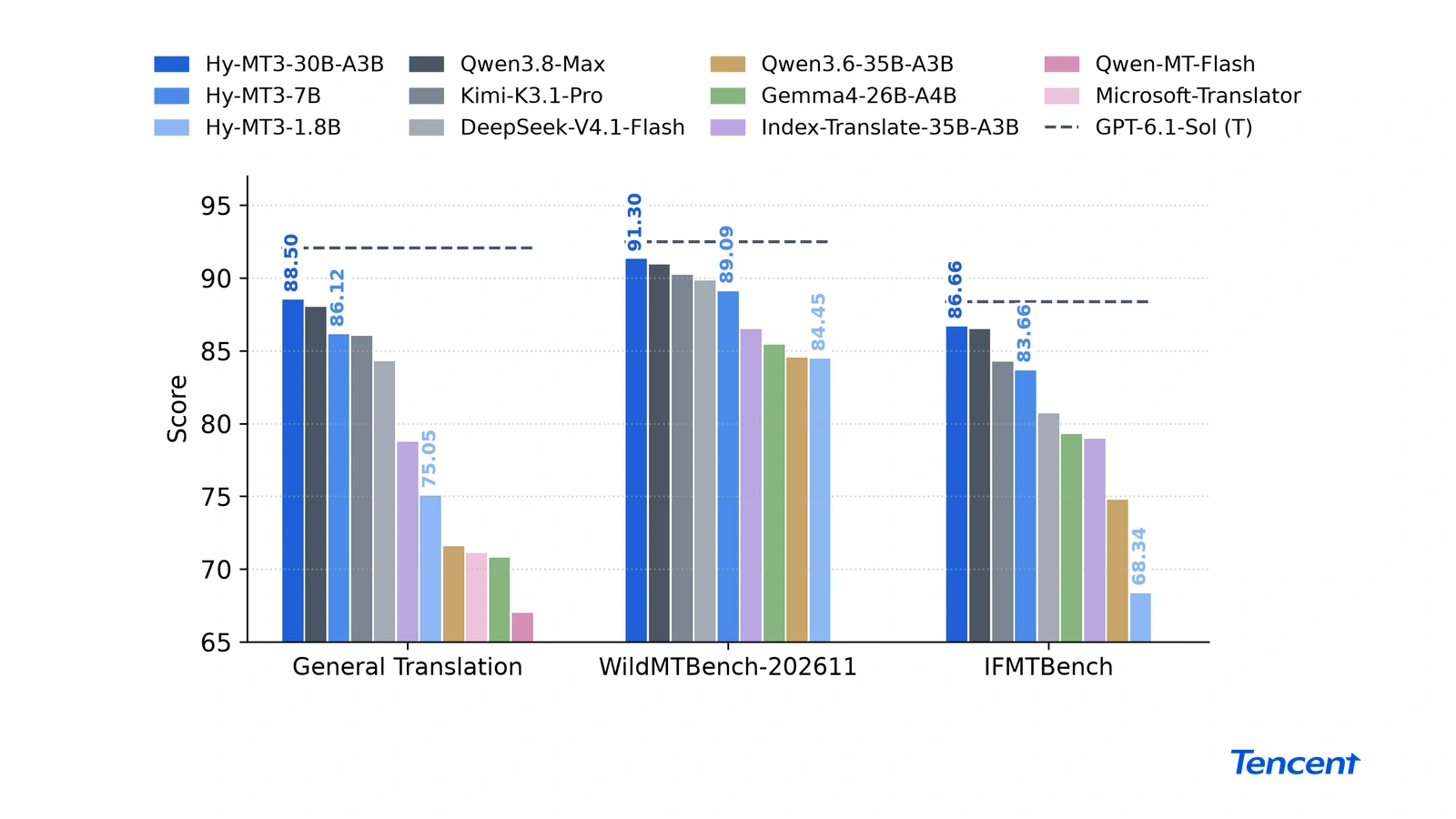
Tencent's general-translation and WildMTBench comparisons use TransRubric. Other columns measure instruction following, while thinking and non-thinking model settings are distinguished in the card. Those choices matter when interpreting the publisher's comparisons.
The efficiency plot also uses estimated inference compute based on activated parameters and generated tokens. It is not a direct measurement of wall-clock latency, power consumption or cost on a particular computer. Our cover reproduces the publisher's comparison figure with that distinction intact.
Our analysis
The useful proposition is a specialized translation stack with inspectable constraints and evaluation prompts. The next practical check is whether it preserves the terminology and document structure of a reader's actual language pairs, rather than assuming an aggregate chart predicts every domain.
The actual LICENSE.txt files explicitly apply Apache 2.0 to Tencent's released code and weights. Hosted apps, benchmark source materials and third-party components remain separate. Browser or mobile availability does not establish offline operation or a particular data-handling policy. Our repository profile links the source. We reviewed these materials without downloading weights, installing clients or running translations.
EXPLORE THE SOURCE
Projects in this story
GitHub repositories
- Tencent-Hunyuan/Hy-MT3 ↗View project details
Model repositories
These are the exact public repositories referenced in the coverage. Public weights may have restrictions: check each publisher’s terms.
- tencent/Hy-MT3-1.8B ↗Apache-2.0
- tencent/Hy-MT3-7B ↗Apache-2.0
- tencent/Hy-MT3-30B-A3B ↗Apache-2.0
Original primary-source review; no weights/datasets downloaded, models or upstream tests executed, compiler/extension/cloud installed or workload benchmarked. Results are publisher/researcher claims, not independent measurements.