
ALIVE has published an 8B checkpoint and local inference code for a streaming-video assistant that can monitor a request, coordinate changing tasks and ask for feedback when the available evidence is insufficient.
The paper appeared November 16; the checkpoint history records inference files added November 17. This is November 21 coverage of those developments, rather than a claim that the model first shipped today.
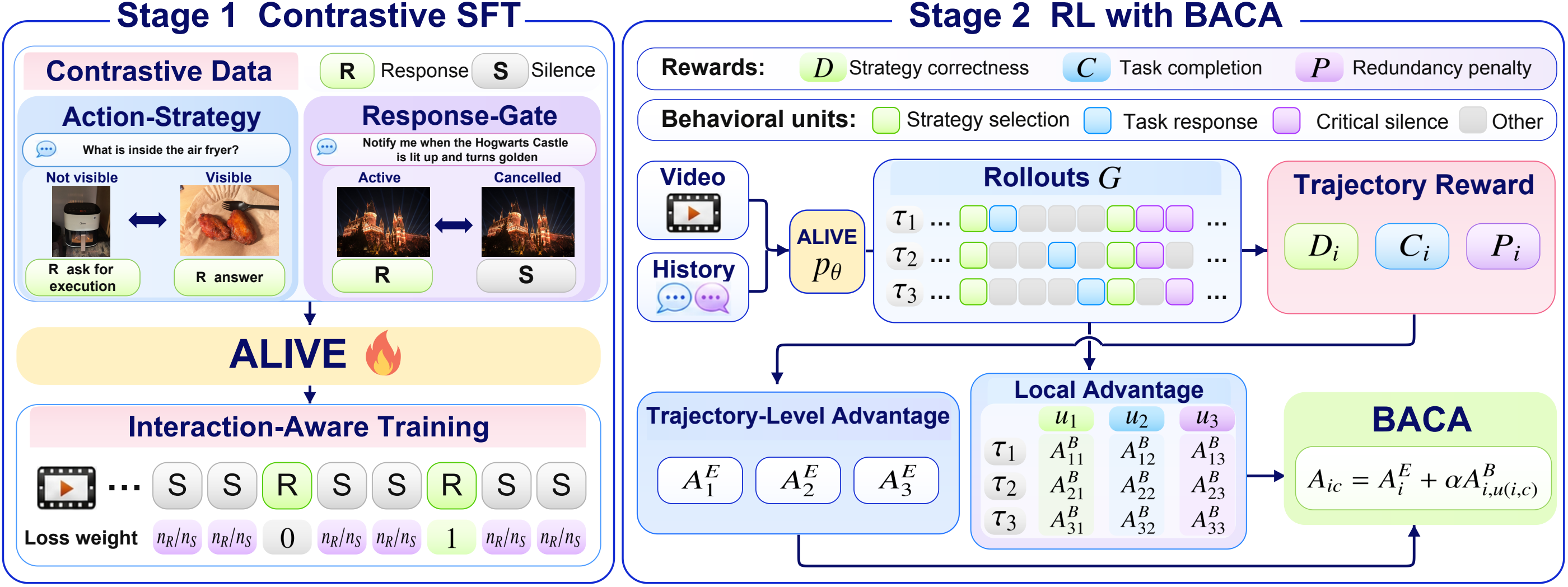
Interaction includes deciding when not to answer
The research report describes contrastive supervised fine-tuning followed by reinforcement learning with Behavior-Aligned Credit Assignment. The intended behavior includes decisions, responses and silence over multiple turns, instead of treating every camera frame as an unrelated question.
The authors introduce FSI-Bench for feedback-seeking interaction and report the strongest overall scores among the compared models across that benchmark and four public benchmarks. Those are their comparisons, not independently reproduced results. The release checklist still marks evaluation code and training data as forthcoming.
What is actually in the checkpoint repository
The Hub listing includes an ALIVE-8B subdirectory with configuration, tokenizer, processor and a roughly 17.5 GB safetensors file. Its configuration identifies Qwen3-VL architecture and BF16 precision. We read the metadata and small configuration files without downloading weights.
The model card is minimal: it declares Apache-2.0 but provides little model-specific documentation. No standalone license file was listed in the model repository. The code repository separately includes an Apache-2.0 license and notices for upstream UI code and other dependencies.
The complete voice demo is a larger deployment
The web inference guide specifies Linux, Python 3.12 and two CUDA GPUs: one for ALIVE, another shared by Qwen speech recognition and speech synthesis. Three Python environments isolate dependency stacks; that does not mean three GPUs.
The documented default working context is 131,072 tokens, below the configuration's 262,144 position setting. The browser pipeline allows one in-flight camera request and skips arriving frames while busy. Its one-frame-per-second target is not a throughput guarantee or a measured result on a consumer card.
Our analysis: useful monitoring needs an honest uncertainty signal
Asking for a better view or a missing action can be more useful than producing a fluent answer from insufficient evidence. The important evaluation question is whether a system recognizes those moments consistently, including when the scene or instruction changes.
That promise should not be expanded into dependable safety monitoring or unlimited memory. Older visual frames leave the documented rolling window, benchmark reproduction is incomplete, and GPU fit depends on the full stack. Our model profile and source profile expose those limits alongside the release.
The authors' official demonstration shows the intended interaction. It is publisher footage, not our test.
Official project demonstration
Source-hosted publisher demonstration, not our independent test. Open the official video.
EXPLORE THE SOURCE
Projects in this story
GitHub repositories
- lijinzhao30/ALIVE ↗View project details
Original primary-source reporting and labelled editorial analysis. No installation, model download, inference, exploit attempt, upstream test suite or independent benchmark performed.