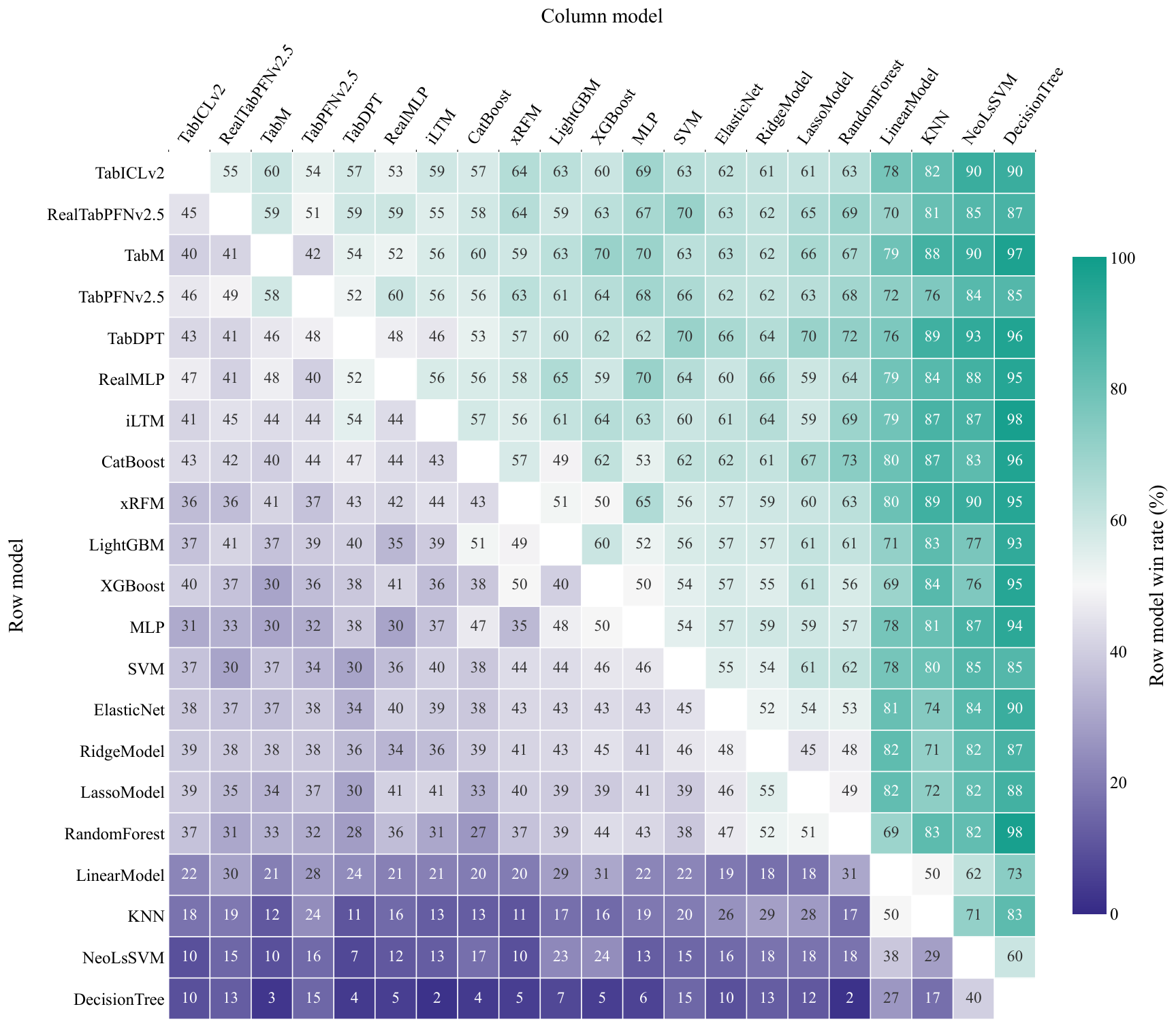

TabBioMed, submitted November 18, brings 94 public biomedical tabular datasets into a common evaluation framework. It covers eight domains and compares 23 model implementations, with code, fixed data releases and published results available for inspection.
The research addresses a practical problem: different dataset shapes, missing values, class balances and compute budgets can make separate biomedical studies difficult to compare. This is a research benchmark, not a clinical deployment or an approved diagnostic system.
A strong model family does not settle every task
The authors report the strongest aggregate predictive performance for tabular foundation models. Tuned trees and neural baselines remain competitive under particular data regimes and training or inference-cost constraints.
A family-level average summarizes a collection of tasks. It cannot tell a team which method will work best on a different dataset or budget. The repository makes scope and implementations visible rather than presenting a score without its protocol.
Budget accounting changes a comparison's meaning
The evaluation guide specifies time and attempted-configuration budgets, with different allowances for fixed splits and outer folds. Validation preprocessing is fitted on the relevant training partition, and test results do not select configurations.
Failed fits and process-startup costs are included in the documented selection procedure. A method receiving more search effort can appear better even when a comparison is nominally about architecture. Tuning should therefore retain its stated cost rather than becoming free work outside the experiment.
Data provenance and licensing remain dataset-specific
The data guide identifies a pinned release and verification of feature values, ordering and splits. Raw-source reconstruction is a separate reference-curation workflow, not required to run the released benchmark.
Code is Apache-2.0. The dataset card declares dataset-specific licenses, rather than a blanket permissive license for every source. Checkpoint permissions remain separate. We read metadata without downloading biomedical records or weights.
Our analysis: reproducibility enables a better next question
A common benchmark can make model choices easier to investigate. Moving from that comparison to an application still requires assessing whether the data, outcome definition and deployment conditions match the intended use. A leaderboard cannot answer those questions on its own.
Readers can inspect our source profile and open the authors' leaderboard through our Space viewer. The public static Space was running at review. We did not execute evaluations, validate clinical outcomes or reproduce its ranking.
EXPLORE THE SOURCE
Projects in this story
GitHub repositories
- AI-sandbox/TabBioMed ↗View project details
Original primary-source reporting with editorial analysis. No installation, model/data download, inference, upstream suite, paid service call or independent security/performance test.