WorldRuler studies a problem that a convincing generated video does not settle: whether an interactive world keeps following the same user-defined rules after actions, objects moving out of view, and saving or loading state.
The paper was submitted November 18. Its November 19 revision corrects author and affiliation information; it should not be counted as a second model release. At our November 21 review, the project checklist still marked inference code, models and the RuleVerse dataset as unreleased.
Keep rules and state somewhere explicit
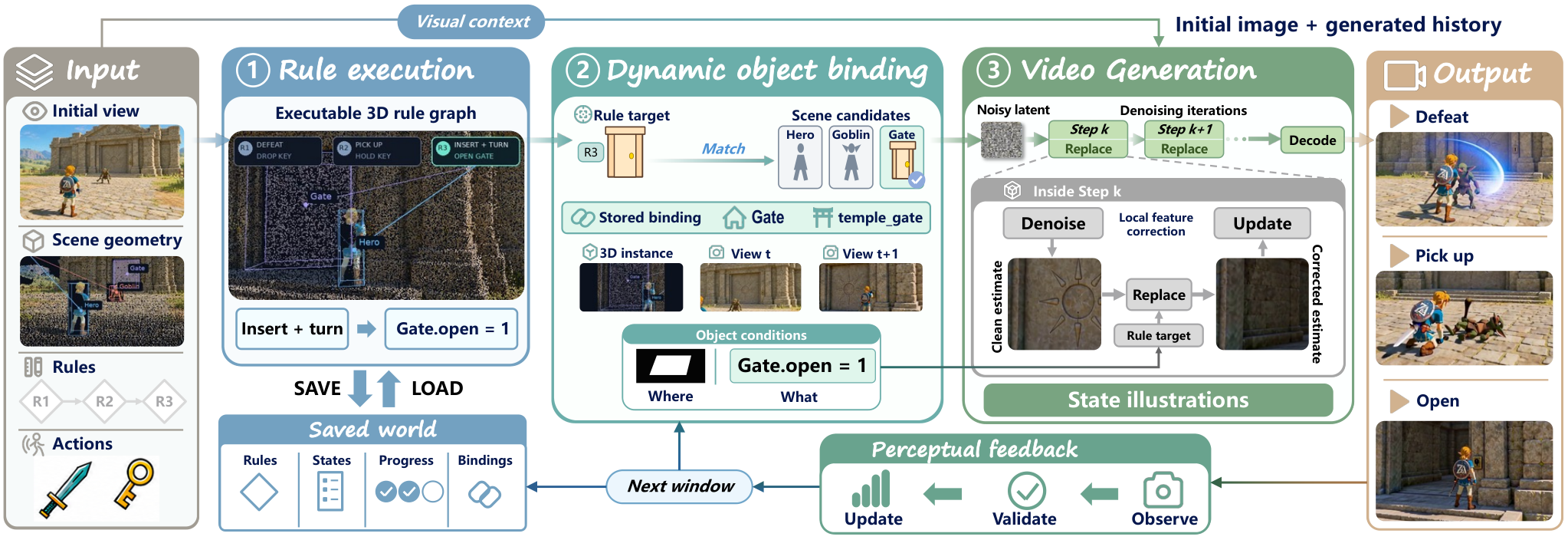
The proposed system puts rule definitions, dependencies and object states in an executable 3D rule graph. Video generation and perceptual feedback form a loop around it. Dynamic object binding connects symbolic objects with visual instances; attribute-state replacement translates rule outcomes into targeted visible changes.
The paper distinguishes preserving a rule-state relationship from making its consequences appear on the right object. A system can remember that an event should occur yet render it incorrectly, or produce an attractive frame while losing the state that should govern later actions.
The dataset is part of the proposed evidence
The authors describe RuleVerse, collected using GTA-V and Habitat, with state and event annotations for rule-driven interactions. Some cases test effects that occur before the affected object becomes visible. Those scenarios probe continuity beyond the immediate frame.
The authors report benefits for rule consistency and targeted visual changes under their evaluation. We have not reproduced those experiments, and the public release checklist limits what a reader can presently inspect or run.
Availability and licensing need separate checks
The linked WorldRuler Hub repository contains a README and attributes file, with no checkpoint files listed at review. Its Apache-2.0 metadata is not a delivery of weights. The GitHub landing repository has no license file in the reviewed listing. The paper's CC BY 4.0 terms apply to the credited figure used here; they do not establish terms for every future code or data artifact.
Our analysis: a world model needs more than visual continuity
Explicit state gives a developer something to inspect when a scene evolves incorrectly. It can also make saving and replaying a scenario more meaningful than asking a generator to remember everything implicitly. That is a promising engineering direction, rather than evidence that this research replaces a game engine today.
Readers can inspect the project profile and the authors' official demonstrations. No cloud service, game package or model was installed for this review.
Official project demonstration
Source-hosted publisher demonstration, not our independent test. Open the official video.
EXPLORE THE SOURCE
Projects in this story
GitHub repositories
- AlayaLab/WorldRuler ↗View project details
Original primary-source reporting and labelled editorial analysis. No installation, model download, inference, exploit attempt, upstream test suite or independent benchmark performed.