Bolna is now presenting Syl as its own speech-recognition model for brief replies on phone calls, especially the short affirmations and refusals that keep a conversation moving. The product page, checked November 20, describes the service as live and directs interested teams to a demonstration or sales contact.
This follows the company’s November 16 announcement that it planned to introduce in-house speech models at its November 20 Symphony event in Bengaluru. That earlier announcement established a launch plan; the current product page supplies the Syl name and availability claim.
A small response can carry the whole decision
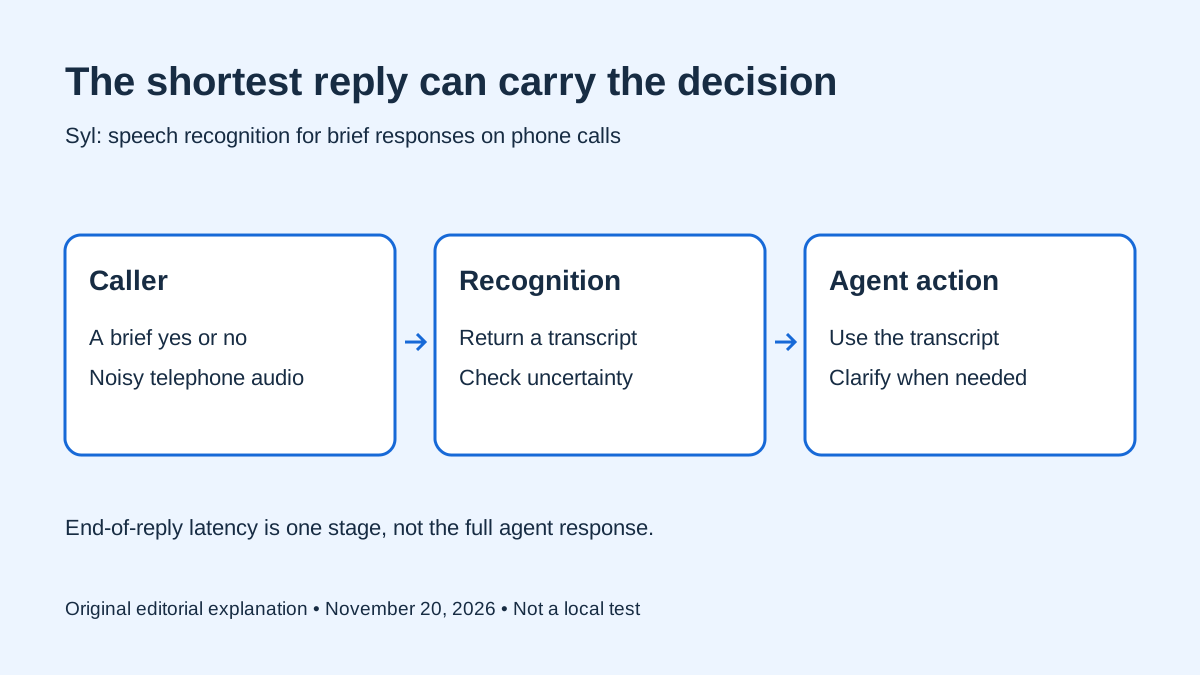
The intended setting is narrow-band, 8 kHz telephone audio, including Hindi-English switching and background noise. Bolna says its model handles 93 percent of one-word yes-or-no responses correctly on held-out production calls. It reports a median 250 milliseconds from the end of a reply to the transcript.
Those figures describe different things. Recognition accuracy concerns what was understood; the delay starts after the caller finishes. It is not the time for a complete agent response, which can involve other processing and speech generation.
Our analysis: measure the conversation, not just a transcript
A missed affirmation can cause an unnecessary question. A mistaken affirmation can be more consequential if an application treats it as permission to proceed. The useful test therefore includes the action taken after recognition, rather than stopping at whether some text appeared.
Bolna also reports fewer requests for repetition and fewer caller repeats in a production-agent comparison. These are useful operational questions to ask, but the product page does not provide enough experimental detail for us to reproduce a comparison. We have not independently verified its results.
Teams evaluating this category should separate recognition mistakes from turn-detection mistakes and downstream decision errors. They should also examine quiet and noisy calls, very short refusals, language changes and cases where the system should ask for clarification. A single overall score can hide different costs for those errors.
What the announcement does not establish
The reviewed Syl page does not establish downloadable weights, an open model license or hardware requirements for local inference. Bolna’s broader platform has self-hosting options, but that does not prove Syl itself is supplied as a local checkpoint.
Nor does a broad claim of lower cost identify an independently comparable workload or public per-minute tariff. We have not placed a call, opened a customer account or tested the service. For now, Syl is a focused hosted-product development worth evaluating, with its evidence and access limits kept visible.
Primary-source review and original editorial analysis. No software installation, model inference, API call, security validation or independent benchmark performed.