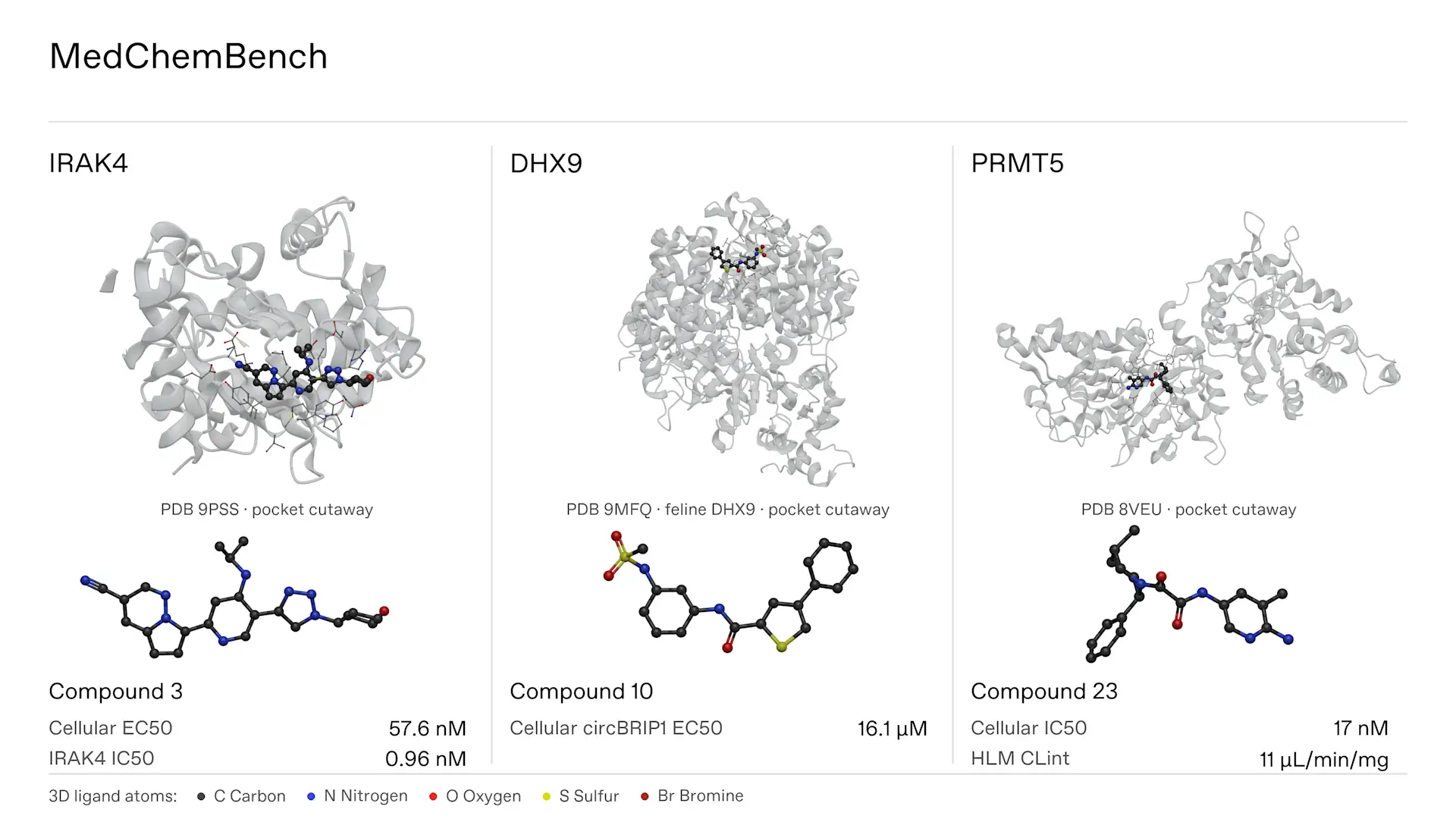

OpenAI introduced MedChemBench in a November 20 announcement, describing a test of how models connect molecular structures with experimental evidence. The accompanying paper is dated November 9. The announcement and paper dates should not be treated as two separate model releases.
The announcement reports that GPT-6.2 Astra earned 84.5 percent of the available credit at xhigh reasoning effort. That is a publisher result on this evaluation. It is not the proportion of drug candidates proven useful, nor a claim that we reproduced the score.
What the questions ask
The paper describes 99 retrospective problems built from published research and patents. A model receives a scientific situation, molecular information and experimental evidence, then answers questions about structures, explanations, compound choices or properties. Later findings in the source material help define the reference answers.
Some grading is deterministic, including comparison of molecular representations. Scientific rationale also uses a model-based judge. A combined score therefore summarizes several kinds of evidence rather than one interchangeable measure of chemistry skill.
Our analysis: reconstructing a molecule is a prerequisite
If an answer identifies the wrong molecule, a plausible explanation of its behavior can be beside the point. Separating structural interpretation from later reasoning makes that failure easier to see. It also helps readers avoid treating fluent scientific language as sufficient evidence of a correct result.
The same distinction matters when choosing a compound. A system might interpret a diagram correctly yet still make a weak prediction about a property not supplied in the question. Evaluating those stages separately gives researchers a more useful diagnosis than a single headline percentage.
For a prospective application, the next question would be whether these abilities improve decisions on genuinely new cases under realistic constraints. That requires a different study design, including an appropriate comparison and independently checked outcomes. It cannot be inferred just by relabeling retrospective benchmark credit as laboratory productivity.
Keep the limits attached to the result
The authors acknowledge possible prior exposure to published sources, the limitations of historical reference answers and a single-turn protocol that does not test recovery through new evidence or iterative work. They call for prospective validation and further expert assessment.
The older paper’s reported results and the later announcement’s additional model score also need their own dates and settings. Comparing numbers without those details can manufacture an apparent contradiction or an improvement that the underlying evaluations do not establish.
We reviewed the announcement and paper. We did not rerun the benchmark, inspect a newly released evaluation repository, conduct an experiment or verify a new treatment. The useful development is a more explicit account of how medicinal-chemistry reasoning is being assessed.
Primary-source review and original editorial analysis. No software installation, model inference, API call, security validation or independent benchmark performed.