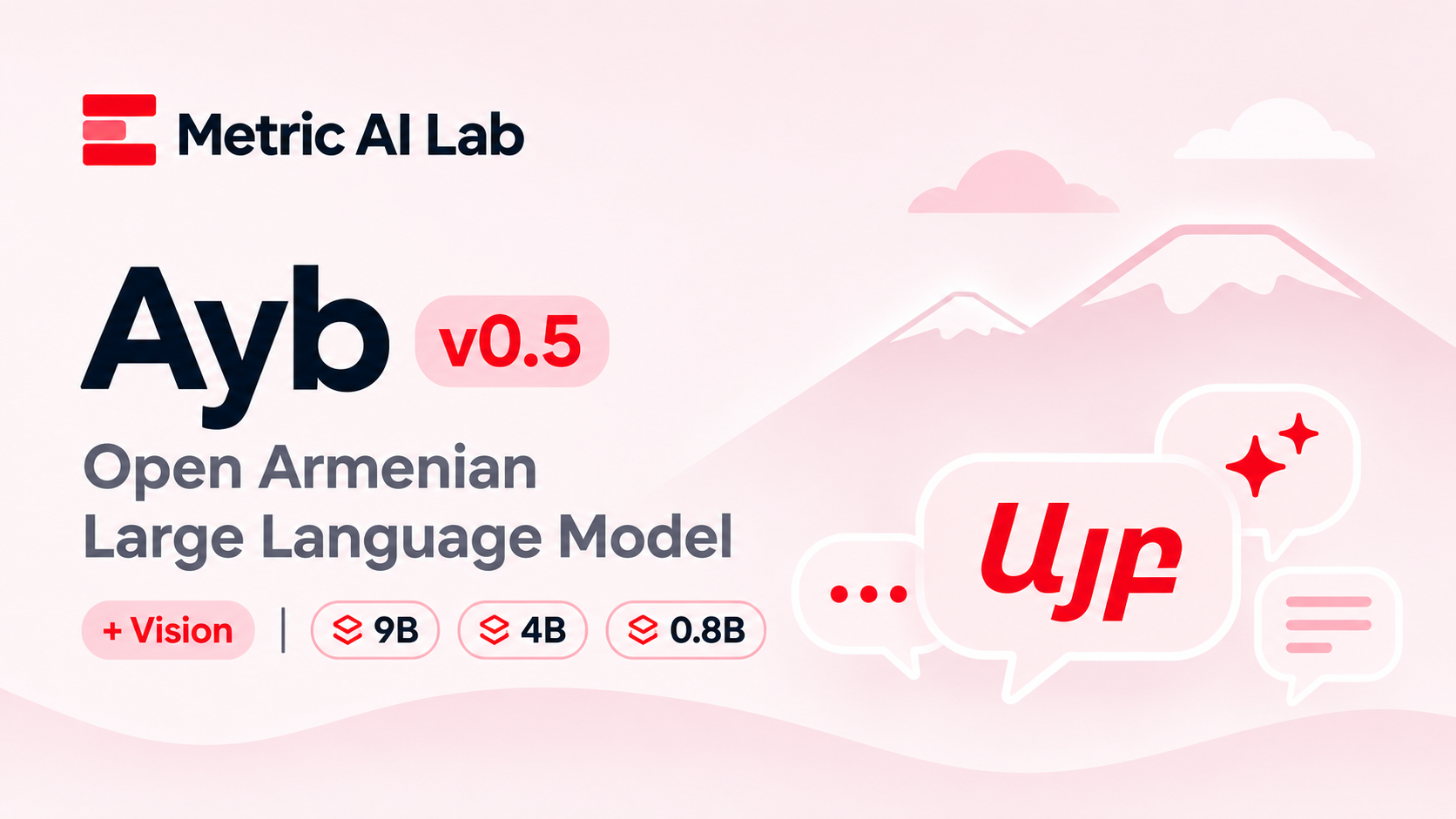

Metric AI Lab has announced Ayb 0.5, a family of Armenian-language adaptations built on Qwen3.5. The November 20 publisher report introduces models marketed as 0.8B, 4B and 9B, developed through Armenian tokenizer expansion, continued pretraining, instruction tuning and post-training.
This is adaptation work on an existing model family, not a new Qwen foundation-model launch. The team says it trained the language component on Armenian and English text while leaving the vision encoder and its projector unchanged.
The public metadata changes how to describe access
The announcement repeatedly uses open-source language. However, the exact repositories’ public metadata declares cc-by-nc-4.0 and a manual access gate. Those conditions should remain visible rather than being replaced by an assumption of unrestricted commercial use.
Our profiles cover Metric-AI/Ayb-0.5-0.8B, Metric-AI/Ayb-0.5-4B and Metric-AI/Ayb-0.5-9B. We read the accessible announcement and API metadata. Protected model cards and history were not accessible anonymously; we did not request access, read gated license files or download weights.
Our analysis: adaptation deserves language-specific scrutiny
A multilingual model’s overall reputation does not settle its usefulness in one language. Tokenization, language variants, factual coverage and instruction following can all affect practical results. A regional adaptation is therefore worth examining on its own stated goals.
Tokenizer changes are especially relevant to that examination. They change how a language is represented to the model, so inherited assumptions about token budgets or throughput should be checked rather than copied from the base family. We have not measured either for Ayb.
The publisher evaluates Armenian tasks in a zero-shot setup and says thinking mode was disabled. That configuration matters when comparing its results with models evaluated using additional reasoning effort. The reported rankings remain the team’s evaluation, not our independent endorsement.
The limits are part of the release
Metric AI says training predominantly covers Eastern Armenian, with weaker reliability for Western Armenian, regional dialects and Latin-script Armenian. It also identifies uneven recent-event knowledge and weaknesses in complex reasoning and preference tuning.
These qualifications suggest useful follow-up questions: which variety of Armenian will an application receive, how will factual mistakes be detected, and what permissions apply to the exact checkpoint? A small marketing size alone answers none of those questions.
The models’ metadata identifies Transformers as the library; our existing implementation profile links that project. This is not a claim that its current release can run every Ayb artifact without further configuration. No local compatibility or hardware-fit test was performed.
Primary-source review and original editorial analysis. No software installation, model inference, API call, security validation or independent benchmark performed.