CARE-3D, a preprint from the University of Queensland, studies a familiar failure in a more spatial setting: an agent can retrieve evidence and still answer largely from its prior expectations. The paper was submitted November 23 UTC, or November 22 in California. Its public training and evaluation code makes this a research workflow readers can inspect, rather than evidence of a deployed robot.
Xiaoqian Hu and coauthors focus on situated 3D question answering. A query depends on an observer's position and orientation, so a plausible association between objects can be wrong for the actual scene.
Reward the returned evidence, not just the answer
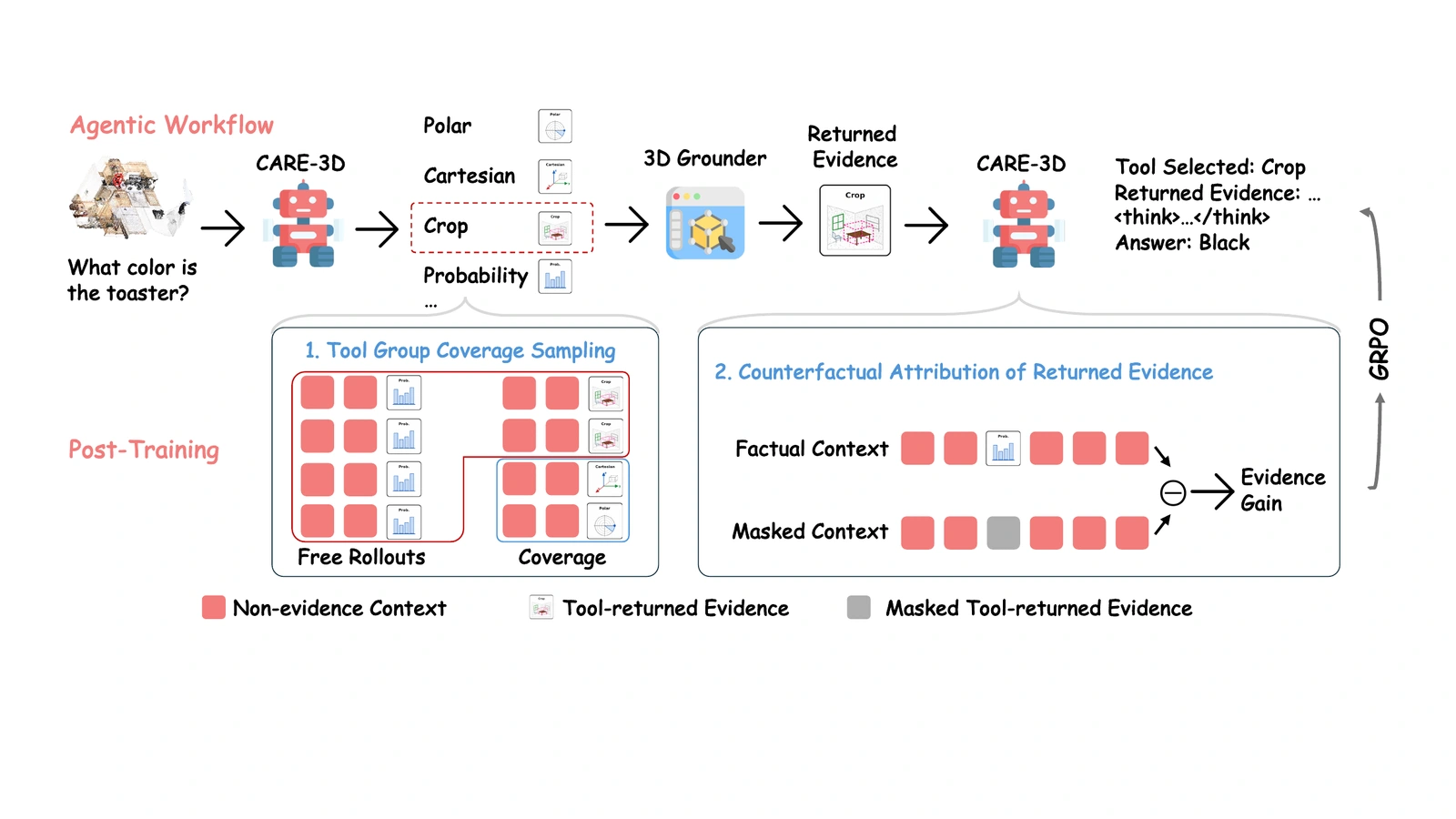
The workflow first generates a grounding request, obtains the selected tool's scene evidence, then produces reasoning and an answer. During supervised training, the agent and grounding components learn the interaction protocol. Reinforcement post-training freezes the grounding module and vision-language backbone and updates the agent's LoRA adapters.
Counterfactual Attribution of Returned Evidence compares the likelihood of the reference answer with the returned evidence present and with that evidence masked. The resulting signal is intended to reward evidence that supports the answer, rather than crediting a correct answer regardless of how it was reached.
This is a training-time intervention on supplied evidence. It is not independent proof that every highlighted object is correct or that the resulting answer will remain reliable in a new physical environment. The authors acknowledge that masking can create distribution shift and that likelihood depends partly on answer wording.
Keep alternative tools in the training comparison
Group Coverage Sampling supplements freely sampled rollouts with coverage rollouts for underrepresented grounding tools. The supplied tool identifier and returned evidence are masked from the policy loss; generated queries and answers remain part of learning. Coverage sampling is disabled at evaluation time.
The point is to prevent an infrequently selected tool from disappearing before its evidence can be compared. The released selection helper prioritizes tools with zero counts and uses inverse-frequency sampling among remaining choices, so the code should not be reduced to a universal deterministic ranking of tools.
What the reported scores establish
The paper reports improvements on MSQA and Beacon3D over corresponding supervised and answer-plus-format baselines. Evaluation uses a model-based GPT-Score protocol; Beacon3D distinguishes per-question scoring from a stricter object-level measure requiring all questions for an object to be correct. Those are research benchmark results, not a rate of safe robot operation.
The system currently makes one grounding action per question. It does not demonstrate iterative query repair or general multi-tool planning. The documented training setup uses two H100 80GB GPUs, which does not establish a consumer-GPU training or inference requirement.
Our analysis
The useful contribution is making evidence acquisition and evidence use separate things to evaluate. Asking for a scene crop is not enough if the answer would be unchanged without it. The proposed reward creates a way to investigate that gap, while leaving the grounding system, judge and counterfactual design open to scrutiny.
Our repository profile links the Apache 2.0 code. The README identifies SceneCOT data as CC BY-NC 4.0, and external model terms remain separate. We did not establish a separately downloadable trained CARE-3D adapter from the examined release materials. We reviewed source and methodology without training a model, downloading datasets or running the evaluations.
Original primary-source review. No model weights/data downloaded, upstream tests or workflows run, clients installed, servers/credentials changed or benchmark independently reproduced.