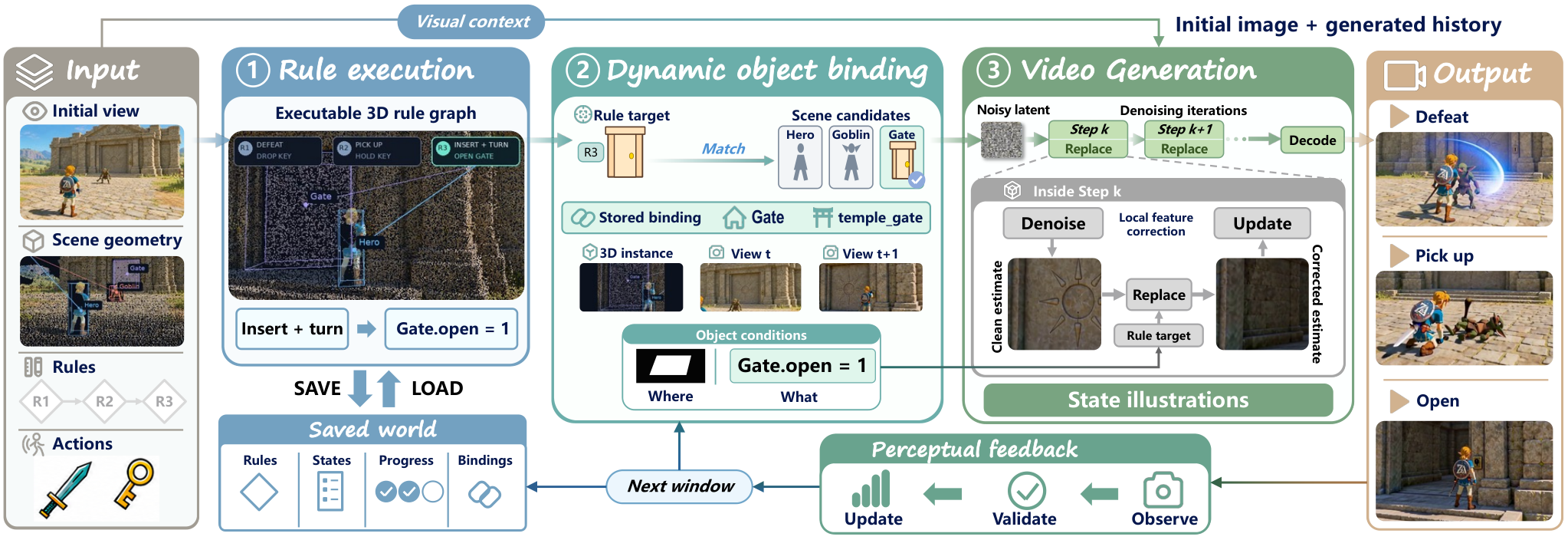

Researchers from Inclusion AI, Westlake University and Zhejiang University have released Code World Model 2.0 inference code for Invoker-Render, a video renderer controlled by a separate representation of a scene. The public repository's initial commit is dated November 20 UTC. The paper was first submitted November 17 and revised November 18; these are different milestones.
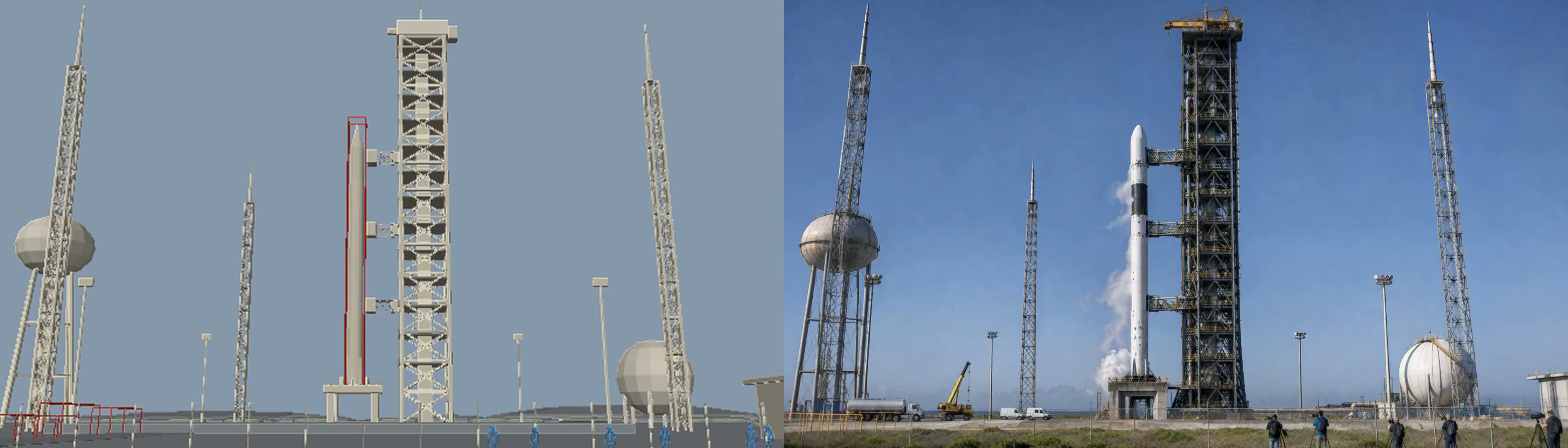
The central separation is straightforward: an upstream engine keeps the world state, while a video model supplies appearance. Structural proxies describe camera movement, layout and object motion. A reference image and text help guide the rendering. This does not mean the generated video itself is a reliable physics simulator.
Streaming control, with a demanding published setup
The released causal model renders in four denoising steps per chunk, retaining a bounded recent history and an appearance anchor. The paper studies several levels of proxy detail, from coarse layouts to more explicit geometry. Its long racing example is a publisher demonstration; it is not independent evidence of unlimited consistency.
The exact model card lists 33.12 billion parameters in FP32, approximately 132.5 GB across 29 shards. The default production configuration uses eight NVIDIA GPUs on one node. Additional matching assets are needed to prepare an inference bundle.
Those specifications matter more than a smooth promotional clip when judging local usability. The documented 24 FPS input timeline is not a claim that an ordinary workstation generates 24 frames per second. We have not downloaded or run this model.
What has and has not been released
The repository provides a session service, file client and browser client. Training code and data are not completed release items in its checklist, although the paper describes the training approach. The checkpoint repository also distinguishes the main causal weights from a separate bidirectional-teacher LoRA; they should not be treated as interchangeable artifacts.
Original repository code is Apache-2.0, but bundled components retain their own licenses, including non-commercial terms for RAVEN. The model card declares combined Apache-2.0 and CC BY-NC 4.0 terms. This is not an unrestricted commercial package simply because the top-level code uses Apache. Third-party game resources shown in demonstrations are not all included in the release.
Our analysis: control can be useful without replacing the engine
The interesting design choice is the interface between an explicit scene and generated imagery. It leaves a place to edit a camera path or trajectory without asking a video model to infer every part of the world from a prompt. That could make errors easier to locate, although it does not establish production readiness.
Readers can inspect our model profile and repository profile, then compare the authors' official demonstrations with the deployment contract. The image here is a credited publisher-generated example, not a real launch photograph or our own benchmark.
EXPLORE THE SOURCE
Projects in this story
GitHub repositories
- inclusionAI/CodeWorldModel ↗View project details
Original primary-source reporting and editorial analysis. No deployment, model download, inference, paid service call or independent performance test performed.