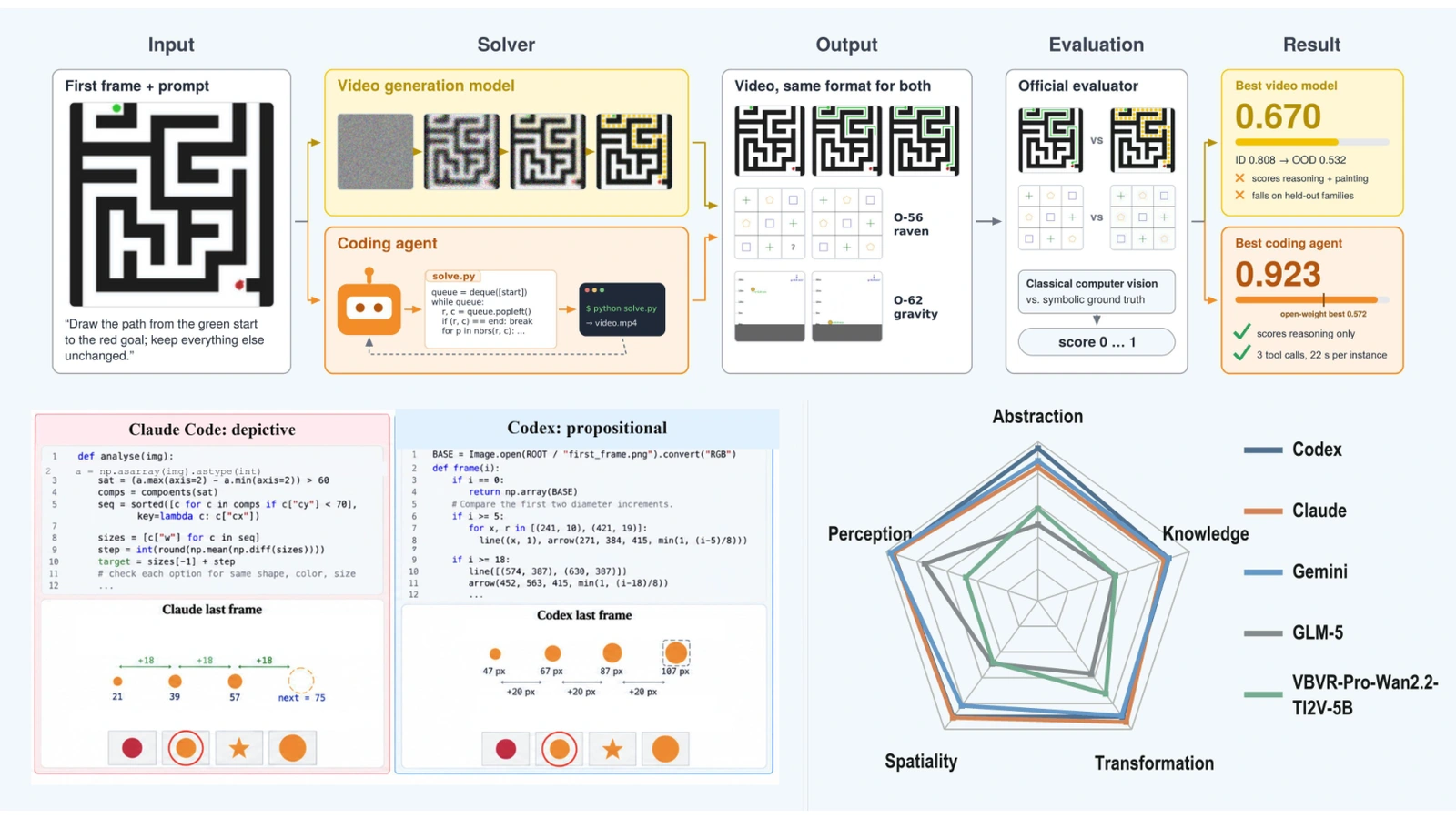
Solve Vision with Code, a preprint submitted November 25, asks whether generating a video is the most reliable way to solve a visual task. Instead, its coding agents inspect the same first frame and prompt, write a program and render the requested answer video.
On the study's 500 VBVR-Pro-Bench instances, the authors report mean scores of 0.923 for Codex with GPT-6-Astra, 0.894 for Claude Code with Fable 5.1 and 0.893 for Gemini CLI with Gemini 3.1 Pro. These are average evaluator scores, not a claim that exactly those percentages of tasks were solved perfectly.
The output is visual; the route need not be
The experiment keeps the first frame, natural-language task and final video specification aligned with the video-model benchmark. Coding agents receive an unprivileged CPU-only Python container with imaging libraries, fonts and a 30-minute wall-clock budget. They can inspect and revise their programs within one attempt.
The protocol forbids generative image and video models, and the authors say they audited event logs and retained programs for compliance. Network access remains available for model calls and package installation; this should not be described as an entirely offline experiment. A missing final video receives zero.
The rule-based evaluator uses symbolic ground truth with computer vision and OCR. This rewards producing the specified measurable behavior. It is not a test of open-ended cinematic realism, natural motion in every scene or general physical understanding.
Delivery failures are part of the ranking
The study also runs open-weight models through OpenCode. Of 24 selected models, one lacks supported tool calling in the chosen Bedrock interface, leaving 23 scored models. GLM-5 is the strongest of that group at 0.572; several lower-ranked systems frequently fail to produce a video at all.
That distinction matters. The final score combines whether a tool-driven system delivers an artifact with how well that artifact performs. An unsupported interface or a model responding only in prose is not equivalent to a successfully rendered video with incorrect visual reasoning.
The video-model rows come from the published VBVR-Pro leaderboard; the authors did not rerun those models. The strongest reported video entry scores 0.670. The shared evaluator helps comparison, but it does not make the historical video runs identical to the coding-agent execution environment and budget.
What the result supports
Our analysis: the practical lesson is to consider a computable representation before asking a generative model to invent every frame. For tasks defined by geometry, counts or transformations, an inspected program can provide a direct path to the required artifact. That does not establish that coding agents dominate all visual tasks.
The paper also distinguishes programs that recover and measure information from the image at runtime from programs that simply render an answer the agent already decided. Both can score well, while implying different things about where reasoning occurred.
Readers can inspect our existing Codex, Gemini CLI and OpenCode profiles. The paper is CC BY 4.0; agent software and models retain separate terms. We reviewed the methods, scoring and failure analysis without running the benchmark or downloading model weights.
Original independent source review; no upstream tests, training, inference, benchmarks, model weights, datasets or software installs performed. Publisher results are not our measurements.