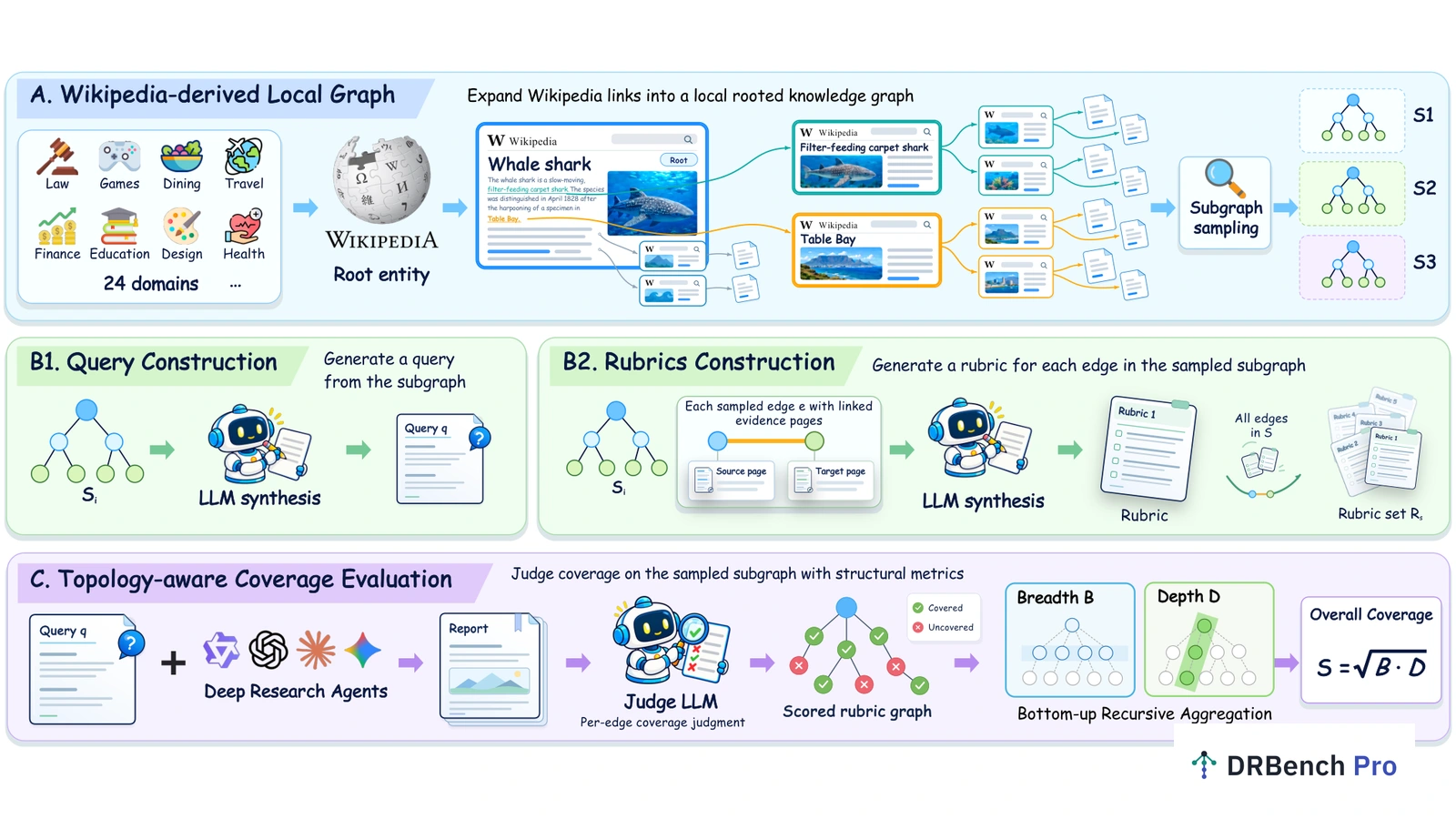

DRBench Pro, submitted November 25 by researchers affiliated with Zhejiang University and Tencent, proposes a more structured way to judge deep-research reports. Rather than asking only whether a report sounds useful, it measures which research directions the report covers and how far it follows related chains of knowledge.
The authors evaluate 16 agents across 144 cases in 24 domains, using 44,102 rubrics. Their highest reported overall coverage is 57.04%. That number is a score under this benchmark's reference structure, not a statement that the best system knows only that fraction of the world, or that the rest of its prose is false.
A knowledge tree makes omissions visible
The paper's construction pipeline starts with Wikipedia-derived entity trees. Sampled subgraphs provide the research scope, from which the system creates both a user-facing query and relation-based rubrics. The evaluated agent sees the query, while the reference tree remains part of the evaluation.
Breadth rewards coverage across major directions; depth measures related knowledge chains and their continuity. The overall score combines those dimensions geometrically. This prevents a report that mentions many disconnected topics from automatically looking equivalent to one that develops a smaller number of connected explanations.
The reports predate the paper
Appendix G is essential context. The specialized deep-research reports were collected July 21–24; the native-search and common-framework model reports were collected August 12–14. These are 2026 collection windows, not November measurements of every provider's latest product.
The study also mixes different operating arrangements: end-to-end research products, models using native web search, and models placed inside a fixed local research framework. That last framework uses a July 1 English Wikipedia snapshot and a common workflow. It helps control retrieval conditions, but does not make every row an identical live-web deployment.
Coverage still needs judgment
The authors use Gemini 2.5 Pro to judge rubric satisfaction, with human agreement checks and metric-sensitivity analysis. Their report-level expert comparison covers 72 reports, while a separate rubric-level check covers 3,695 judgments. These checks support the proposed measurement; they do not eliminate reference selection or judge-model effects.
A small reconstruction experiment changes the benchmark-construction model and narrows Claude's relative advantage. That is a useful warning against treating a generated reference space as a neutral inventory of every valid answer. Wikipedia coverage, selected roots, report length and research budgets all shape the question being measured.
Our analysis: this is a productive evaluation direction because a polished report can still miss an important branch of the problem. Readers should use coverage alongside factual checking, citation quality and relevance to the actual assignment. None of those responsibilities disappears when an aggregate score improves.
The repository profile links the MIT-licensed evaluation code and its documentation. The paper is CC BY 4.0; dataset and third-party source terms require separate review. We read the paper, methods, collection windows and repository documentation without downloading the benchmark data or executing the framework. This is research coverage, not a new model-checkpoint release.
Original source review; no upstream tests, inference, training, benchmarks, installs, model weights or datasets downloaded. Research methods are not asserted to be newly available checkpoints.