EgoCaptioner, a report submitted November 19, studies how to describe first-person video with more useful detail and timing. Its project repository links public code and the exact adapted model weights.
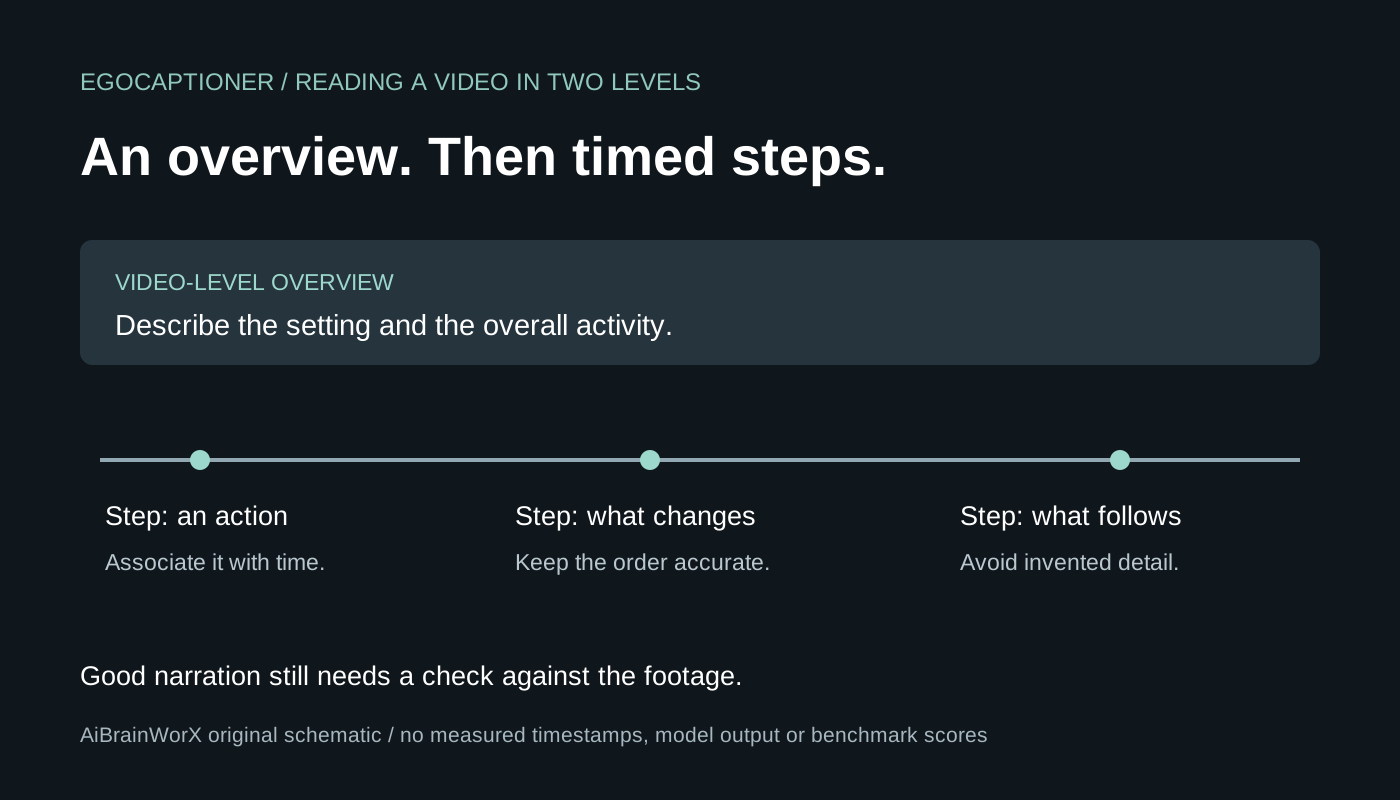
This is a fine-tune of Qwen3.5-9B, not a new independently pretrained foundation model. The project combines a video-level overview with timestamped steps intended to describe how the activity unfolds.
What a good caption needs beyond a fluent sentence
In first-person footage, a short action can change the meaning of everything that follows. A narration that misses an object being moved, reverses two steps or invents an interaction may remain plausible to read while becoming less useful for retrieval or analysis.
The paper describes coarse-to-fine annotation and reinforcement-learning rewards for factual content, temporal alignment and caption style. Its training collection includes 50,000 examples drawn from eight sources. The authors report gains across five evaluated benchmarks; those results concern their selected tasks and protocols rather than universal video understanding.
Overview, full caption or a named event
The usage guide exposes whole-video narration, a shorter overview and event-conditioned steps. A user can name an event to locate and describe, with extra context suggested when the activity occurs more than once.
That design makes the requested level of detail explicit. It does not guarantee that every event is found, that all timestamps are precise or that a caption distinguishes uncertainty correctly. The output still needs comparison with the source footage for consequential use.
Availability and hardware are separate questions
The model card identifies the base-model relationship and Apache-2.0 terms; we also read the published license files. Hub metadata counts approximately 9.41B BF16 parameters. The project documents Linux, a suitable NVIDIA GPU and additional CUDA build requirements for its single-video examples, with a separate batch-inference path.
Those requirements are not a verified memory-fit promise for an ordinary desktop GPU. We have added a model profile and repository profile so readers can review the exact artifact and setup before deciding whether to test it.
Our analysis: an index into footage is not the footage itself
Timed descriptions can make long recordings easier to search. They can also make an error look more authoritative by attaching a precise-looking time to it. A useful interface should preserve a way to open the relevant interval and inspect what was actually visible.
The public research package makes that kind of inspection more practical. It does not establish reliable memory of a person's day, a safety-qualified robot perception system or dependable evidence for an incident. We reviewed the paper and source materials without processing a video, downloading weights or reproducing the benchmarks.
EXPLORE THE SOURCE
Projects in this story
GitHub repositories
- cactusqq/EgoCaptioner ↗View project details
Original primary-source reporting and editorial analysis. No software installation, model download, inference, paid service call or independent benchmark/security test performed.