
ElevenLabs has added a beta Content Provenance API that checks uploaded audio for the company's own embedded watermark. Announced in its November 17 changelog, the endpoint can also return limited generation metadata when a record can be recovered. It is a provider-specific watermark reader, not a universal AI-audio detector.
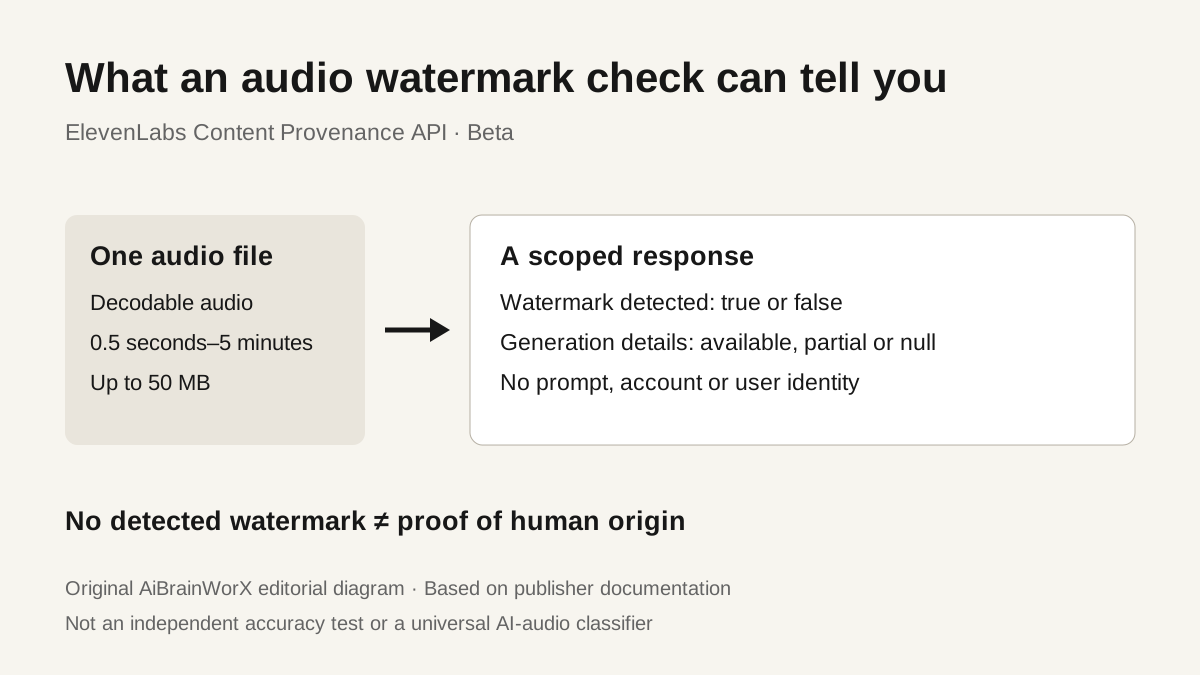
The dated announcement and detailed documentation describe a detected flag and an optional details object. Recoverable fields include the product, model, generation time and a unique generation identifier. The prompt and the identity of the user or account are not returned.
Detection and identification are separate outcomes
A detected watermark does not guarantee that all metadata can be recovered. The documentation notes that short or heavily changed audio may prevent that recovery; individual metadata fields can also be null. A client should distinguish “watermark detected,” “generation details available” and an unsuccessful request instead of presenting them as one confidence score.
A negative flag means the decoder did not recognize an ElevenLabs watermark in that file. It does not establish that the audio was recorded by a human, that another generator was not used, or that the surrounding claim about the recording is true. We have not submitted audio or independently measured false positives, false negatives or robustness to editing.
The beta has practical boundaries
The documented endpoint accepts one decodable audio file per request, up to 50 MB and between half a second and five minutes after decoding. It requires an API key with the watermark permission; OAuth tokens are not accepted. The stated limit is twenty-five checks per API-key user in twenty-four hours.
Those details matter for a newsroom or a moderation queue. A rate-limited or invalid upload is an operational failure, not a clean authenticity result. A system should preserve the original evidence and record which decoder version and response it received. The documentation currently supports only the latest decoder selection.
Useful provenance is narrower than a truth label
Our analysis: the value of a watermark interface is that it can provide a concrete, scoped observation about a file. That becomes less useful if an application turns it into an unsupported binary label such as “real” or “fake.” Origin, editing history, speaker identity and the truth of what was said are different questions.
A generation identifier may help organize an investigation, but it does not identify the person responsible, establish consent or resolve the context of distribution. Keeping the provider's claim separate from an editorial conclusion is especially important for consequential allegations.
The beta is therefore a potentially useful provenance input with explicit limits. It should sit alongside source verification and human review. Its availability does not establish an open-weight model release or prove that an automated moderation workflow can make the final decision safely.
Original reporting from primary-source and implementation review, with clearly labeled editorial analysis. No model inference, API submission, vehicle test, software installation or independent benchmark was performed.