
Galaxea's G0.7 technical report, submitted November 24, describes a world action model designed to remember longer visual histories while controlling a robot. Its important deployment idea is not simply generating a more detailed imagined video: a fast mode decodes actions without synthesizing that future video at each step.
The official model page presents the research and demonstrations. At our source check, those materials did not establish downloadable G0.7 weights or a reuse license for them. Earlier Galaxea releases are not evidence that the new checkpoint has the same availability or terms.
Remember the scene, then act
The report builds on video-generative training and jointly models video and actions. Its context can include up to five minutes of camera observations, combining the robot's own history with an optional demonstration. That is a description of the authors' system, not a measured guarantee of memory quality across arbitrary tasks.
The same checkpoint supports an imagine-then-act route and a direct Fast route. The latter decodes a 16-step action chunk without generating future video during deployment. This separates the value of video-derived representations during training from the cost of repeatedly rendering a prediction while operating.
The speed comparison needs its configuration
The authors report 60 milliseconds per action chunk for a deployed FP8 Fast configuration on one RTX 5090. In their unoptimized BF16 eager comparison, Fast takes 156 milliseconds and imagine-then-act takes 457 milliseconds.
Those are different comparison conditions. A headline comparing 60 with 457 milliseconds combines the action-path change with precision and runtime optimization; the matched BF16 figures isolate a narrower comparison. None is a benchmark we reproduced, and the GPU named in an experiment is not a verified minimum system requirement.
Progress is not the same as complete success
The report's zero-shot pick-and-place trials include 12 successes in 25 attempts on R1 Pro and 27 in 50 on R1 Lite, reported as 48% and 54%. These are specific small evaluations rather than general industrial reliability rates.
Similarly, the 86.9% mean task-progress figure in post-training evaluation should not be relabelled a full-task completion rate. Simulation scores, real-robot success and partial-progress metrics answer different questions. A useful assessment keeps their denominators and settings visible.
Our analysis
The compelling research direction is a practical separation of memory, prediction and control. Richer visual training may support action selection even when synthesizing every future frame is too costly. The open questions are how robust that advantage remains under unfamiliar conditions and what an independently reproducible deployment would require.
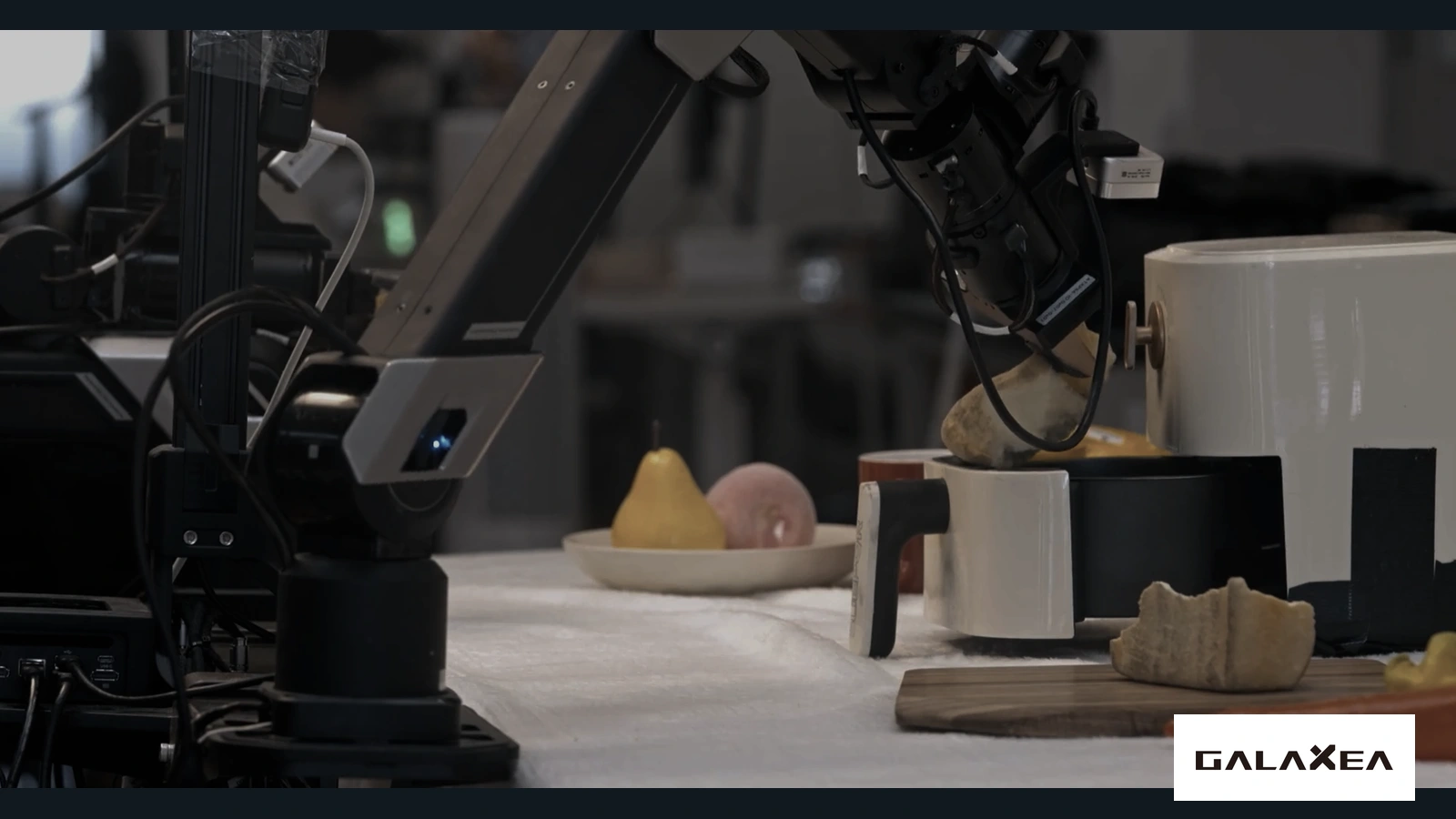
G0.7 is listed here in AI News and Model Watch as a report-stage model, not a downloadable open-weight release. We reviewed the paper and official materials without running a robot or downloading weights. The paper's CC BY-NC-SA terms do not establish a model-weight license; our image instead uses separately credited official product imagery.
Independent primary-source review. No upstream tests, inference, installations, weight downloads or hardware benchmarks performed. Publisher measurements are not independent validation.