A new robotics preprint, GEMS, combines generated intermediate goals with stored experience to help a visual world model plan over longer sequences. The study by Yangchen Zhao, Ali Payani and Caiwen Ding was submitted on November 18. It reports improvements on selected manipulation benchmarks without retraining the shared world model during planning.
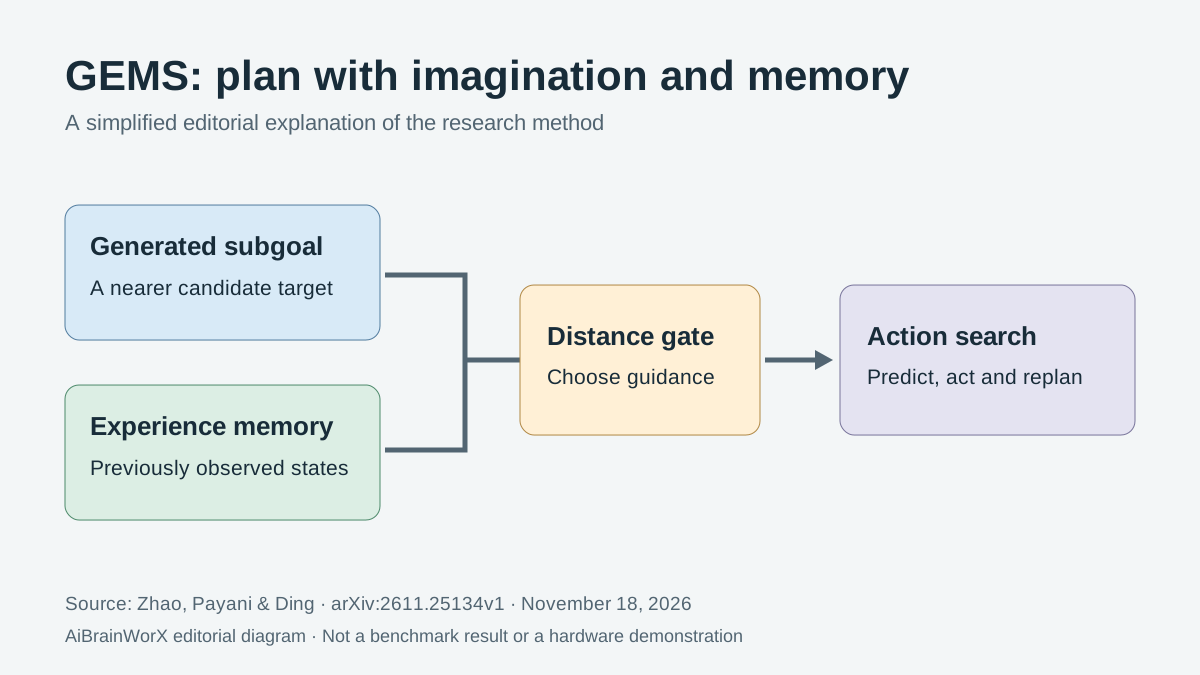
The full paper addresses two complementary weaknesses. Generated waypoints may depict inaccurate object positions or timing; stored observations are grounded in experience but cannot cover every useful future state. GEMS uses temporally structured subgoals, memory selection and a distance gate to decide which target should guide an action search.
A better intermediate target can change the search
Rather than repeatedly comparing a short prediction with a distant final image, the planner works toward a nearer representation. Experience memory can refine that target when suitable observations exist. This is a planning method around a world model, not a newly released general-purpose language-model checkpoint.
The experiments use six tasks or task suites spanning manipulation, navigation and reaching. The researchers describe episode-based data splits, success tests, step budgets and multiple planner seeds for most tasks. Those choices matter: a success percentage has little meaning without knowing how the goal was selected and how long the planner was allowed to try.
The difficult case remains difficult
The authors report 92.8 percent success on Cube, 68.4 percent on Push-T and 54.1 percent on the selected Meta-World tasks. On the harder Cube-double setting, the reported result is 17.7 percent. These are study results, not AiBrainWorX measurements, and they do not establish comparable reliability on a physical robot in an unfamiliar home.
The paper also flags a comparison involving released baseline weights trained on episodes overlapping its test episodes. Readers should retain that qualification when interpreting the table rather than treating every row as a perfectly matched, independently reproduced experiment.
Our analysis: the interesting idea is that generation and memory solve different parts of the same problem. Memory can constrain an imagined waypoint to something plausible, while generation can suggest progress beyond what the memory already contains. Neither source should be assumed sufficient on its own.
For deployment, the next questions are whether a system recognizes poor memory coverage, handles incorrect observations and preserves safety when its prediction is wrong. The reported benchmark gains motivate further testing; they do not remove those questions.
We reviewed the preprint and its methodology, without reproducing the experiments. No associated public implementation or standalone model download was verified in this review, so this article links the exact paper instead of inventing a repository or a one-click installation path.
Original primary-source review and clearly labeled editorial analysis. No local model evaluation, Mac automation, cloud training, software installation or independent benchmark was performed.