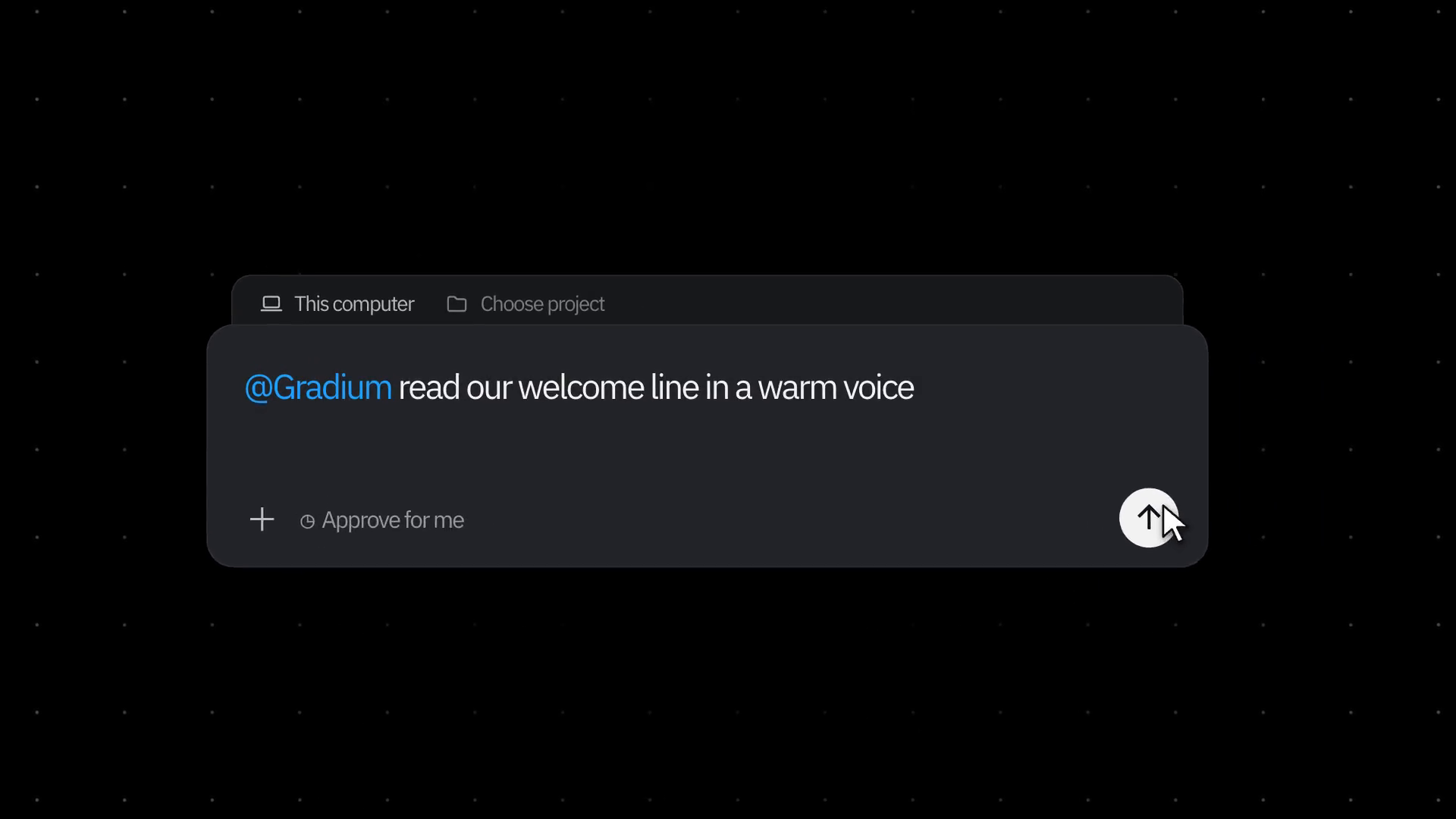

Gradium has released a beta MCP integration that lets a coding agent browse voices and generate speech through a Gradium account. Announced November 19, it brings a hosted voice workflow into the same agent session used to build an application.
Sign-in uses OAuth rather than an API key supplied to the agent. That simplifies one part of setup; it does not make the service unauthenticated, turn it into a local model or remove usage charges.
Voice browsing and voice auditioning have different costs
The announcement lists voice discovery, voice details and credit checks as free tools. Speech generation consumes one credit per character. An audition that actually generates audio therefore uses credits too.
Our analysis is that this distinction should appear before an agent starts comparing many takes. Searching a catalog and listening to newly generated candidates can feel like one action in a conversational interface, while having quite different billing consequences. A useful workflow makes that boundary explicit and keeps the selected script, voice and resulting files easy to inspect.
Long input is not a promise of equally long output
The published limits allow up to 9,000 input characters per call but describe an output ceiling of about two minutes and 55 seconds. The announcement discusses splitting longer scripts through its Claude Code speech skill; readers should not assume every client automatically handles segmentation and joining.
A narration workflow needs to know which text actually reached the output file. A technically valid audio response is not enough if a paragraph was omitted or a section ended early. Reviewing the script against the resulting segments is a separate task from judging whether the voice sounds natural.
The beta's boundaries matter
This MCP beta covers text-to-speech and voice selection. Speech recognition and voice design are described as possible next additions, not current MCP capabilities. The official integration guide is the appropriate place to check the current tool contract.
Gradium also publishes MIT-licensed agent skills. Their code license is separate from access to the hosted voice service, account credits and any terms governing a selected voice.
Official launch demonstration
We reviewed the documentation and publisher demonstration without connecting an account, generating speech or measuring latency, pronunciation quality or task completion. Our view is that making voice tools accessible to an agent is useful only when their account, cost and output boundaries stay equally understandable.
Primary-source reporting with original editorial analysis. No software installation, paid API call, local inference, deployment or independent performance/security test performed.