
The ERNIE research team has published HiUni code and model weights for a system combining image understanding, generation, editing and text chat. Its technical report was submitted November 19; the Hub repository is dated November 20. Repository creation is not, by itself, proof of the exact first public-release time.
The architectural idea is extensive sharing: the same visual encoder and dense backbone serve understanding and image synthesis, with task-specific work concentrated at the output. The project is initialized from Qwen3-VL-4B-Instruct rather than presented as an independently pretrained foundation model.
Shared semantics do not preserve every pixel detail
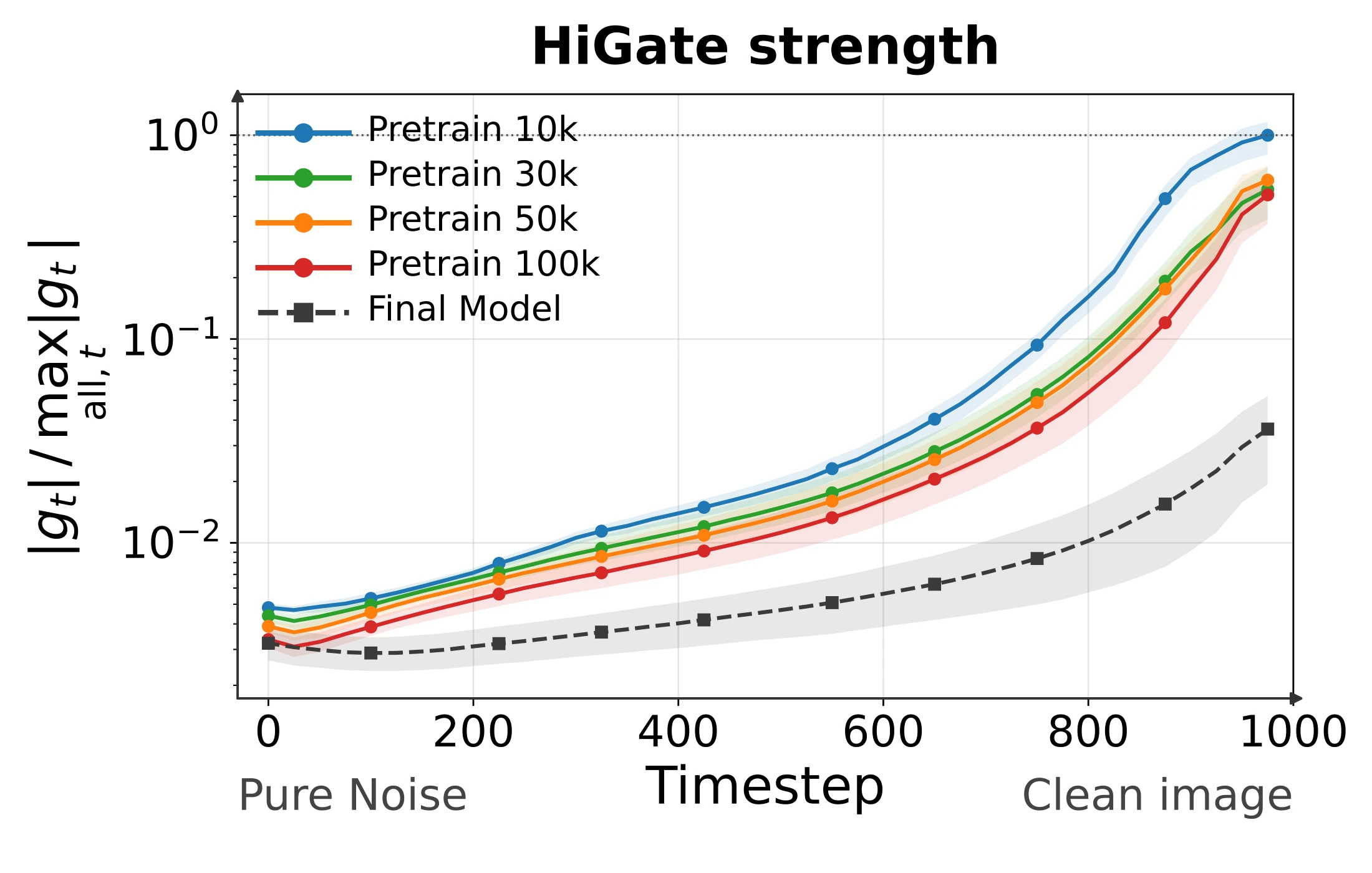
The paper identifies a tension between compressed representations useful for understanding and fine spatial information needed to generate an image. Its Pixel Diffusion Head produces images directly in RGB space. A lightweight pathway called HiGate supplies local detail near the output stage.
The authors report competitive image results while retaining similar average understanding performance to their starting model. These are their evaluations under the paper's settings, not a finding that we reproduced. The credited plot shows an internal HiGate analysis, not a universal ranking against image generators.
What is available, and what the size numbers mean
The card describes a 4B backbone and 0.9B generation-specific modules. The Hub's total tensor count is approximately 5.4B; a component breakdown should not be mistaken for a complete checkpoint accounting. Primary and Base checkpoints are offered, with the Base described as trained without synthetic data.
The plain-PyTorch inference guide separates inference from the Megatron training environment. The root README estimates about 13 GB for text-to-image at 2048-square resolution. That is publisher guidance, not a tested fit on a 12 GB card; task, resolution and runtime overhead still matter. Loading the published format also involves custom modeling code.
Licensing is a decision point, not a footnote
At this review, the Hub metadata has no license declaration and no standalone license file appeared in its file list. The GitHub repository's license metadata is also unset; the expected root LICENSE path was unavailable. We therefore do not describe this release as permissively licensed open source or assume commercial reuse is authorized.
Being based on another model does not automatically settle permissions for a derivative release. That unresolved boundary belongs beside the download link and hardware requirements, not hidden behind an optimistic label.
Our analysis: a useful research direction with an incomplete adoption story
Sharing more computation could simplify a multimodal system's design. Practical adoption still depends on output quality across tasks, reproducible resource measurements and clear artifact rights. A publicly readable checkpoint addresses only one part of that assessment.
Our model profile and source profile preserve these qualifications. We did not run its custom code, download weights or generate images.
EXPLORE THE SOURCE
Projects in this story
GitHub repositories
- ernie-research/HiUni ↗View project details
Original primary-source reporting and editorial analysis. No software installation, model download, inference, paid service call or independent benchmark/security test performed.