
AWS has introduced managed cluster extensions for SageMaker HyperPod Slurm clusters, starting with observability and user management. Its November 20 announcement describes a way to declare software settings once and apply them across a changing fleet.
This is distinct from the GPU diagnostics and inference routing changes we covered earlier. These extensions address software on running nodes: who can log in, which metrics are collected and how settings reach replacement capacity. AWS describes availability across supported HyperPod regions during November, rather than giving a separate day-by-day regional rollout table.
What moves out of a lifecycle script
The observability extension collects node, GPU, network and Slurm metrics for CloudWatch or Amazon Managed Service for Prometheus. The user-management extension maintains Linux users and groups, SSH and sudo rules, and Slurm-accounting registration. Local accounts and Active Directory over LDAPS can be used together.
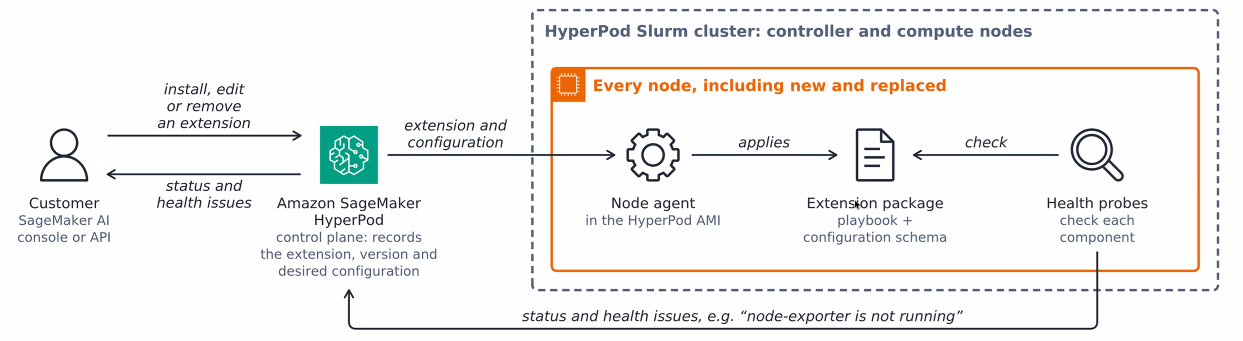
Settings are checked against a versioned schema when submitted. A node agent then applies the desired state, including on new and replacement nodes, with status and per-node health reported back. A successful configuration request therefore needs to be distinguished from a fleet that has finished applying it.
Our analysis: consistent administration is valuable, but intent still matters
Repeated setup scripts create an awkward question: does the file describe what the cluster should be, or what every machine actually became? Declared state and visible application status make that question easier to answer. They can also make changes easier to review before a busy training period.
Validation has a narrower job than deciding whether a policy is sensible. A syntactically valid group rule can still give more access than an organization intended. Teams will still need identity review, appropriate service permissions and a clear account of who can change an extension.
Version changes and costs remain operational decisions
AWS says extension upgrades move forward, making maintenance planning important. The service retains direct node access and support for custom AMIs and lifecycle scripts where managed capabilities do not cover an organization's needs. This is not a promise that every existing customization migrates automatically.
There is no additional extension charge in the announcement, but CloudWatch, Prometheus, Secrets Manager and other underlying resources remain billable. An easier control plane does not make the cluster free to operate.
We reviewed the publisher's configuration, lifecycle, access-control and pricing explanation. We did not create a cluster, validate a directory integration or measure how quickly settings converge. The linked announcement contains the console walkthrough and official documentation links; its architecture image is publisher material, not our test environment.
Original primary-source reporting and editorial analysis. No deployment, model download, inference, paid service call or independent performance test performed.