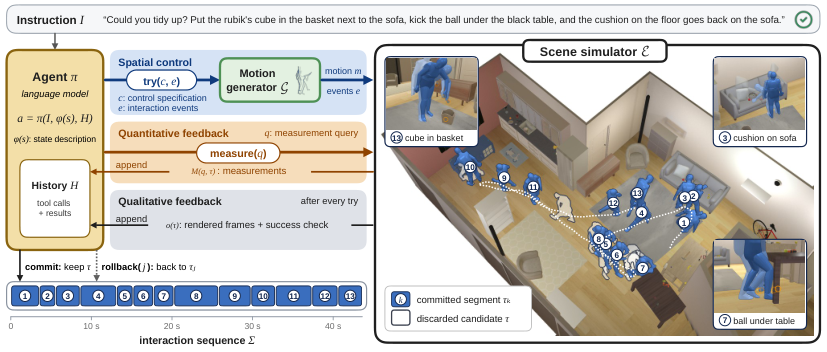
Inhabitant is a training-free framework that lets a language-model agent plan simulated whole-body interactions, measure how an attempt differs from its intended motion and revise the next attempt. The November 18 preprint reports completion of 74 out of 75 household benchmark tasks with Claude Opus 5.5. That is an animation and simulation result, not evidence of a robot performing the same chores.
Yao Zhang, Zhuchenyang Liu and Yu Xiao describe the method in their paper and official project page. The agent receives spatial controls and quantitative feedback, rather than relying only on a textual motion description or judging a rendered clip by appearance.
Try, measure and revise
The system specifies positions, paths and poses, evaluates an interaction in a scene simulator and can revise or roll back segments. Its Inhabit benchmark contains 75 tasks across 31 furniture layouts. Individual instructions combine up to three goals involving movable objects, performed by a whole body excluding fingers.
The reported high completion rate comes from that particular setup and model. The paper's ablations indicate that spatial control and numerical feedback both matter. This does not establish that changing the language model alone would deliver the same result in another animation pipeline.
The authors’ limitations change the interpretation
Repeated simulator attempts are central to the approach. The authors describe offline animation and data generation as suitable uses, while noting that irreversible online actions are a different setting. They also state that the body is driven kinematically, without full balance or torque constraints, and uses rule-based grasping.
The agent receives a scene-state description and a success check after attempts. Replacing that supplied state with perception is future work. Because of budget constraints, each task is run once, and ablations use a smaller subset; the comparison systems are the authors' adaptations. Those facts limit how broadly the aggregate success number should be generalized.
Our analysis: a useful animation agent needs more than fluent instructions. It needs a way to express what should move, detect a miss and preserve the parts that already work. Inhabitant makes those interfaces explicit, which is a more actionable contribution than treating the final success percentage as a universal capability score.
The same distinction helps readers evaluating demonstrations: a character clip may be valuable for content production even when its motion would not be physically executable by a robot. Those are different quality criteria.
The project page includes an official film. Its GitHub and dataset links were placeholders when checked, despite the paper's code-availability statement. We therefore do not present this as a verified public code release. No local animation generation or independent benchmark was performed.
Original primary-source review and clearly labeled editorial analysis. No local model evaluation, Mac automation, cloud training, software installation or independent benchmark was performed.