
Paris-based research lab Kyutai has released AURA checkpoints for turning a reference portrait and incoming speech into talking-head video. The November 20 release includes 1.3B and 5B variants, merged checkpoints and research-stage adapters. Their availability is verifiable, but two important qualifications belong beside the announcement: speed depends on the variant and pipeline, and the licenses restrict commercial use.
The 1.3B repository history records the checkpoint upload on November 20, although the repository was created two days earlier. Kyutai's official site also lists AURA as a November 20 announcement. We reviewed cards, file listings, history and code terms without downloading weights.
Streaming is not one speed claim
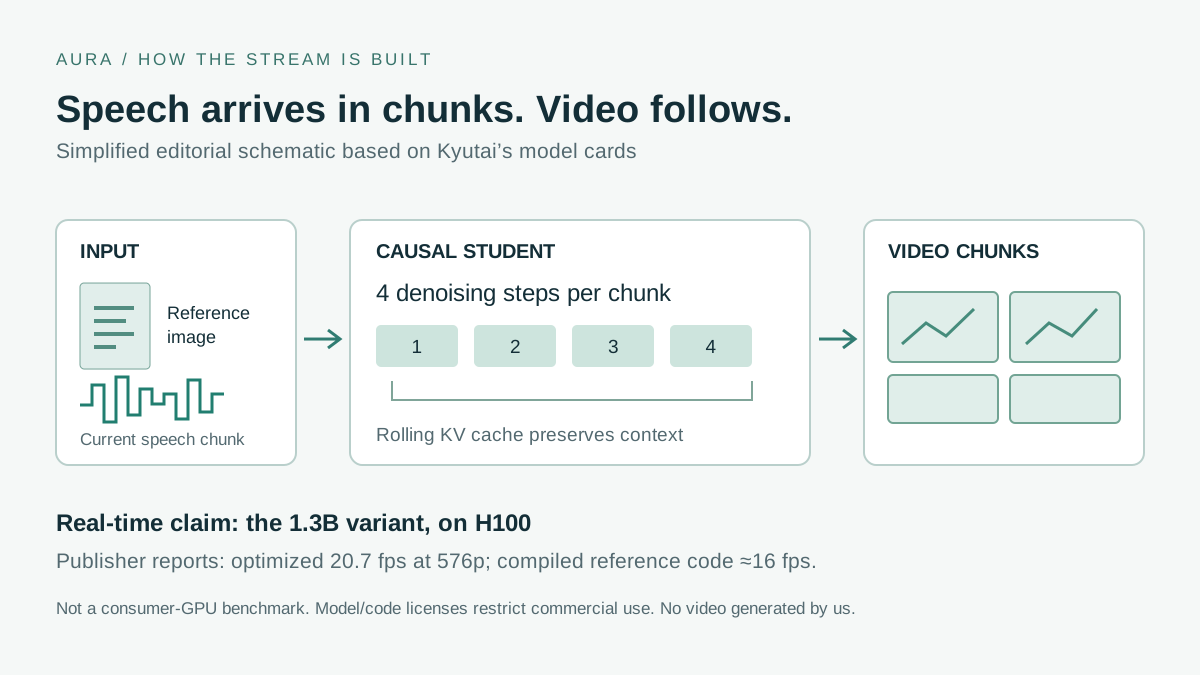
The 1.3B card describes four denoising steps per chunk and a rolling attention cache. It reports 20.7 end-to-end frames per second at 576p on one H100 in the optimized paper pipeline. The reference code's compiled path is described as roughly 16 fps on that GPU, matching its 16 fps playback setting.
The 5B card reports 9.7 end-to-end fps at 720p in its optimized H100 pipeline. That is a different operating point. It should not inherit the smaller variant's real-time label without qualification, especially where output is configured for 25 fps playback.
Neither result establishes performance on a consumer card. Model size, a file's download size and total working memory are different quantities; separate text, audio and video components also matter.
Available weights do not mean unrestricted business use
Kyutai declares the 1.3B weights CC BY-NC 4.0. The 5B weights use the Snap Inc. Non-Commercial License, limited to non-commercial research purposes. The code license also carries Snap's non-commercial research terms, while identified third-party components keep their own licenses. These are not interchangeable with a permissive open-source grant.
Our exact 1.3B profile, 5B profile and code profile preserve those distinctions. A research release can be useful without being cleared for a commercial character-production workflow.
Our analysis: watch the latency budget and the rights
A chunked pipeline is an interesting route toward responsive avatars because it need not wait for a complete speech recording before producing video. But an interactive experience depends on the complete chain, including incoming audio, chunk scheduling and display. Transformer-only throughput cannot stand in for that end-to-end result.
Releasing multiple training stages also makes the work more inspectable. For a prospective user, the practical starting point is still the specific final checkpoint and its documented dependencies, not an assumption that every released file is an independent ready-to-run model.
The publisher asks users to obtain subjects' consent and disclose generated videos. We have not evaluated identity preservation, synchronization, robustness or misuse resistance; demonstrations remain publisher evidence rather than our independent tests.
EXPLORE THE SOURCE
Projects in this story
GitHub repositories
- kyutai-labs/aura ↗View project details
Original primary-source reporting and labeled analysis. No model inference, installation, API submission, hardware test or independent benchmark performed.