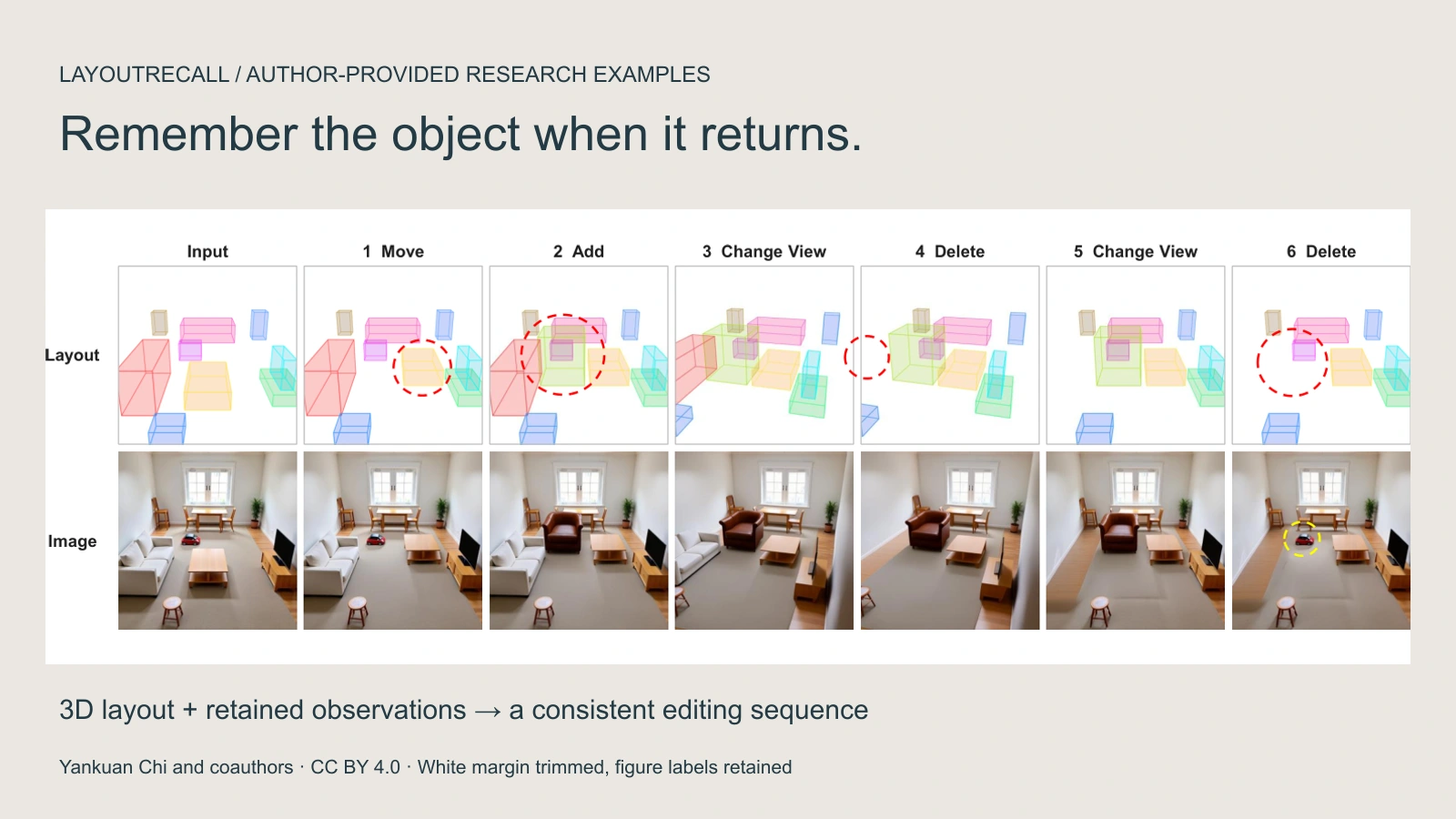
LayoutRecall addresses a familiar weakness in iterative image editing: move an object out of sight, bring it back, and the editor may invent a different-looking instance. The research system retains earlier appearance information in a memory tied to each object's 3D box.
The preprint's submission was November 25 at 07:00 UTC, which was November 24 in Los Angeles. Its appearance in a later discovery feed is not a second release. The work comes from an academic team including researchers affiliated with UC San Diego, UC Irvine and Nanyang Technological University.
Remembering appearance where the object moves
In the proposed method, Box-Surface Latent Memory places previously observed image latents on faces of a box in the object's own coordinates. When a requested camera or object position changes, rays into the target view retrieve the relevant observations.
A second component aligns those retrieved tokens with the target image and constrains attention around the appropriate object. A correspondence loss encourages the editor to use matching evidence rather than simply generate a plausible replacement. The box therefore provides more than placement: it supplies a coordinate system that follows the object.
This is still image editing with spatial controls. It does not establish a complete, physically accurate 3D reconstruction or guarantee that an unseen surface has been recovered from evidence. When the system has never observed the needed appearance, a memory cannot supply it.
A benchmark that deliberately comes back
The authors introduce LayoutLoop with calibrated multiview scenes and object revisits. Their synthetic evaluation includes 400 single-round edits and 50 ten-round sequences; the real-scene evaluation includes 80 single-round edits and 10 ten-round sequences. Each method recursively uses its own prior output in the multi-round comparisons.
That design makes returning objects more meaningful than a collection of unrelated before-and-after examples. It also leaves important qualifications. Some compared methods receive different kinds of conditioning, and a system that follows spatial instructions poorly may distort preservation metrics. The paper itself notes cases where replacing a scene with an empty background inflates particular scores.
Useful memory, approximate geometry
The implementation builds on FLUX.2-klein-9B-base with operation-specific adapters. The authors report better appearance consistency in their evaluated sequences, but a loose box remains an approximation: neighboring memory cells can put appearance into empty space, and background recovery depends on camera views observed earlier.
Our analysis: the promising idea is treating an edit session as a sequence with persistent evidence. For product imagery or scene planning, recovering the same object's details can matter more than producing another attractive image. The next practical questions are how much manual spatial setup is required, how errors accumulate and what happens outside the evaluated scene types.
The official project page links the paper. We did not establish released inference code, downloadable adapters or a model license from that page, so this is not presented as an installable open-model launch. The paper and credited figure are CC BY 4.0; that does not automatically license the backbone, scene assets or future weights. No editor, model or dataset was downloaded or tested for this article.
Original source review; no upstream tests, inference, training, benchmarks, installs, model weights or datasets downloaded. Research methods are not asserted to be newly available checkpoints.