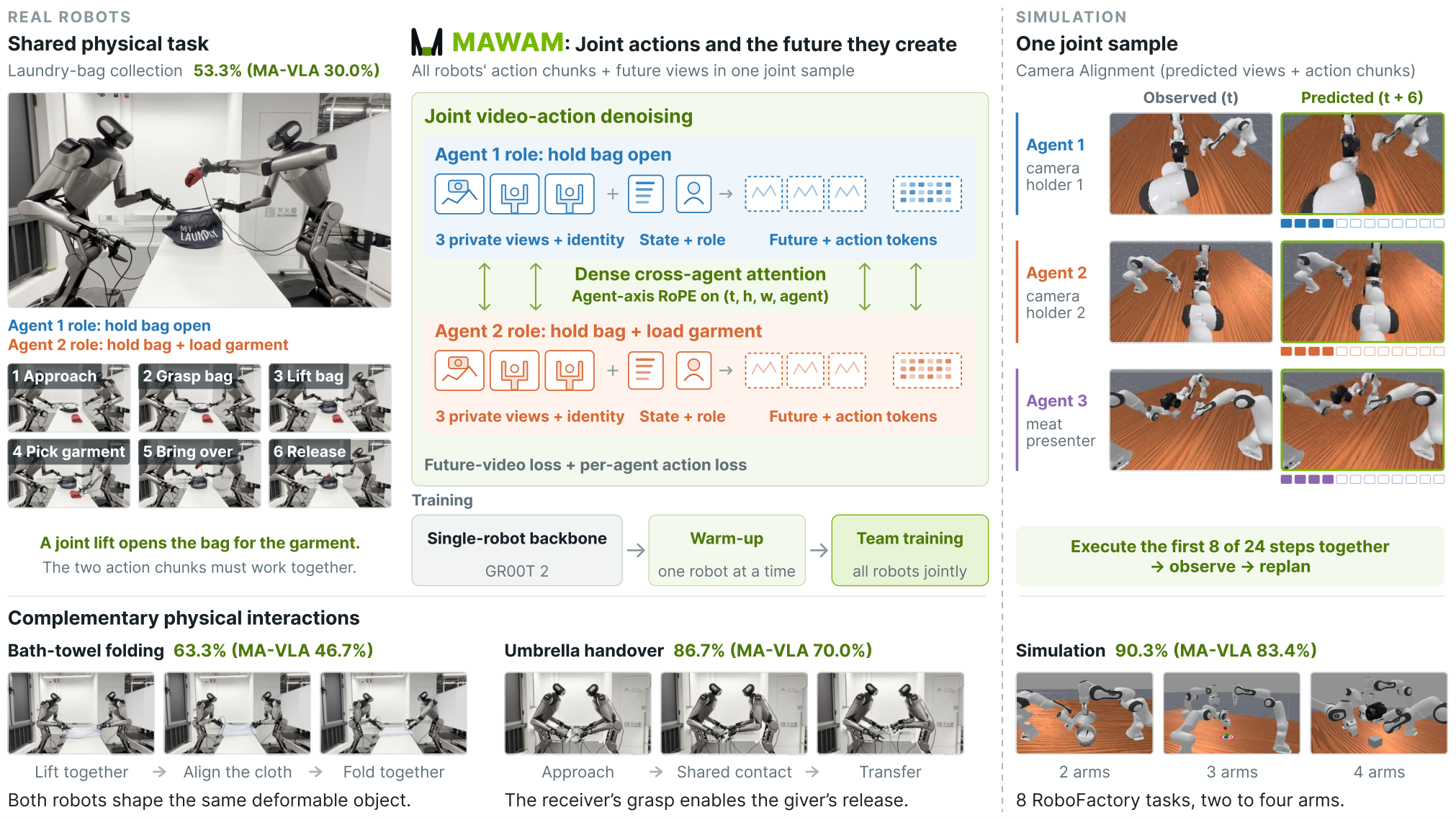
MAWAM, a new multi-agent world-action model from a research team affiliated with NVIDIA, the University of Hong Kong and MIT, tackles a basic coordination problem: one robot’s movement changes what its teammate can do next. The system jointly generates the robots’ action chunks and predicted future camera views, rather than treating each arm as an isolated planner.
The first preprint version was submitted on November 18 UTC. Its experiments cover three real-robot tasks and eight simulation tasks. The results are research measurements reported by the authors, not evidence that a general-purpose robot team is ready for unsupervised deployment.
Predicting the team rather than one arm
The technical paper builds on a pretrained single-robot backbone. Cross-agent attention links the robots’ future-view and action tokens, while separate output interfaces keep each action attached to the correct robot.
The tasks make the motivation concrete. Holding a laundry bag open while another arm loads it, folding a bath towel and handing over an umbrella all involve complementary movements. A locally sensible action can still fail if the other robot releases too early or moves to the wrong place. The authors use shared prediction to train this dependence directly.
What the reported improvement covers
The paper reports 67.8 percent mean success across the three physical tasks, 18.9 percentage points above its MA-VLA comparison trained with the same demonstrations and cameras. It separately reports 90.3 percent mean success across the simulation tasks, with teams of up to four arms. Physical and simulated results should stay separate; one is not a substitute for the other.
The team’s ablations examine the contribution of cross-agent attention and future-video supervision. Such comparisons help explain why a method improves within the study. They do not establish that the same advantage will hold across different hardware, tasks, camera layouts or data collection procedures.
A useful direction, with a clear deployment gap
Our analysis: the interesting question is whether a shared prediction gives a team a better representation of dependency: which robot must wait, which must hold an object steady and which can safely proceed. That is more specific than adding another robot to a scene or sending identical instructions to multiple independent agents.
The limitations section explicitly bounds the experiments to fixed teams of up to four agents. Larger teams, changes in membership and robots with different embodiments or sensors are future work. A successful controlled manipulation trial also does not by itself establish collision safety, recovery from an unfamiliar failure or suitability around people.
We have not run MAWAM, reproduced its benchmarks or verified a downloadable weight package. Readers should use the paper’s detailed experiment and limitation sections as the current evidence, and treat any future code or model release as a separate event with its own licensing and reproducibility checks.
Original reporting based on primary source review. Publisher results are attributed; no local installation, inference or independent benchmark was performed.