
Microsoft has published Aion-1.0-Instruct-2.3B, an instruction-tuned small language model aimed at on-device text tasks. Its model card describes summarization, rewriting, chat and document-oriented work across eight languages. The public checkpoint should be distinguished from a further optimized Windows OS model that Microsoft says is planned for the end of January 2027.
The original Hugging Face repository was created on November 18 UTC. Its history records the model import that day and subsequent documentation and image changes. We are reporting that downloadable preview, not announcing that every Windows PC has already received an integrated Aion feature.
The small-model tradeoff is unusually explicit
The card specifies approximately 2.29 billion parameters, a 32,768-token context and a mixture of sliding-window and full-attention layers. It also warns that a small model can miss details, make incorrect statements and struggle with complex reasoning. Those limits are relevant to exactly the document and operating-system tasks the model is meant to support.
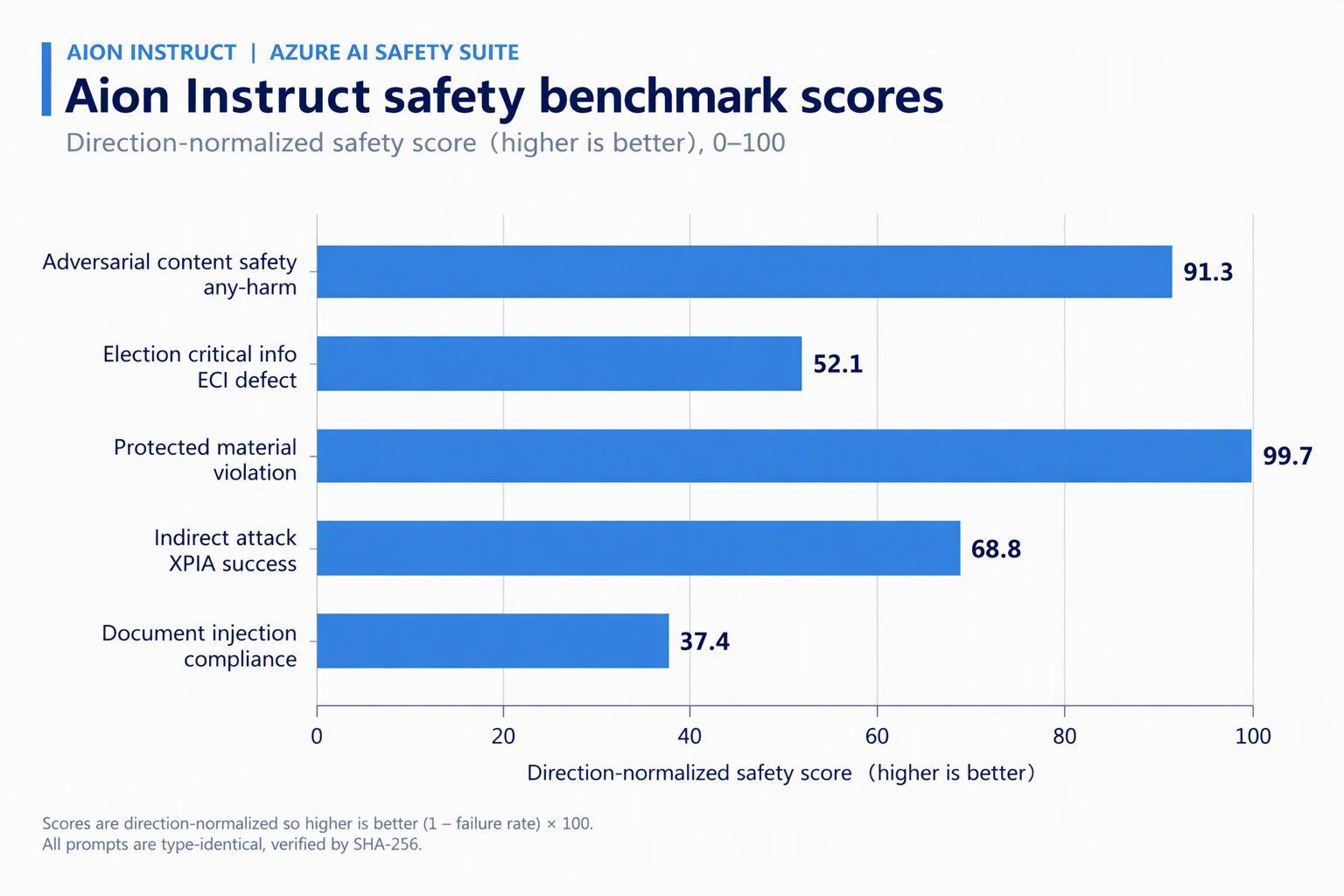
Microsoft publishes benchmark and safety results, including areas it says need improvement. The accompanying chart uses direction-normalized scores; it should not be read as a guarantee that the model safely handles that percentage of every possible real-world request. We have not repeated the evaluations or compared Aion on a local PC.
Three different licensing and delivery questions
The checkpoint’s included MIT license is one part of the release. The card’s planned Windows deployment also describes an additional moderation model and optimization work. Separately, the developer validation sample’s license notice points to limited-use, pre-release Microsoft Software License Terms. The sample package should not be described as MIT merely because the downloadable model is MIT.
The model quickstart uses custom Transformers code and enables remote-code loading. Developers should review the exact implementation and revision they intend to execute. Library names or autogenerated platform suggestions are not independent confirmation that a particular quantization or backend already works with the custom architecture.
What this could mean for ordinary applications
Our analysis: a compact model can be useful when the task is bounded and the application can check its result. Rewriting a selected paragraph or extracting a few fields is different from letting a model make an irreversible operating-system change. The surrounding permissions, validation and recovery path matter at least as much as model size.
Local execution can reduce the need to send text to a remote inference provider, but it does not establish an application’s complete privacy behavior. Logging, telemetry, updates and external tools remain separate questions. Aion’s preview gives developers something concrete to inspect while leaving the Windows rollout and device-specific performance to be verified when those pieces arrive.
See our exact model profile and the separately licensed sample profile.
EXPLORE THE SOURCE
Projects in this story
GitHub repositories
- microsoft/Aion-Instruct-Preview-Sample ↗View project details
Original reporting from primary source review. Publisher evaluations are attributed; no installation, local inference, device test or independent benchmark was performed.