A November 23 preprint by Andrew Perminov presents 62,029 schemes for multiplying two 3-by-3 matrices with 23 multiplications. The contribution is the diversity of those schemes: each has a different rank pattern, giving researchers a larger pool of structurally distinct candidates to investigate.
This is algorithm-search research relevant to the mathematical operations beneath scientific computing and AI. It does not announce a new language model, a faster GPU kernel or an end-to-end reduction in the cost of training a neural network.
The same multiplication count leaves many choices
A scheme combines entries of the input matrices into linear forms, multiplies selected pairs and recombines the results into the output. Two schemes with the same multiplication count can require different additions, coefficients and intermediate values.
The paper uses a rank pattern formed from the ranks of the factor matrices in each term. Different patterns establish inequivalence under the considered symmetries. Matching patterns do not by themselves prove that two schemes are equivalent, so the catalogue is a lower bound on diversity, not a complete classification.
The reported search combines gradient descent with alternating least squares and flip-graph methods. Some searches take place over small finite fields before lifting coefficients. The output includes ternary, integer and rational schemes; it should not be described as a collection discovered solely by a generative AI agent.
A larger catalogue does not imply a faster implementation
The paper explicitly cautions that recursively applying a rank-23 scheme gives an exponent of approximately 2.854, compared with approximately 2.807 for Strassen's 2-by-2 construction. This collection therefore does not beat Strassen's asymptotic exponent.
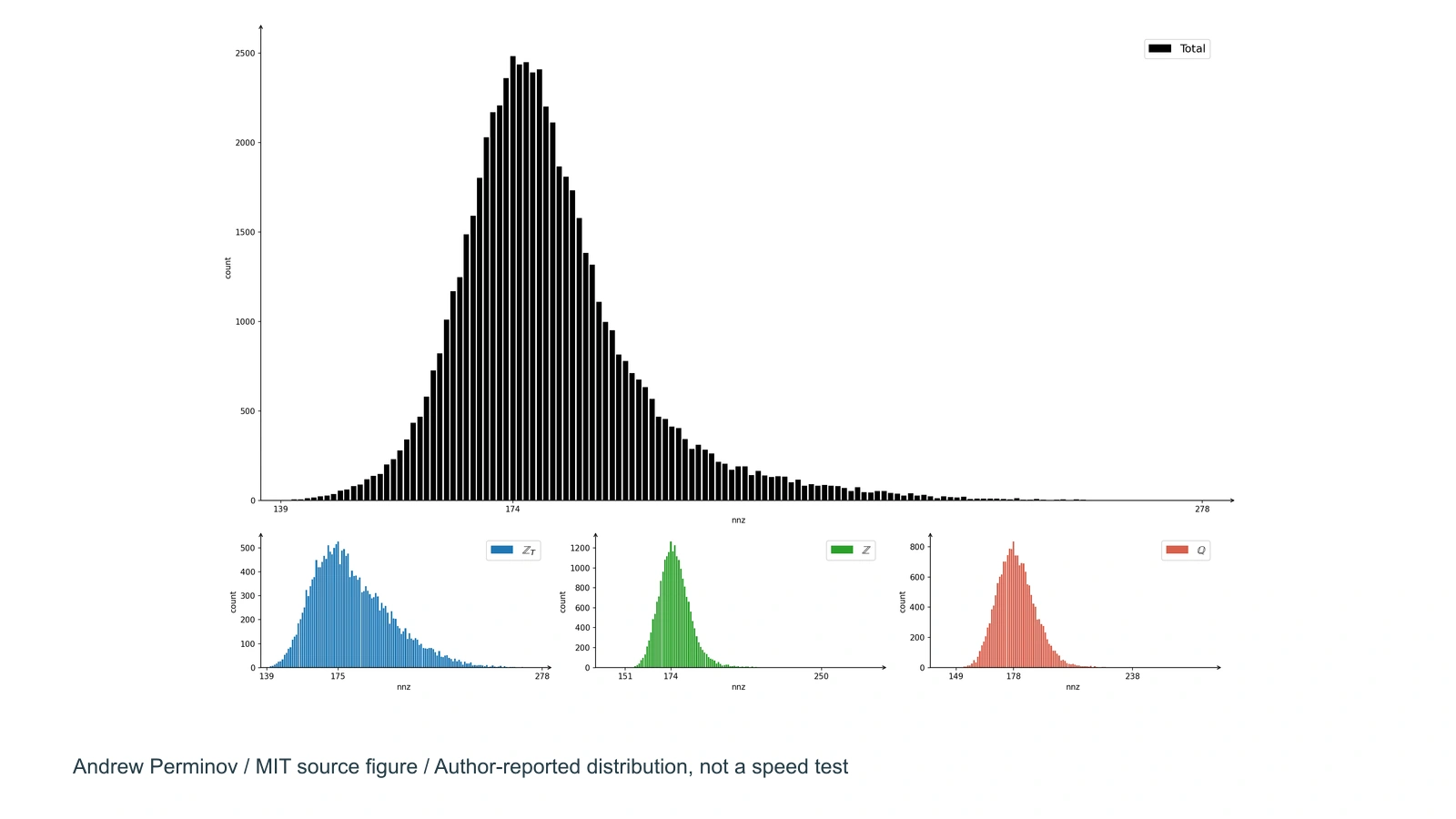
Its more useful role is supplying starting points for other searches. Researchers can investigate additions, sparsity, coefficient structure and numerical stability across a broader set of candidates. Nonzero coefficient counts are a convenient first filter, but they do not count reuse of intermediate sums and are not execution-time measurements.
The author also distinguishes coefficient domains when discussing optimality. The paper cites rank 23 as optimal over the two-element field and for integer-coefficient schemes, while leaving the characteristic-zero rank between 21 and 23. Rational coefficients with even denominators cannot simply inherit the reduction-modulo-two argument.
What readers can inspect
The accompanying repository profile links the MIT-licensed dataset and its verification script. Schemes are supplied in JSON, plain text and Maple formats. The verifier checks the algebraic identities in exact arithmetic; we reviewed its source without downloading the scheme collection or running the verifier.
The public repository predates the paper, and later repository edits are distinct from its November 23 submission. The count in this article is the paper's reported collection, not a claim that we exhaustively enumerated all possible schemes.
The reproduced figure is credited to Andrew Perminov; its MIT copyright and permission notice accompanies this article.
Our analysis
The strongest result is a more diverse, inspectable search space. Algorithm discovery needs candidates whose properties can be compared and independently checked. That is a meaningful contribution even when it does not immediately replace a production numerical library.
For AI coverage, the distinction matters: a mathematical search resource, a proven arithmetic identity, an optimized kernel and a faster application are different achievements. This work expands the first and supplies machinery to check the second. The latter two still need their own evidence.
Original primary-source reporting. No upstream software installed, tests executed, datasets or weights downloaded, server settings changed, or performance independently measured.