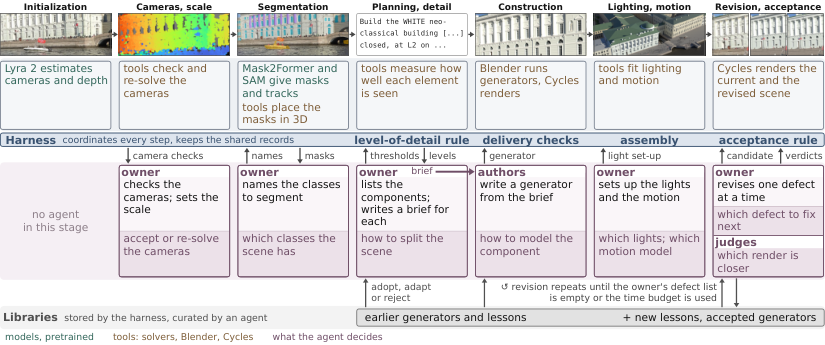

SceneAnything, a research preprint from researchers affiliated with NVIDIA, the University of Manchester and UC San Diego, describes a system that reconstructs editable mesh scenes from a single continuous video shot. Instead of delivering only a rendered view, its agents write parameterized Blender programs that construct scene components.
The paper’s first arXiv version was submitted on November 19 UTC. Its release statement says the authors will publish the harness, instructions, reusable libraries and scenes. We are covering a research result and planned release, not claiming that a complete public installation package is already available.
What the agents actually do
The method description combines camera, depth and segmentation estimates with a scene-owner agent. That agent organizes the environment and briefs component authors. The resulting Blender construction programs are assembled, lit and revised through a protocol that checks the result and compares renders against the input.
The design also uses a visibility-based level of detail. Geometry that the camera clearly observes can receive different treatment from regions that are barely seen. Surfaces outside the footage are completed as inferred content. Those labels are important: a plausible back wall is not a measurement of the real wall behind the camera.
The interesting output is something you can edit
Our analysis: explicit meshes, lights and construction programs address a practical problem for creative work. A convincing novel view is useful, but a production team may also need to move an object, change the lighting or revise a dimension. A reconstruction that exposes these components offers a different kind of control from a system that primarily reproduces pixels.
That does not make inferred geometry accurate enough for surveying, engineering or collision design. Anyone considering the approach for a game environment would still need to inspect topology, scale, material assignments and the unseen surfaces. The paper does not remove that verification work.
Read the limits beside the demonstration
The authors evaluate 100 scenes and report advantages in selected comparisons of view fidelity and content similarity. These are their experiments, not independent AiBrainWorX results. The limitations section says the best scenes require commercial models, while the tested open-weight author agents produce lower-quality reconstructions.
The system also inherits errors from camera, depth, segmentation and material estimates. It operates on a continuous shot, with cross-cut reconstruction left for future work. Human reconstruction is excluded, and most non-rigid motion is outside its scope. These boundaries make it easier to understand what the demonstration does—and what a future downloadable release would still have to prove.
For now, SceneAnything is a useful sign of where agent-assisted graphics is heading: toward construction processes that can be inspected and revised. The next milestone is a public release whose dependencies, license, examples and reproducibility can be checked against the paper.
Original reporting based on primary source review. Publisher results are attributed; no local installation, inference or independent benchmark was performed.