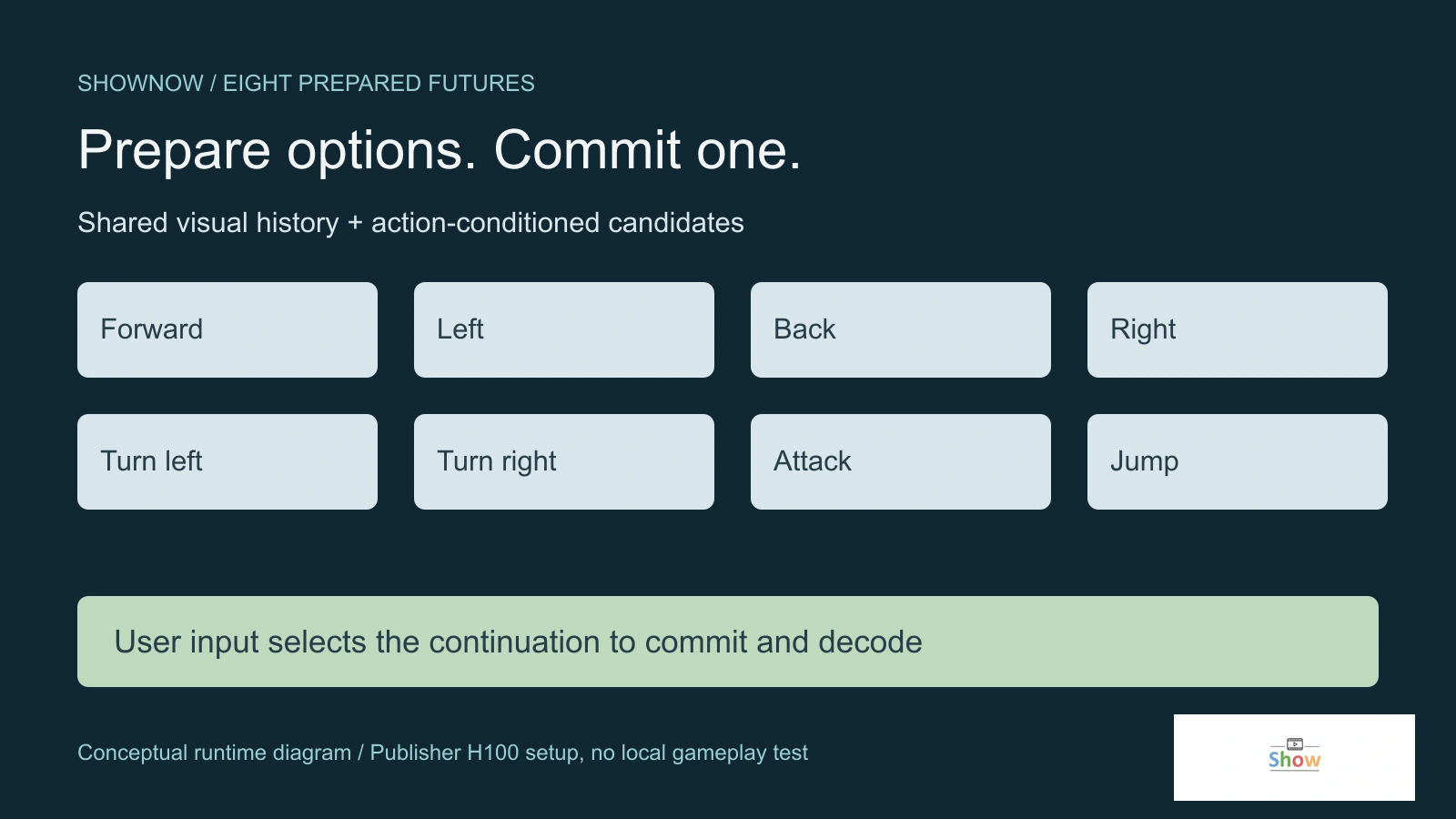

ShowNow, from Show Lab at the National University of Singapore, tackles a problem that frame-rate headlines can hide: a generated world may keep playing smoothly while taking too long to respond to a new command. Its solution is to prepare several action-conditioned futures while the current frames are playing.
The paper was submitted November 25. The public eight-future checkpoint upload followed at 06:37 UTC on November 26, still November 25 in Los Angeles. This is a specific 5B inference release, rather than a claim that every variant discussed in the paper is downloadable.
Generate possibilities, commit one
The model shares visual history across candidate branches, prepares supported actions together and commits only the selected continuation. A generation update covers one latent, corresponding to four frames. At the documented 16 fps playback rate, that creates a 250-millisecond decision interval.
The authors report 480p generation on one H100 with eight prepared futures. Their complete ViZDoom deployment reduces median input-to-display latency from 620 to 208 milliseconds against the native-block SolarWM-FT deployment. That comparison includes trained deployment, block-size and runtime differences; it is not a clean measurement of speculative preparation alone.
Matched-policy experiments separate that question. Eight-future preparation reduces restart empty ticks from 1.56% to 0.09% under the reported scheduling setup, while using substantially more playback-time GPU capacity. Preparing more options trades compute for readiness; it does not make their cost disappear.
Response time is not the same as visible action
The paper distinguishes commitment, presentation and detected action-effect latency. Decoding and software queues add delay, and a displayed command-conditioned frame does not necessarily show the action clearly yet. Rapidly superseded inputs can wait or be omitted from the committed stream.
The evaluated eight-action setting uses mutually exclusive ViZDoom controls. Simultaneous actions, unfamiliar scenes, repeated revisits and longer rollouts remain harder. The authors report visual-fidelity and long-horizon tradeoffs, and the system has bounded visual history rather than an explicit persistent scene-memory objective.
What readers can actually inspect
Our model profile links the exact checkpoint, and our repository profile links the custom training, inference and evaluation code. The card describes BF16 weights of roughly 10 GB, a 15-latent history and a tested H100 80 GB deployment. File size is not total runtime memory or evidence that a 12 GB consumer card fits.
Code and model weights use Apache 2.0; the bundled demo inputs retain separate BSD-3-Clause terms, and external runtime components retain their own licenses. This is not a drop-in Diffusers checkpoint. The paper's 33B extension is not included in this model package.
Our analysis: this is a useful shift from asking only how fast a world model generates to asking when a user's decision becomes visible. Whether the additional speculative compute is worthwhile depends on the interaction budget and tolerated visual drift. We reviewed the paper, source, license, model card, upload history and release manifest without downloading weights or running the demo.
EXPLORE THE SOURCE
Projects in this story
Model repositories
These are the exact public repositories referenced in the coverage. Public weights may have restrictions: check each publisher’s terms.
- songyiren/ShowNow-5B-8F ↗Apache-2.0
Original independent source review; no upstream tests, training, inference, benchmarks, model weights, datasets or software installs performed. Publisher results are not our measurements.