Stable Gated DeltaNet-2, a preprint submitted November 25, investigates why an efficient recurrent attention design can become numerically unstable during long-context training. Its proposed fix changes the memory update itself rather than simply increasing a context-window setting.
Linear-attention systems summarize previous tokens in a recurrent state instead of retaining an ordinary attention cache that grows with every token. That offers an attractive computational tradeoff, but a compact state still has to preserve useful information and remain numerically well behaved as updates accumulate.
Memory can amplify even after writing stops
The authors' analysis identifies an asymmetry between the directions used to read and modify memory during erasure in Gated DeltaNet-2. Consecutive updates can amplify particular directions in the state, even when the experiment stops adding new write terms.
The distinction is subtle: an operation intended to forget information can still participate in a sequence that magnifies existing values. In one replayed failure, the paper traces nonfinite loss back to state growth and numerical overflow. This is a diagnosis within the studied architecture and training setup, not evidence that every deployed recurrent model has the same failure.
Across the reported baseline seeds and architectures, three of eight pretraining runs and four of eight post-training runs failed numerically. The five post-training stages started after successful pretraining completed. Those different regimes should not be collapsed into a single universal failure percentage.
A more constrained update
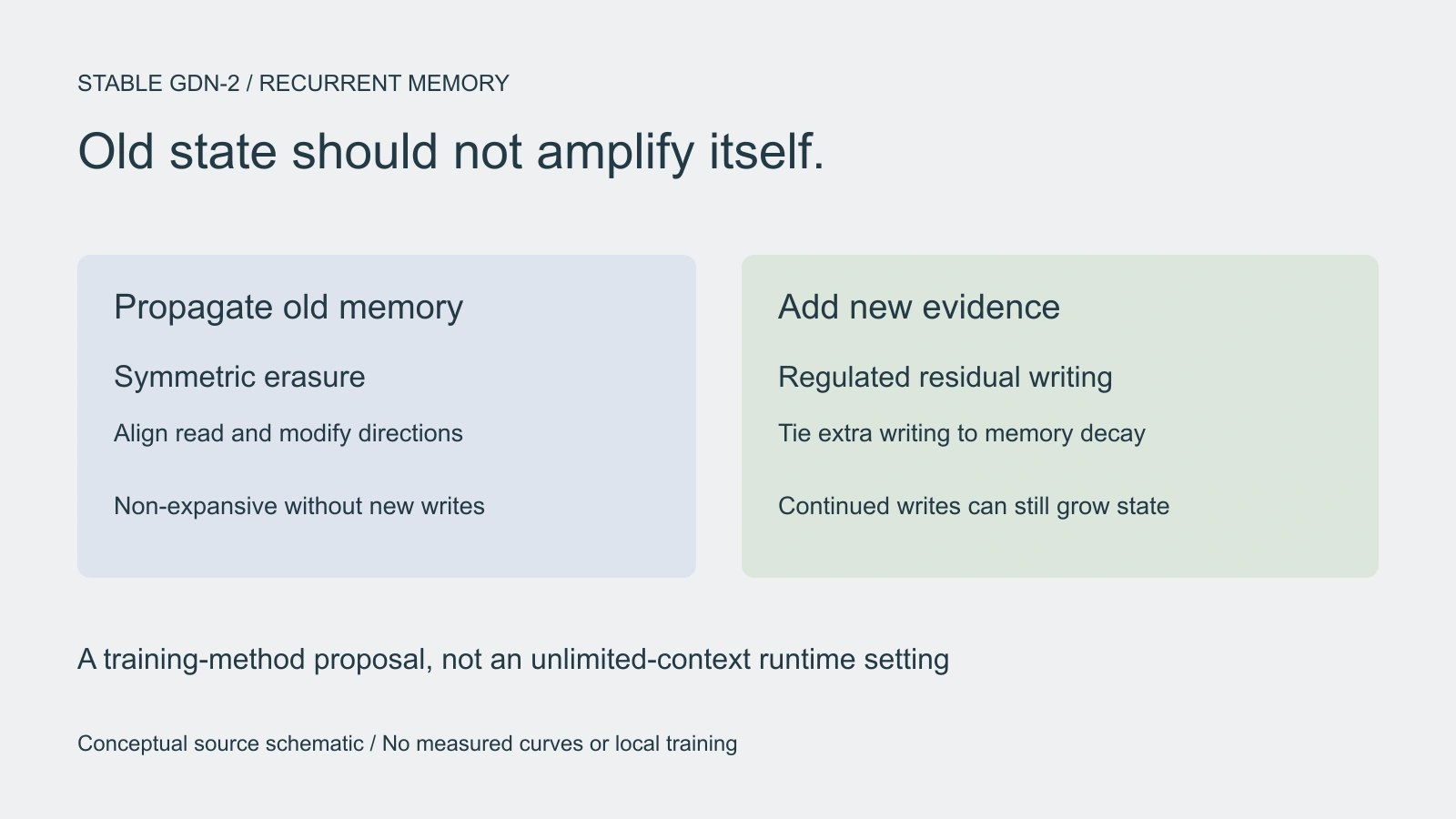
The proposed Stable GDN-2 aligns the erase directions symmetrically and supplements writing with a decay-regulated residual. In plain language, the method limits how old memory can be magnified while retaining a way to insert new information.
The paper establishes non-expansive propagation when no new writes occur, under its normalization and gate assumptions. With ongoing writes, state growth remains governed by accumulated inputs; the analysis gives additive bounds and a tighter energy-related result under additional conditions. That is not a guarantee of bounded memory values for arbitrary data or a proof that all training failures are impossible.
Training evidence, not a launcher switch
The experiments use roughly 1.6-billion-parameter models, a shared long-sequence training protocol and recurrent and hybrid variants. The reported recurrent-setting average RULER improvement at 128K is 6.80 points over GDN-2; the separate hybrid-setting average across nine downstream tasks rises 0.62 points. These are different evaluations, not interchangeable gains.
Our analysis: stability work deserves attention alongside headline context lengths. A system can accept a long sequence while its internal representation becomes less useful. However, changing a recurrent update is architectural and training work; it is not something users can safely infer has arrived in an existing model by changing a runtime flag.
The reviewed paper cites upstream baseline code, but we did not establish a separately released Stable GDN-2 implementation or downloadable checkpoint from the examined sources. Its arXiv distribution uses the perpetual non-exclusive license, which does not itself grant a software or weights license. We read the methods, failure accounting and evaluation protocol; no training, inference or benchmark was run, and no Model Watch launch is being asserted.
Original source review; no upstream tests, inference, training, benchmarks, installs, model weights or datasets downloaded. Research methods are not asserted to be newly available checkpoints.