
Standard Bank Group and AWS describe a process that collects evidence, tests generative-AI applications and uses an LLM judge. Their November 20 case study keeps human reviewers involved before approval decisions.
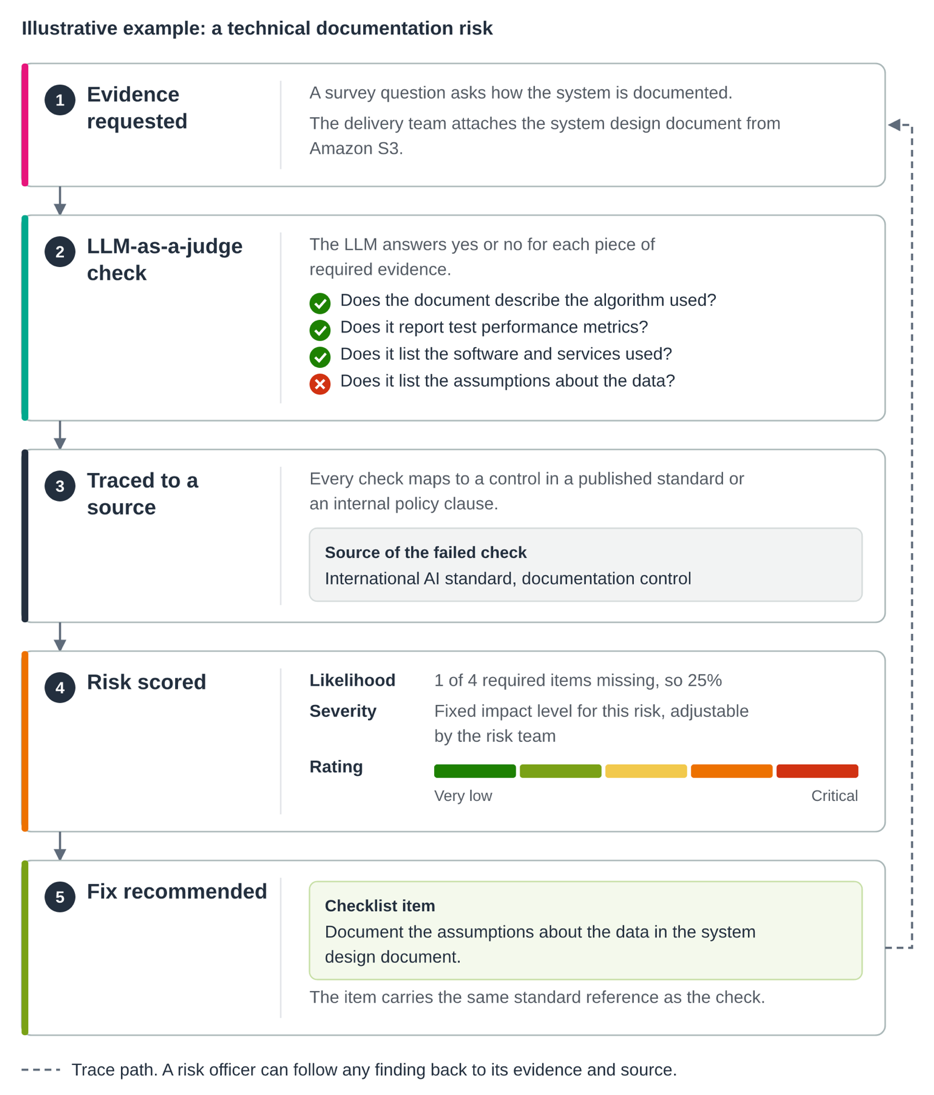
An evidence-collection agent proposes answers that delivery teams review. Subsequent stages examine documents, source code and application responses against control questions derived from standards and the bank’s policies.
Our analysis: a missing document is evidence of a gap, not a complete risk estimate
Turning a policy into a repeatable check can make an assessment easier to inspect and rerun. It can also make disagreements concrete: a reviewer can ask which evidence was supplied, which control it was supposed to support and why the system considered it insufficient.
But a documented control and an effective control are different things. A document can describe a process that is not followed. Conversely, a missing piece of documentation does not by itself measure the probability of a real-world failure. The assessment needs to preserve those distinctions rather than flatten them into one reassuring number.
The judge’s output remains reviewable
The account describes evidence-linked yes-or-no judgments, repeated checks for inconsistent findings and a fixed scoring formula. Human reviewers can amend answers with a business justification.
That is a more inspectable design than an unconstrained model opinion, but it does not make the judge infallible. The useful evaluation includes whether its findings are correct, whether its evidence actually supports them and which disagreements require a person’s judgment.
Read the timing claim at the right scope
The authors report generating a comprehensive risk report in about two hours against a traditionally manual two-week review, demonstrated across six assessments. This is a jointly authored case-study claim, not an independent study or a guarantee that the entire approval process takes two hours.
Report preparation, review and the final gate decision should remain separate milestones. Combining them would make an automation appear to remove work that may still be necessary after the report exists.
Continuous reassessment is a further step
The account says the assessment runs in the bank’s production environment before use cases go live. Scheduled or change-triggered reassessment after live workloads are connected is described as the next stage. It should not be presented as already operating continuously across every deployed application.
The authors explicitly say the assessment does not certify regulatory compliance. Our view is that its value lies in a traceable evidence process that supports decisions. We did not inspect the bank’s systems, validate its risk scores or reproduce its reported time savings.
Primary-source reporting and original editorial analysis. No installation, model inference, paid service call, security test or independent benchmark performed.