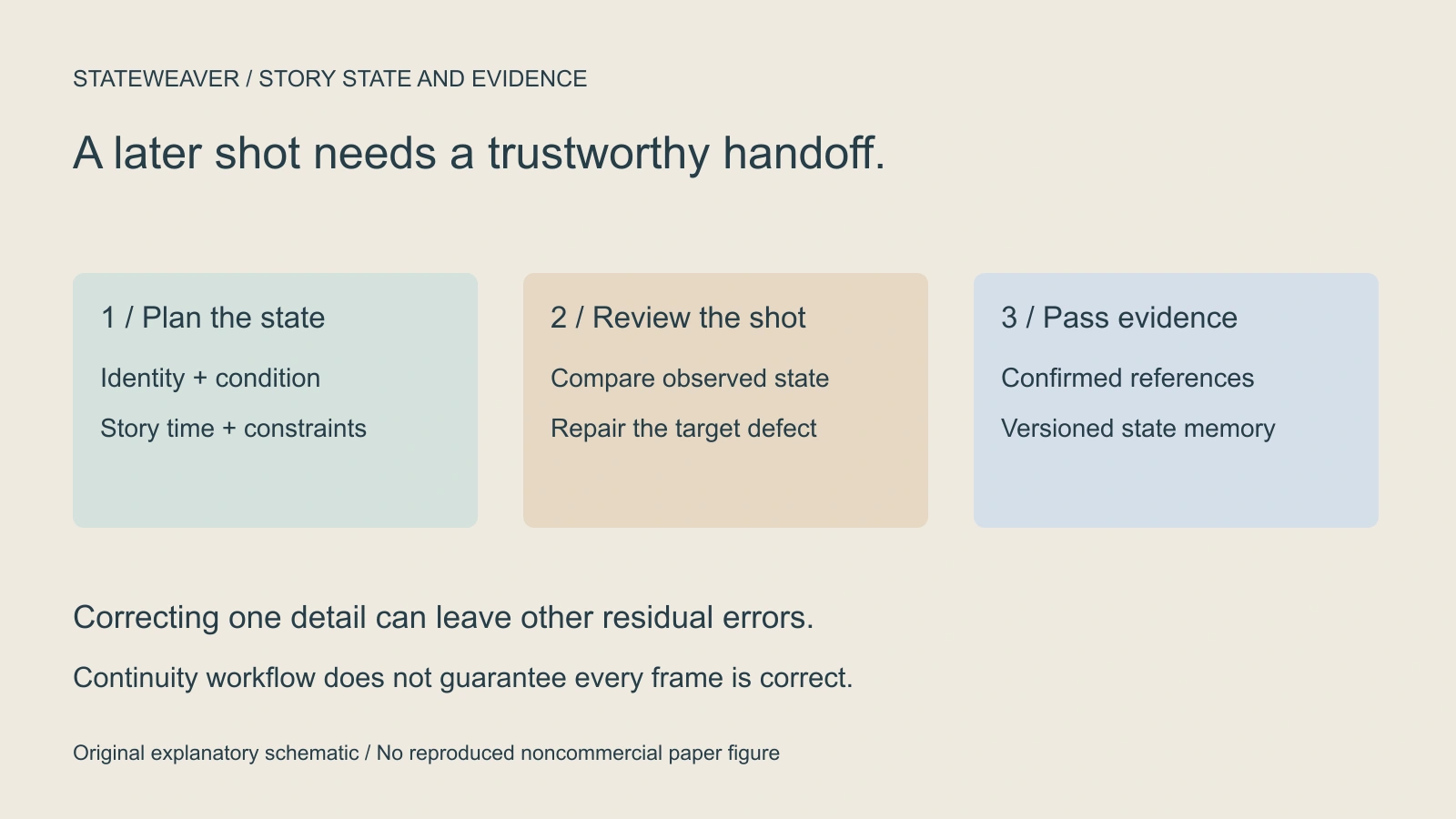
StateWeaver, a November 25 preprint from researchers affiliated with Nankai University, JD's Joy Future Academy and other institutions, treats long-video continuity as a coordination problem. Its agents must track an asset's story state, repair references when a shot contradicts that state and pass confirmed visual evidence into later shots.
The idea goes beyond keeping a character's name in a long prompt. A prop can keep the same identity while changing condition or position. A workflow must represent that change and decide which generated frame is trustworthy enough to become the next shot's reference.
A repair becomes a new reference
The paper's Active States mechanism translates reviewed state discrepancies into concrete asset requirements. Reference construction and regeneration aim to repair the target attribute while retaining identity and already-correct content.
Confirmed generation evidence is associated with the relevant asset state, story time and reference version. Hierarchical collaboration separates task, clip and repair-round contexts, while memory organizes which observations should be reused. This is a production workflow around underlying models, rather than a newly trained replacement video foundation model.
The evaluated setup uses GPT-6.1-sol for its directing agents, GPT-Image-2.5-Sunburst for references and MiniMax-H3-Sol for video generation. The paper describes local video inference on RTX PRO 6000 hardware. Those are the authors' configurations, not a setup we installed or a claim that the workflow fits a consumer card.
Continuity gains do not mean every shot improves
The evaluation uses 75 story-production tasks drawn from four benchmarks. Comparisons retain common underlying text, image and video models while changing the production workflows. Some tasks provide shot descriptions and order; others require each framework to plan its own shots. The evaluated videos exclude audio.
The authors report strong continuity and state-transition results, but their human evaluation shows a smaller visual-quality advantage against some baselines. Twenty raters provide blinded comparisons, with majority-resolved story judgments used for each dimension. Unresolved judgments are excluded under the reported protocol, which readers should consider when interpreting preference scores.
The failure appendix is particularly useful. In one example, a sequence still shows five cups where four were requested; another retains an incorrect recorder orientation. A jump's important contact moment falls outside the frame. Repairs can improve one part of a shot while the workflow selects a compromise with other known defects.
A useful architecture, not a finished editor
Our analysis: the valuable engineering principle is to make a handoff carry evidence and versioned state, rather than merely a confident instruction from another agent. That could help explain and repair continuity errors, but it cannot turn a base model's weak counting or framing into a guarantee.
The official project page presents the research. We did not establish downloadable implementation code or a separately licensed model checkpoint from the examined materials. The paper uses CC BY-NC-SA 4.0; its noncommercial terms do not authorize treating figures or future software as unrestricted business assets. We use an original explanatory diagram and make no claim to have reproduced the films or evaluated their audio.
Original independent source review; no upstream tests, training, inference, benchmarks, model weights, datasets or software installs performed. Publisher results are not our measurements.