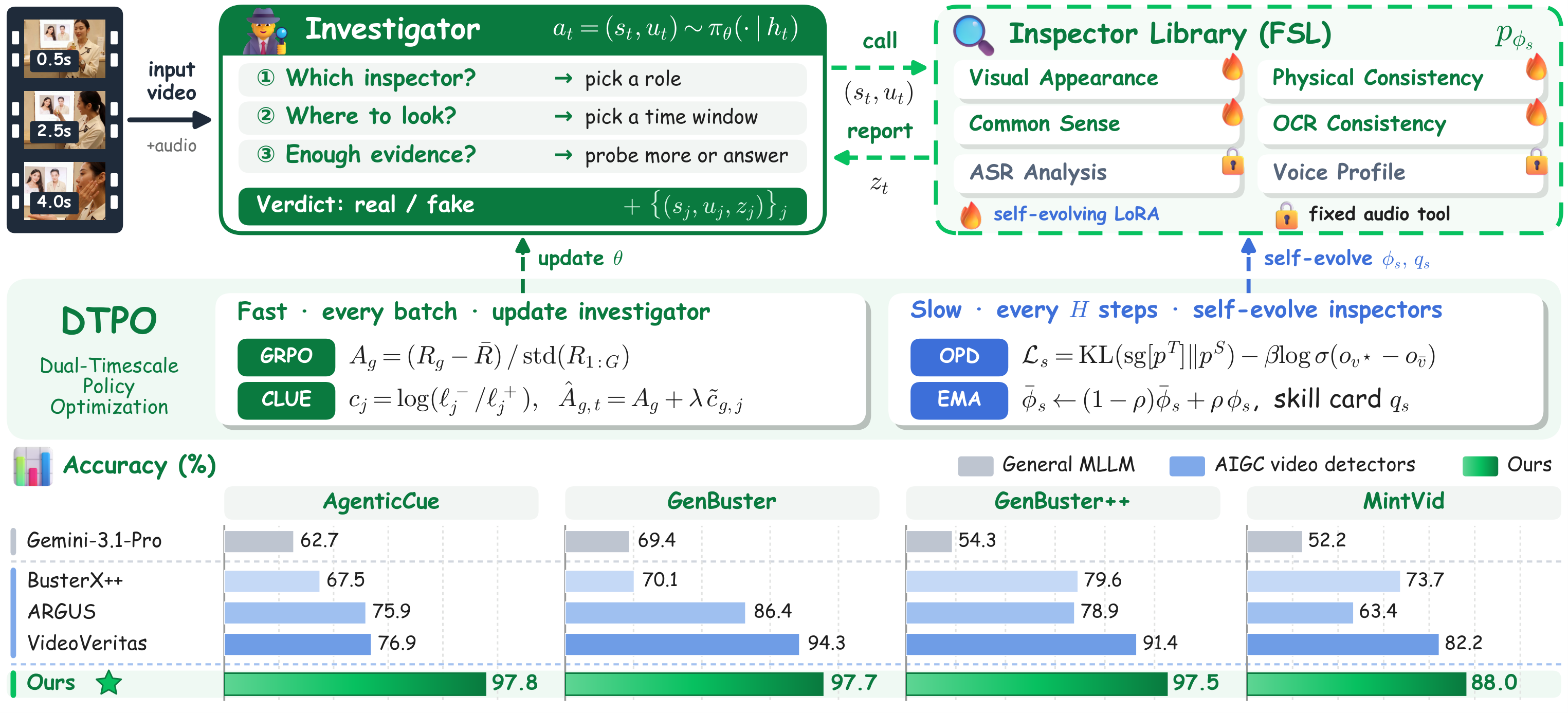

Tencent has released five LoRA adapters for WeVisForensics-4B, a system that treats AI-generated video detection as a coordinated investigation. An investigator selects a time window and inspection task, then combines information from visual inspectors and audio tools. The adapters depend on Qwen3.5-4B; they are not a standalone full model.
The original repository history records the weight-and-card release on November 19. The repository itself was created on November 14, and a November 20 change moved the main adapter to the root. Those three dates describe different events. Today's reorganization should not be counted as another model release.
Five adapters, with more than five dependencies
The model card lists the main investigator plus four visual adapters for appearance, physical consistency, common sense and on-screen text. The root adapter configuration identifies Qwen3.5-4B and specifies rank 64 with alpha 128. Speech and speaker analysis use additional tools rather than additional copies of those four visual adapters.
Tencent calls the method self-evolving because of its training procedure, which refines the investigator and inspectors on different timescales. That description is not evidence that an installed detector autonomously retrains itself on every uploaded clip.
The code repository still contains an unchecked weights checklist entry, despite the verifiable Hugging Face release. We use the actual artifact history and files to establish availability rather than treating that stale checklist as proof that weights remain unavailable.
Detection evidence needs a narrower interpretation
Tencent reports a 95.2 percent average accuracy over its selected benchmarks. We have not repeated the evaluation. The number does not establish a universal error rate across every generator, edit, language, recording process or real-world source. A detector's output should be evidence to investigate, not an autonomous accusation about a person.
Our analysis: a multi-inspector workflow is interesting because it can make the reason for an assessment more inspectable. But a plausible explanation can still be wrong. The useful test is whether the individual observations and final conclusion remain reliable on unfamiliar material, including genuinely recorded clips with unusual lighting, physics or sound.
The publisher's in-process Transformers path specifies a GPU with at least 24 GB. That is documented guidance, not a hardware-fit test by us; the small adapter files do not represent the memory requirement of the whole system.
Tencent-authored released adapters and code carry Apache-2.0 terms, while third-party components keep their own licenses. Readers can inspect our exact adapter profile, base-model profile and code profile. No weights were downloaded or local detection performed for this story.
EXPLORE THE SOURCE
Projects in this story
GitHub repositories
- Tencent/WeVisForensics ↗View project details
Original reporting from primary-source and implementation review, with clearly labeled editorial analysis. No model inference, API submission, vehicle test, software installation or independent benchmark was performed.