A new preprint by Andreas Look asks whether learned driving planners are always the strongest component inside an end-to-end driving system. It evaluates sixteen combinations of classical path and trajectory methods, including a closed-loop experiment that replaces UniAD's planner while retaining its frozen perception outputs.
The November 18 paper finds that several textbook alternatives outperform the selected learned planner in its simulation setup. The title's qualification matters: sometimes. This is neither a public-road deployment result nor evidence that all hand-written driving software is safer than all learned systems.
Hold one layer still to examine another
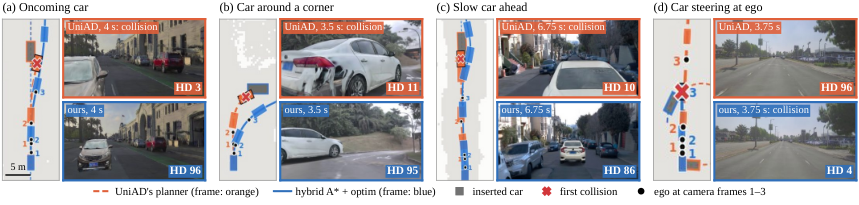
The HUGSIM comparison gives the replacement planners UniAD's predicted agents, forecasts, occupancy and drivable-area information. They do not receive the simulator's true object boxes or an additional high-definition map. Holding those inputs fixed helps isolate what a different planning rule can do with the same available perception.
The study also evaluates open-loop behavior on nuScenes and closed-loop behavior on nuPlan with ground-truth perception. Those settings answer different questions. A low trajectory error or a high score in one should not be casually converted into a claim about live autonomous driving.
The improvement has an important failure case
The best reported HUGSIM combination uses hybrid A* followed by nonlinear trajectory optimization, raising the driving score from 32.0 to 41.8. The authors report the largest gains with standing and oncoming vehicles, but no gain against vehicles steering toward the ego car. We have not reproduced the runs.
The paper's limitations are substantial. Learned-perception results use one end-to-end model, scenario variants are not independent in the way the reported standard-error calculation assumes, and the simulator inserts only cars. Its score mostly evaluates planned waypoints and does not penalize driving direction, so occupying the oncoming lane can escape that particular penalty.
A benchmark is useful when its blind spots remain visible
Our analysis: the contribution is a diagnostic comparison, not a contest that settles the architecture of autonomous driving. Replacing one layer while preserving its inputs can reveal failures that might otherwise be attributed to perception. It can also show where a planner still depends on an incorrect forecast.
The interactive failure case is particularly instructive: better optimization around a forecast does not necessarily help when the forecast itself is wrong. That distinction supports evaluating hybrid systems rather than declaring either learned or classical planning obsolete.
This is a preprint, with the author's evaluation and stated limitations. No real vehicle was tested by us, no road-safety approval is implied, and no independent public implementation was verified in this review. Readers should use the full methods and limitations alongside the headline scores.
Original reporting from primary-source and implementation review, with clearly labeled editorial analysis. No model inference, API submission, vehicle test, software installation or independent benchmark was performed.