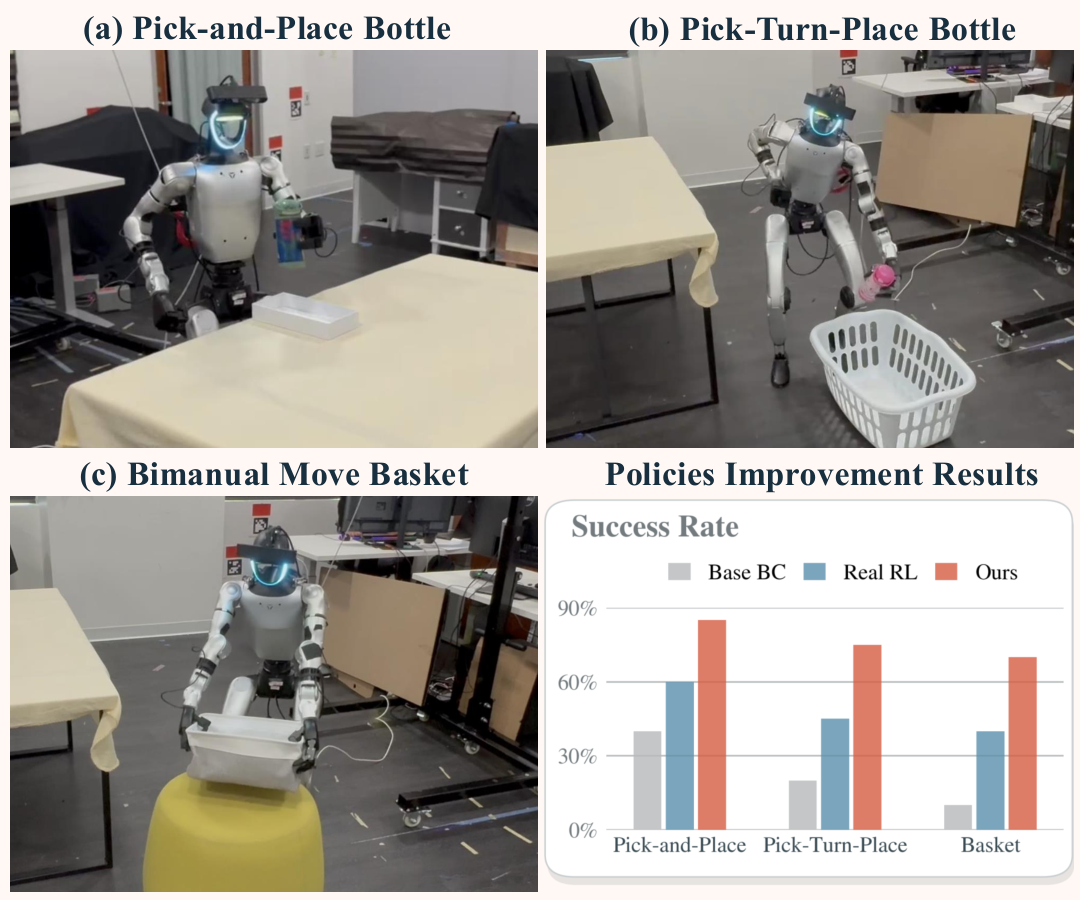
WEVO, a research preprint from a team affiliated with Amazon, Stanford University and the University of Texas at Austin, proposes improving whole-body humanoid policies inside an action-conditioned video world model. Its headline result is a reported increase in mean success from 23.3 percent to 75 percent across three physical tasks. That result comes from the authors’ experiments, not an independent AiBrainWorX test.
The first paper version was submitted on November 18 UTC. The researchers’ project page provides demonstrations and says code is coming soon. Readers should treat it as a research method with published evidence, rather than an already verified, downloadable robot-control package.
Simulation is the starting point, not the entire answer
The pipeline begins with a policy trained on synthetic demonstrations and simulated play. It then collects 20 autonomous real-robot rollouts per task to align the video world model with deployment observations. The policy, a whole-body controller and the video model form a loop in which further policy improvement can use generated observations and progress rewards.
This is what makes the paper’s “teleoperation-free” description specific. It refers to the proposed training workflow’s use of autonomous data and simulation; it does not mean the method uses no real robot experience. That distinction matters when estimating what another laboratory would need to reproduce the work.
What the physical experiments show
The project evaluates bottle placement, bottle placement after turning and moving a basket with both hands. Its results compare behavior cloning, direct simulator reinforcement learning, real-robot reinforcement learning and video-world-model training. The authors report a 48.3 percent mean for their real-robot RL comparison, below the 75 percent result for the selected world-model approach.
The result is a comparison within a particular study. It does not establish that video models replace physics simulation in general, that all humanoid tasks improve similarly or that the trained policy can be deployed safely around people. Task choice, controller behavior, reward design and the real-data alignment procedure all affect the interpretation.
The important boundary is between a plausible video and a useful environment
Our analysis: a convincing predicted frame is not automatically a good training signal. A policy can exploit a world model’s mistakes just as it can exploit a simulator’s mismatches. The valuable question is whether improvements inside the generated environment transfer to the physical robot under controlled evaluation.
WEVO is interesting because it tests that connection, while retaining real rollouts as an anchor. Independent reproduction, a released implementation and a wider set of tasks would provide stronger evidence about how much of the improvement travels beyond the reported setup. The project’s official demonstration video is useful context, but edited demonstrations do not replace the paper’s evaluation details.
Original reporting from primary source review. Publisher evaluations are attributed; no installation, local inference, device test or independent benchmark was performed.